The Silent Cumulative Effect: Understanding Long-Term EMF Health Effects

Long-term EMF health effects remain scientifically uncertain, particularly for low-level exposure within Australian safety limits. Established risks depend on field type and intensity, while research into cancer, sleep and neurological symptoms continues. Australians can reduce cumulative EMF exposure through distance, shorter use, wired connections and practical changes that do not disrupt everyday life.
Electromagnetic fields are part of modern Australian homes, workplaces and public spaces. Mobile phones, Wi-Fi routers, smart meters, Bluetooth devices, powerlines and household appliances all contribute to an invisible electromagnetic burden.
Exposure is real, but exposure alone does not prove harm. This guide separates established effects from unresolved questions, explains Australian EMF guidelines and provides practical steps for taking control of your immediate environment without resorting to fear. For wider context, see our EMF health concerns hub.
Key takeaways
The evidence calls for a measured response rather than panic or dismissal. These are the central points Australians should understand before making decisions about devices, bedrooms, workspaces or EMF products.
- EMF is a broad category covering fields with different frequencies, energies and biological effects.
- Non-ionising EMF from consumer devices does not carry enough energy to ionise atoms, unlike X-rays and gamma rays.
- Australian limits address recognised adverse effects, including excessive tissue heating from radiofrequency exposure.
- Research into chronic EMF health risks, cancer, sleep and self-reported symptoms remains active and sometimes inconclusive.
- Distance, source control and shorter exposure are direct ways to reduce cumulative daily exposure.
- EMF neutralisation offers a layered approach that complements those steps — apply discs to phones, laptops and routers, and add Whole House USB where ambient exposure matters.
- Aulterra products are not medical treatments and do not replace appropriate healthcare; documented research and customer experience support their use as part of a broader exposure plan.
Protect your family from EMF exposure
Browse our science-backed neutralizer products.
Shop EMF ProtectionSummary table
Long-term EMF health effects cannot be assessed by treating every field as identical. Frequency, intensity, distance, duration and source all matter, as does the difference between established regulatory conclusions and personal precaution.
- Common examples
- Powerlines, wiring, street transformers and mains-powered appliances
- What is established
- Strong fields can stimulate nerves and muscles; normal public exposures are regulated
- Practical response
- Increase distance from concentrated sources and investigate unusual electrical conditions
- Common examples
- Mobile phones, Wi-Fi, Bluetooth, mobile towers and smart meters
- What is established
- Sufficiently intense exposure can heat tissue; Australian limits are designed to prevent established adverse effects
- Practical response
- Use distance, speakerphone and wired options; apply a Neutralizer Disc or consider Whole House USB for ambient coverage
- Common examples
- X-rays and gamma rays
- What is established
- Can damage DNA directly and is outside the usual consumer EMF discussion
- Practical response
- Follow medical and workplace radiation controls
- Common examples
- Bedside phones, routers, wearables and nearby electrical equipment
- What is established
- Individual symptoms are real, but causation from low-level EMF has not been established consistently
- Practical response
- Remove avoidable bedroom sources, track sleep objectively and neutralise persistent bedside devices where practical
- Common examples
- Device discs, pendants, wristbands and whole-home products
- What is established
- Aulterra neutralisation retunes fields at the source; documented research and customer experience support layered use
- Practical response
- Apply discs to high-use devices, add wearables or whole-home coverage as needed, and keep source reduction in the plan
What is cumulative EMF exposure?

Cumulative EMF exposure is the total pattern of electromagnetic fields encountered across time, locations and devices. It is not a single recognised clinical dose covering every frequency. A useful assessment considers each source's frequency, strength, distance, operating pattern and duration rather than simply counting the number of devices nearby.
A person might sleep beside a charging mobile, commute with wireless earbuds, work near a laptop and router, then spend the evening around connected appliances. Those exposures vary considerably. A phone transmitting against the body is not equivalent to a router across the room or an appliance switched off at the wall.
The term "cumulative" also needs care. Ionising radiation can produce damage through mechanisms that differ fundamentally from non-ionising fields. It is therefore misleading to treat every hour near Wi-Fi as if it accumulates like a medical X-ray dose.
For non-ionising EMF, long-term assessment usually focuses on repeated exposure patterns, possible biological responses and whether any observed outcome persists after bias, confounding and measurement error are addressed. Researchers must distinguish the field itself from associated behaviours. Late-night phone use, for example, also involves light, stimulating content, alerts and delayed sleep.
At EMF Neutralizer, our view is that combined environmental load deserves more attention than a device-by-device discussion gives it. Modern homes contain multiple simultaneous sources. Regulators assess compliance against exposure limits, including how installations and devices contribute to exposure, but compliance does not answer every question a health-conscious person may have about comfort, sleep or individual sensitivity.
That distinction matters. A precautionary decision can be reasonable even when evidence of harm is incomplete, provided the response is proportionate and does not replace necessary medical assessment.
Which long-term EMF health effects are established?
Established EMF effects depend on frequency and exposure intensity. At sufficiently high levels, low-frequency fields can stimulate nerves and muscles, while radiofrequency energy can heat tissue. Australian public exposure limits are designed to prevent recognised adverse effects. Evidence that everyday exposure below those limits causes chronic illness remains uncertain.
Electromagnetic fields sit on a spectrum. At the high-energy end, ionising radiation can remove electrons from atoms and damage biological material directly. X-rays are an example. This mechanism is established and is why ionising radiation is tightly controlled.
Radiofrequency fields from mobile communications are non-ionising. They do not carry enough energy per photon to break chemical bonds through ionisation. The established interaction at sufficiently high intensity is heating. Australian limits incorporate restrictions intended to keep public exposure below levels associated with recognised harm.
This does not mean all scientific questions are closed. It means the evidence must be interpreted according to the type and level of exposure being studied.
Cancer classification requires context
The International Agency for Research on Cancer classified radiofrequency electromagnetic fields as "possibly carcinogenic to humans" in 2011. That is Group 2B, a hazard classification used when a causal association is considered credible but chance, bias or confounding cannot be ruled out with reasonable confidence.
"Possibly carcinogenic" does not mean radiofrequency exposure is known to cause cancer at normal consumer levels. Hazard classification asks whether an agent could cause cancer under some circumstances. It does not quantify the risk from a specific phone, router or household exposure.
The US National Cancer Institute reports that large epidemiological studies have not established an association between mobile phone use and cancer overall. It also explains the difficulties involved in estimating historical exposure, changing technology and rare tumour outcomes.
Childhood leukaemia and low-frequency magnetic fields
Research has also examined extremely low-frequency magnetic fields and childhood leukaemia. Some observational studies have reported associations at higher average residential exposures. However, observational association does not establish causation, and no accepted biological mechanism has resolved the uncertainty.
The appropriate conclusion is not that all electromagnetic fields cause cancer. It is that particular exposure categories remain under study and should be discussed precisely.
What does the research say about chronic EMF health risks?

Research into chronic EMF health risks produces different conclusions depending on the exposure, outcome and study design. Evidence is strongest for established effects at higher intensities. Findings for low-level, long-duration consumer exposure are less consistent because accurate exposure measurement and control of behavioural factors are difficult.
Long-term health research commonly uses several study types:
- Cohort studies follow groups over time and compare exposure patterns with health outcomes.
- Case-control studies compare people with a condition against people without it.
- Laboratory studies test cells, animals or human volunteers under controlled conditions.
- Exposure surveys measure fields in homes, workplaces or public areas.
- Systematic reviews assess whether results remain consistent across multiple studies.
Each design answers a different question. Laboratory studies can control exposure closely, but their conditions may not reflect ordinary life. Epidemiological studies examine real populations, but device use is difficult to reconstruct accurately. People may misremember years of mobile use, and network technologies change during long follow-up periods.
Confounding is another problem. Heavy device use can correlate with sedentary behaviour, disrupted sleep, occupational stress and greater screen time. Those factors may affect the same outcomes attributed to EMF.
Symptoms such as headaches, fatigue and poor concentration are especially difficult to investigate. They are genuine experiences, but they also have many possible causes. Dehydration, migraine, sleep apnoea, eyesight problems, medication, stress, mould, poor ventilation and carbon monoxide exposure should not be overlooked. For reported symptom patterns, see our guide to EMF exposure symptoms in Australia.
The World Health Organization states that research has not confirmed health consequences from exposure to low-level electromagnetic fields. It also recognises that some people attribute non-specific symptoms to EMF. In controlled provocation studies, participants have generally not identified exposure reliably, although this does not mean their symptoms are imaginary.
Separate from population studies, a substantial body of independent laboratory research reports non-thermal biological responses to everyday RF and ELF fields in controlled settings, including:
- oxidative stress (reactive oxygen species)
- DNA strand breaks and integrity effects
- melatonin pathway disruption
- cortical excitability and EEG-measured brain wave changes
- other sub-cellular stress markers
That work helps explain why long-term, cumulative exposure remains an active research question even when individual devices comply with Australian limits. It does not prove that a specific person will develop a named disease from home exposure; it shows plausible biological pathways worth taking seriously over years of daily contact. For the full evidence map — oxidative stress, DNA responses, cortical and EEG findings, cumulative load and Aulterra neutralisation research — see our independent scientific studies guide.
Our position is more precautionary than a simple "within limits, therefore ignore it" message. Scientific uncertainty is not proof of harm, but it is also not a reason to keep unnecessary sources beside the body around the clock. Low-cost exposure reduction is sensible when it preserves the benefits of technology.
Can EMF affect sleep, energy and overall wellbeing?
People commonly connect EMF exposure with poor sleep, fatigue, headaches, tinnitus or difficulty concentrating. Current research has not established low-level EMF as the cause of these symptoms in most people. However, wireless devices can still damage sleep indirectly through light, alerts, content, stress and bedtime habits.
The practical mistake is to focus on one mechanism while ignoring the complete sleep environment. A mobile beside the bed may involve several overlapping exposures:
- radiofrequency transmissions from mobile data, Wi-Fi and Bluetooth
- screen light before sleep
- notifications and vibration
- mentally stimulating content
- checking behaviour after waking
- charging cables and powered accessories close to the bed
Moving the phone away addresses several of these at once. That makes it a strong intervention even when the precise role of EMF remains uncertain.
If you suspect an exposure-related pattern, run a structured trial. Keep bedtimes, caffeine, alcohol, room temperature and exercise reasonably stable. Move the mobile out of reach, disable unnecessary wireless functions and avoid screens before bed. Record sleep onset, awakenings, morning alertness and headaches.
Do not change ten variables randomly. You will not know which adjustment mattered. Begin with direct source reduction, then review the pattern over repeated nights rather than judging one unusually good or bad sleep.
Persistent fatigue, vertigo, headaches, tinnitus, palpitations or cognitive changes need medical assessment. These symptoms can indicate treatable conditions unrelated to EMF. Exposure reduction and healthcare are not competing choices.
Your home should work with you, not against you. In practice, that means designing a quieter bedroom, removing avoidable sources and ensuring concerns about EMF do not create anxiety that itself interferes with sleep.
How do Australian EMF guidelines protect the public?
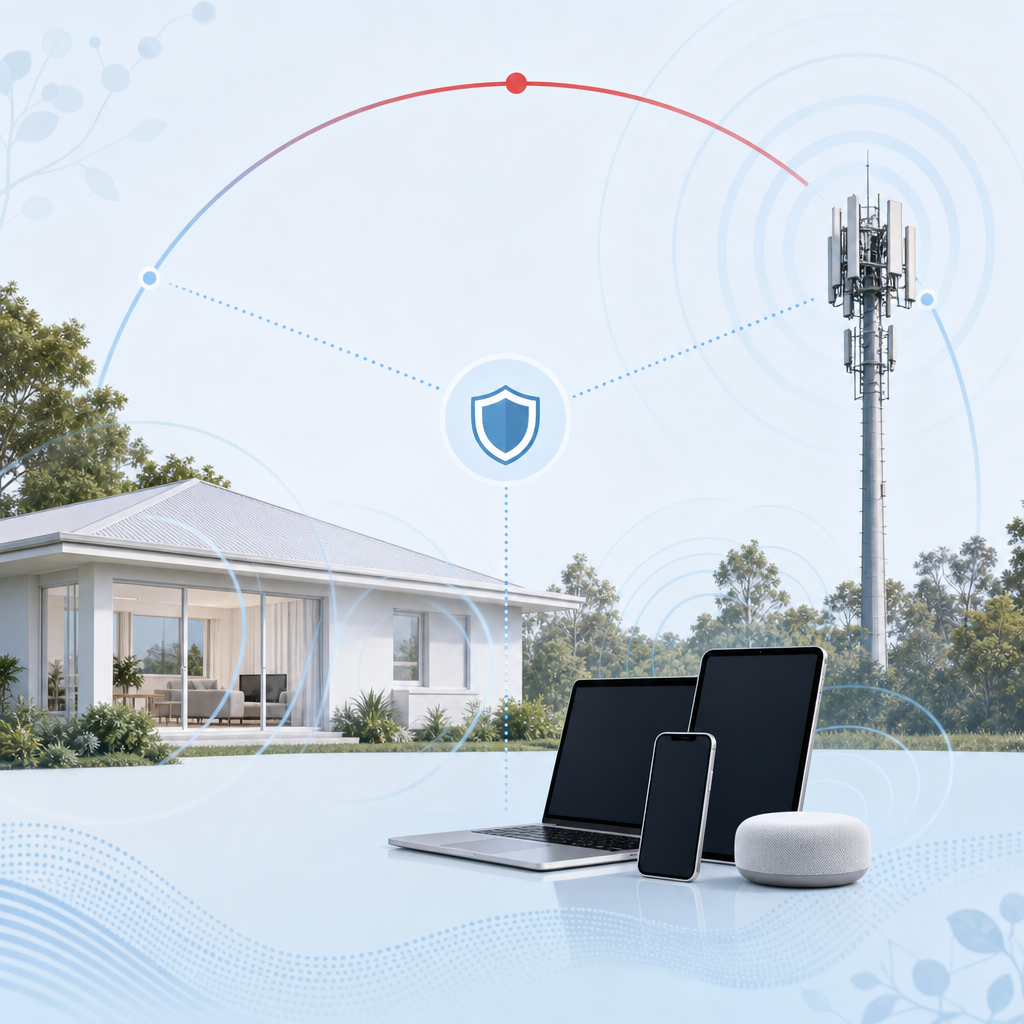
Australian EMF guidelines use frequency-specific limits to protect people from established adverse effects. ARPANSA's radiofrequency exposure standard covers frequencies used by wireless communications and other sources. Compliance is important, but exposure limits are not a promise that every possible long-term effect has been disproved.
The Australian Radiation Protection and Nuclear Safety Agency develops radiation protection guidance and publishes the relevant radiofrequency exposure standard. The standard sets basic restrictions and reference levels based on recognised interactions between radiofrequency fields and the body.
For mobile telecommunications infrastructure, carriers must comply with applicable regulation and prepare environmental exposure reports for installations. These reports model expected radiofrequency exposure around a site and compare it with the public limit.
Several points are often confused:
A safety limit is not a measurement of personal wellbeing
A regulatory limit is designed to prevent established adverse health effects. It does not predict whether a particular person will report headaches, sleep disruption or discomfort in a particular room.
Distance changes exposure
Radiofrequency exposure generally falls as distance from a local source increases, although the exact pattern depends on the antenna, reflections, power control and surrounding environment. A phone touching the body is a different scenario from a base station located at a distance.
Phones adjust their transmitting power
A mobile does not necessarily transmit at one fixed level. Network conditions, signal quality, data activity and device design affect output. A poor connection can make a phone work harder, which is one reason speakerphone can be useful during calls.
Multiple sources need competent assessment
If you are concerned about a nearby street transformer, mobile installation, workplace equipment or unusual wiring, use an appropriately qualified professional. Consumer meters can be useful for identifying sources, but they are easy to misuse. See our home EMF testing guide for meter types and limits. Readings depend on frequency response, calibration, orientation and whether electric fields, magnetic fields or radiofrequency fields are being measured.
Australian EMF guidelines provide an essential baseline. Our view is that people can go further through voluntary, proportionate precautions, especially in bedrooms and high-use work areas.
How to reduce cumulative EMF exposure practically
The most reliable way to reduce personal EMF exposure is to increase distance, reduce unnecessary transmitting time and replace wireless connections with wired ones where practical. Start with sources close to the body and areas occupied for long periods. Avoid costly changes until you understand what is actually present.
Start with distance
Distance is usually the simplest control. Use speakerphone for longer calls. Keep a transmitting mobile out of pockets when practical. Place laptops on a desk rather than directly against the body. Move routers out of bedrooms and away from beds, couches and work chairs.
Placement and distance address proximity directly. They do not retune the electromagnetic field at each source. EMF neutralisation — through Neutralizer Discs on phones, laptops and routers, and Whole House USB where ambient exposure matters — works at the source so everyday device use does not require constant rearrangement, but it does not remove the value of sensible distance and wired connections where practical.
Control active transmission
Turn off wireless features you are not using. Download media before travel where practical. Use aeroplane mode when a device does not need to communicate, while checking that Wi-Fi and Bluetooth have not been re-enabled separately.
Do not disable communications when doing so would compromise safety. A working mobile can be essential during emergencies.
Use wired alternatives selectively
Ethernet can replace Wi-Fi for fixed computers, televisions and gaming devices. A wired keyboard or mouse removes the need for wireless peripherals. Wired headphones can reduce the need to keep a transmitting phone against the head, although the phone should still be positioned sensibly.
You do not need to wire every appliance. Prioritise equipment used for long periods or kept close to the body.
Clean up the bedroom
Keep charging devices away from the bed. Remove powered equipment that serves no overnight purpose. If you need an alarm, consider a simple battery-powered clock. Review wireless baby monitors carefully and follow the manufacturer's placement instructions.
Switching off a router overnight may reduce avoidable exposure, but only if it does not interrupt medical, security or safety systems. It also will not remove signals from mobile networks or neighbouring devices.
Review the workspace as a system
A desk can contain a laptop, external display, mobile, wireless accessories, chargers and a router. Separate the body from these sources where practical. Route cables neatly, place the mobile away from the keyboard and avoid resting against powered equipment.
Measure before making structural changes
If concern relates to wiring, a smart meter, solar equipment, a street transformer or a persistent hum, seek an electrician or suitably qualified EMF assessor. Do not alter electrical systems yourself. A hum can also indicate an electrical fault or mechanical vibration requiring urgent investigation.
A sensible hierarchy is straightforward: identify sources, improve placement, neutralise main devices, reduce unnecessary transmission and add wired alternatives where practical. That approach helps take control of your immediate environment without letting the process take over your life.
Why aggregate daily exposure deserves a closer look
Our concern is not one compliant device viewed in isolation. It is cumulative daily exposure from phones, routers, computers, smart meters and household electronics across sleeping, working and leisure hours. Regulation remains essential, but personal exposure management asks a broader question: which sources are necessary, and which can be reduced easily?
This is where our position differs from much mainstream advice. A standards-based assessment asks whether a product or installation stays below limits intended to prevent established harm. A household assessment asks how many sources are active, how close they are and how long someone remains near them.
Those are not contradictory questions. They operate at different levels.
At EMF Neutralizer, we favour layered EMF protection. Practical source control and thoughtful placement matter, but neutralising concentrated device clusters is often what makes long-term exposure manageable in a real home or office. Some customers apply Neutralizer Discs from our EMF protection devices collection to phones, laptops and routers; others add a pendant or wristband for changing environments or Whole House USB for broader residential coverage.
Our customer outcome descriptions include an estimated 60–85% improvement in perceived EMF-related fatigue after EMF products were applied across residential use cases. This is EMF Neutralizer's own qualitative customer experience data, not a controlled clinical finding.
In one workplace case from our own experience, an individual spent long working days surrounded by a laptop, external monitor, mobile phone and wireless peripherals. After EMF products were applied to the concentrated device cluster, the user estimated that headache frequency fell by 70–90% over four weeks and reported better concentration and less early-afternoon mental fatigue. Individual results vary.
No EMF product should be presented as a cure for cancer, allergies, sleep disorders or another medical condition. Persistent symptoms still require appropriate medical assessment.
A stronger mainstream conversation would hold both ideas at once. Most everyday exposures comply with Australian limits, and people can still choose reasonable measures — including neutralisation — to reduce unnecessary load. Dismissal creates distrust. Fear-based selling does the same.
Where do Aulterra EMF protection products fit?
Aulterra products are designed for layered EMF neutralisation at personal, device, room and travel levels. Neutralizer Discs, pendants, whole-house USB and whole-car USB devices retune incoherent fields at the source rather than blocking signals.
The mechanism is field retuning, not shielding — see how Aulterra neutralisation works. The phone continues to function; the aim is to address the incoherent field component linked to oxidative stress in laboratory research, not to block communication.
Neutralizer Discs can be applied to commonly used devices such as phones, tablets, laptops and routers. A pendant or wristband provides a wearable option for people moving between multiple environments. Whole-house and whole-car USB neutralisers are intended for the broader mix of electronics encountered at home or during travel.
The practical approach is to map exposure by location:
- Personal layer: consider a pendant or wristband for changing environments.
- Device layer: apply discs to frequently used phones, laptops, routers and other devices.
- Room layer: consider Whole House USB for ambient home exposure; improve router and bedside placement where practical.
- Travel layer: consider the whole-car USB neutraliser for regular driving.
At EMF Neutralizer, we describe this as layered EMF protection. It is designed to help people take control of their immediate environment rather than sell fear about every electrical device. Browse the EMF protection hub before choosing products.
Keep using speakerphone, sensible distance and wired connections where practical. Neutralisation and distance each address a different part of the setup; neither makes the other unnecessary.
When evaluating any EMF brand, ask what testing was performed and whether claims match a plausible mechanism. Documented Aulterra research, practitioner observations and consistent customer experience carry meaningful weight even where large randomised trials remain limited by research funding, not by absence of effect.
No EMF product should be presented as a guaranteed prevention or treatment for disease. The goal is informed control of cumulative daily exposure, not a false promise of zero EMF.
A balanced decision framework for concerned Australians
A sound EMF decision separates hazard, exposure and personal response. Confirm the source, compare the exposure with authoritative guidance, make low-cost reductions and monitor relevant symptoms. Escalate to qualified electrical, environmental or medical professionals when a problem persists. This prevents both complacency and expensive reactions based on fear.
Use these questions in order:
- What type of field is involved?
- Is the source active continuously or intermittently?
- How close is it to the body?
- How long do you spend there?
- Can distance or operating time be changed safely?
- Are there other plausible causes for the symptoms?
- Does the concern require a calibrated assessment?
- Have persistent symptoms been discussed with a health professional?
This framework also protects against misleading marketing. A product description should not blur ionising radiation, radiofrequency fields and low-frequency magnetic fields into one undefined threat. If a company cannot explain what it means by EMF, its claims deserve scrutiny.
Precaution is strongest when it is specific. Move the router because it sits beside the bed, not because every wireless signal is assumed to be dangerous. Investigate the street transformer because of a measurable concern or electrical symptom, not because its appearance is alarming.
The aim is informed control. Keep the technology that improves your life, remove exposure that serves no purpose and use neutralisation where it fits your actual device pattern.
References
These authoritative sources explain electromagnetic field categories, recognised biological effects, cancer research and Australian exposure standards. For Aulterra-specific research context, see our independent scientific studies guide.
- Australian Radiation Protection and Nuclear Safety Agency, Standard for Limiting Exposure to Radiofrequency Fields (RPS S-1)
- World Health Organization, Radiation: Electromagnetic fields
- International Agency for Research on Cancer, IARC classifies radiofrequency electromagnetic fields as possibly carcinogenic to humans
- US National Cancer Institute, Electromagnetic Fields and Cancer
- International Commission on Non-Ionizing Radiation Protection, Guidelines for Limiting Exposure to Electromagnetic Fields
Stay informed on EMF wellness
Get practical tips and product updates in your inbox.
Frequently asked questions
Does our "long-term emf health effects" guide explain what the evidence does and does not show?
Yes. This guide explains established effects, independent biological research, unresolved population-study questions, Australian exposure limits, and practical ways to reduce cumulative daily exposure without replacing medical care.
Does EMF exposure build up in the body over time?
Non-ionising EMF is not generally described as accumulating in the body like a stored chemical. Exposure can repeat across the day and over many years, so researchers assess frequency, intensity, distance and duration when studying possible long-term effects.
Can Wi-Fi cause long-term health problems?
Research has not established that ordinary Wi-Fi exposure within recognised limits causes long-term health problems. Concerned users can increase router distance, use Ethernet for fixed devices and disable wireless functions that are not needed.
What symptoms are commonly attributed to EMF exposure?
Reported symptoms include headaches, fatigue, sleep difficulty, dizziness, tinnitus, poor concentration and skin sensations. These symptoms are non-specific, and persistent or severe symptoms should be assessed by a health professional.
Are Australian EMF guidelines adequate for long-term exposure?
Australian guidelines are designed to protect against established adverse health effects and provide the appropriate regulatory baseline. Scientific review continues, while individuals may adopt proportionate, low-cost precautions below the limits.
Should I switch off Wi-Fi at night?
Switching off Wi-Fi can reduce an unnecessary overnight source when no household system depends on it. Do not interrupt medical equipment, security services or essential communications without understanding the consequences.
Do EMF neutralisers help with long-term daily exposure?
Aulterra neutralisers retune incoherent fields at the source so normal phone, laptop and router use does not require constant avoidance. They are designed for layered home and personal protection, not as medical treatments. Many customers neutralise main devices and continue usual habits; others add distance or wired connections as complementary steps.

Richard Kent
Science-backed EMF wellness education from the EMF Neutralizer team.
Related articles
What Is EMF Radiation? A Plain-English Explainer for Australians (2026)
If you have typed "what is EMF radiation" into a search bar at midnight, you are not alone. Millions of Australians are surrounded by wireless devices around th…

Best EMF Protection Sticker for Your Phone in Australia: An Honest Review and Comparison
The best 'EMF protection sticker' for an Australian phone user is the Aulterra Neutralizer Discs 3-Pack — small adhesive discs applied one per device, starting…

Do EMF Pendants Actually Work? An Honest Answer for Australians
EMF pendants are not designed to block or shield electromagnetic fields the way a bed canopy, Faraday enclosure, or device pouch does. They are designed to harm…