Does Phone EMF Protection Actually Work? An Evidence-Based Look for Australians
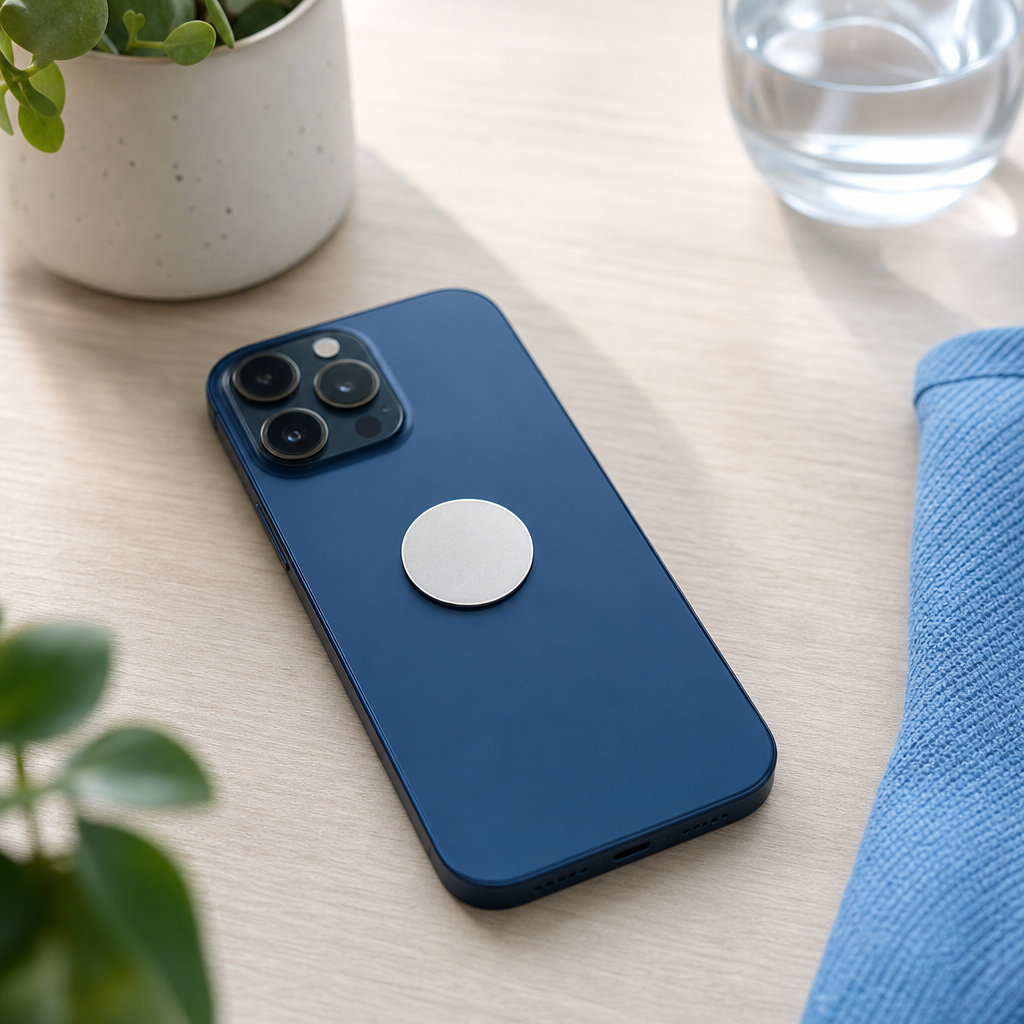
Phone EMF protection products such as the Aulterra neutraliser disc do not block or reduce mobile radiation, and they are not designed to. Genuine harmonising discs work by changing how the electromagnetic field interacts with the body, not by shielding signal. Customers in high-device environments report meaningful drops in fatigue and headaches, though this is based on reported outcomes, not clinical trials.
If you are reading this, you are probably on your phone for most of your waking day, you have noticed headaches, restless sleep or a wall of fatigue by 3pm, and you have seen enough EMF marketing to be suspicious of all of it. That scepticism is healthy. Most of what gets sold in this space is either fear dressed up as science, or vague promises with nothing behind them.
At EMF Neutralizer we take a different position. We think the invisible electromagnetic burden of modern life is real and worth addressing, but we also think you deserve a straight answer about what a product can and cannot do before you spend a cent. This article explains the mechanism, the honest evidence, and how to test it on yourself without wasting money.
Key Takeaways
- Harmonising discs like the Aulterra neutraliser do not block phone signal, so call quality, data speed and battery performance stay exactly the same.
- Shielding products that physically block RF can force a phone to boost its transmission power to maintain connection, which may increase exposure rather than reduce it.
- Regulatory exposure limits from bodies like ARPANSA and ICNIRP are set for single-device, short-term exposure, not the cumulative daily load of a phone, laptop, router and smart meter running simultaneously.
- Customer-reported outcomes (not clinical trial data) point to an estimated 60-85% improvement in perceived EMF-related fatigue and a 70-90% reduction in headache frequency in high-device environments.
- A disc works best applied directly to the phone or its case, with results honestly judged over a two-week self-assessment period.
- Layered EMF protection across phone, car, bedroom and body addresses the whole environment, not just the one device you happen to be holding.
Protect your family from EMF exposure
Browse our science-backed neutralizer products.
Shop EMF ProtectionSummary Table: Shielding vs Harmonising
- Shielding Products
- Physically blocks or absorbs RF signal
- Harmonising Products (e.g. Aulterra disc)
- Changes how the field interacts with the body without blocking it
- Shielding Products
- Can degrade signal strength, cause dropped calls
- Harmonising Products (e.g. Aulterra disc)
- No measurable change to signal
- Shielding Products
- Phone often boosts transmission power to compensate, draining battery faster
- Harmonising Products (e.g. Aulterra disc)
- No measurable change
- Shielding Products
- Phone case, pouch, fabric sleeve
- Harmonising Products (e.g. Aulterra disc)
- Small disc adhered to phone, case, laptop or tablet
- Shielding Products
- Prevent radiation reaching the body
- Harmonising Products (e.g. Aulterra disc)
- Reduce the body's stress response to the field it is already exposed to
- Shielding Products
- Reduced network performance for theoretical exposure reduction
- Harmonising Products (e.g. Aulterra disc)
- No trade-off to signal, results are subjective and self-assessed
What Phone EMF Protection Can (and Can't) Do
A genuine phone EMF product cannot make your phone emit zero radiation, and any product claiming that is lying to you. What it can realistically do is change how that field interacts with your body, without touching signal, call quality or battery life.
This is the most important distinction in the entire category, and it is where most of the scepticism you have picked up online is actually justified. A huge share of products sold as "radiation blockers" are cases, stickers or pouches that claim to stop RF energy from reaching you while you keep using the phone normally. Physically, this does not add up. To block a signal while still making calls and using data, the phone has to push harder to maintain connection through the barrier. That is basic radio engineering, not opinion.
Harmonising products, including the Aulterra neutraliser disc, do not attempt this. They are built on a different premise: the field is going to reach you regardless, so the more useful question is how your body registers that field, not whether you can somehow make it disappear. That is a fundamentally different product category, and conflating the two is where most of the online "debunking" content misses the mark entirely.
Shielding vs Harmonising: Why Blocking the Signal Is the Wrong Goal
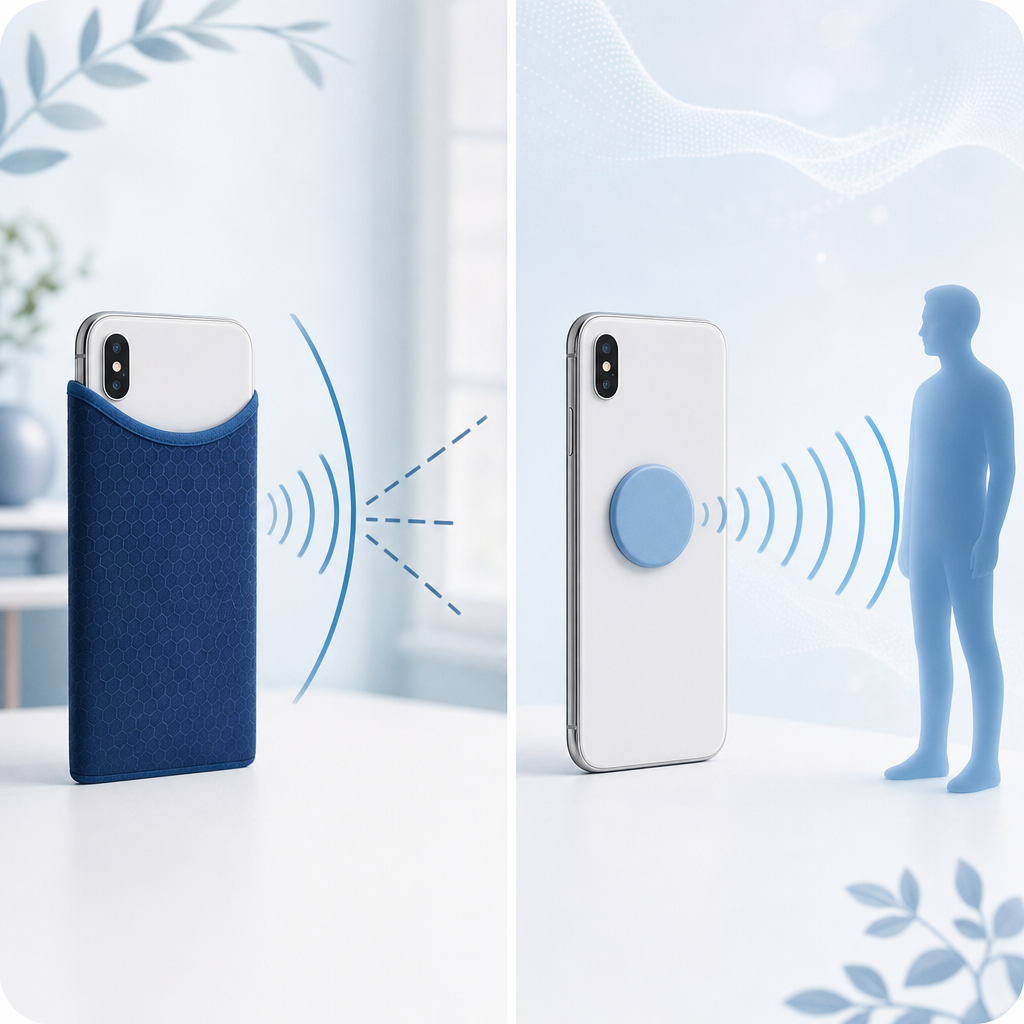
Shielding a phone signal is the wrong goal because you cannot block RF energy and use the phone at the same time without degrading performance. Harmonising products leave the signal untouched entirely, so reception, call quality and battery drain remain exactly as they were before the disc was applied.
Think about what a phone actually needs to do its job. It has to send and receive a radio signal to a cell tower. Any product that meaningfully attenuates that signal is working against the phone's basic function, and the phone's own software will respond by increasing power to the antenna to compensate. This is precisely why some radiation-blocking phone cases have drawn criticism: they can create a worse outcome than doing nothing, by pushing the handset to transmit at higher power for longer.
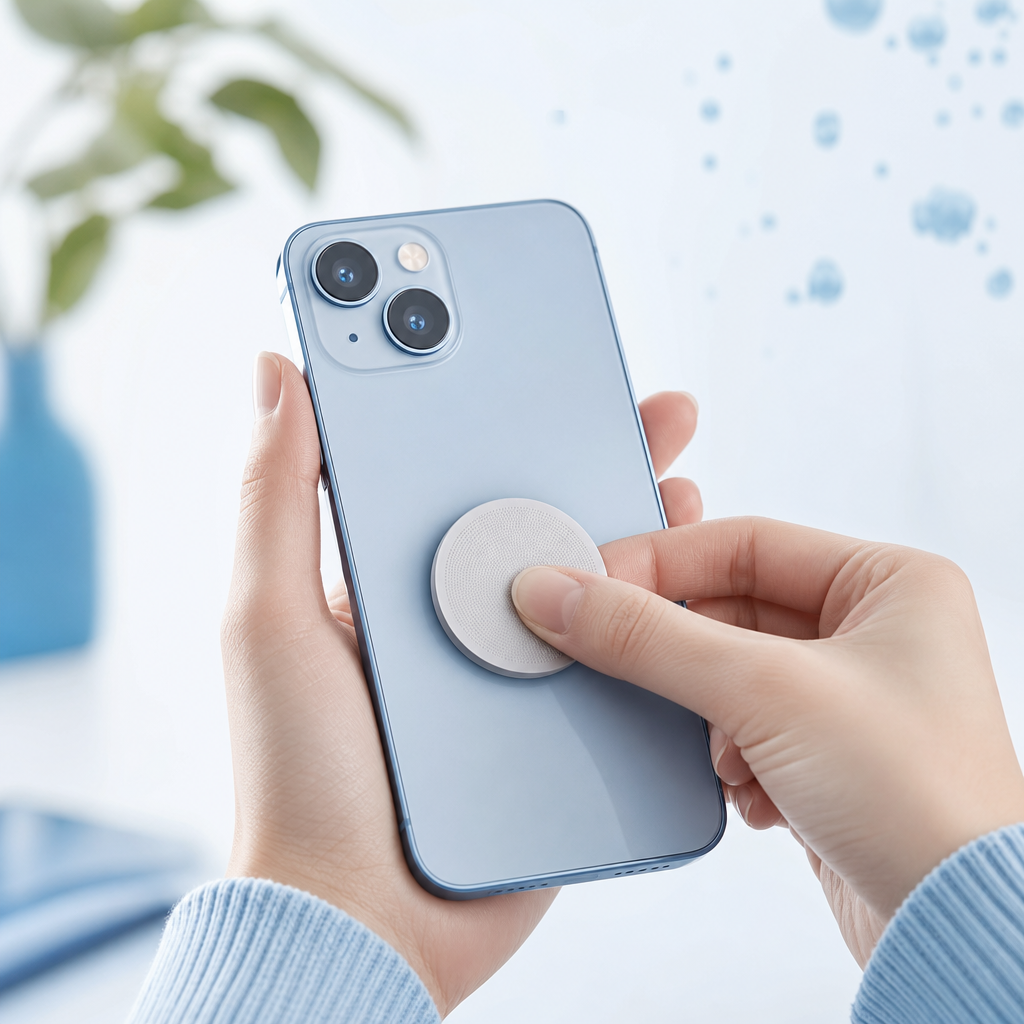
An Aulterra neutraliser disc takes none of that risk, because it is not shielding anything. It is a small adhesive disc, generally a few centimetres across, applied directly to the back of the phone or its case. It does not contain conductive shielding material, it does not sit between the antenna and the tower, and it has no mechanism by which it could reduce reception or drain the battery faster. If you are worried that adding one of these to your phone will hurt your signal, the honest answer is that it structurally cannot, because that was never the mechanism.
The trade-off with harmonising products is different, and worth being upfront about. Because nothing measurable changes in the signal itself, you cannot verify the product's effect with a signal strength meter or a speed test. The only honest verification available is how you feel, tracked over time, which is exactly why the self-assessment method later in this article matters more than any spec sheet.
Why Regulated Safety Limits Miss the Point
Regulated EMF safety limits from ARPANSA and international bodies are set for a single device operating in isolation over a short exposure window. They do not model a person sitting sixteen hours a day within reach of a phone, a laptop, a Wi-Fi router, a smart meter and a television, all running simultaneously. That combined, cumulative daily exposure is the reality regulators are not measuring.
This is the contrarian part of our position, and we hold it deliberately. The standard argument goes: "Every individual device in your house complies with ARPANSA and ICNIRP exposure guidelines, therefore there is nothing to worry about." That statement is technically true and, in our view, largely beside the point. It answers a question nobody in a real Australian household is actually living through.
Consider a typical work-from-home setup. A laptop on the desk, an external monitor, a mobile phone within arm's reach, a Wi-Fi router in the next room, a smart speaker on the shelf. Each device, tested individually, sits under the relevant threshold. But nobody is exposed to one device at a time for a discrete ten-minute test. They are exposed to all of them, continuously, for the length of a working day, then again in the evening with a television, a router and a phone by the bed overnight.
We believe the aggregate daily burden is the number that actually matters to how someone feels, not the isolated single-device figure that appears on a compliance sticker. A phone is the closest and most constant of these sources, held against the ear, carried in a pocket, or resting on a desk within thirty centimetres of the body for most of the day. That proximity and constancy is precisely why it is the sensible place to start addressing the load, rather than the smart meter on the side of the house that you interact with for zero minutes a day.
This is not an argument against the regulators' work. Their thresholds are appropriately conservative for the scenario they were built to test. It is an argument that the scenario they were built to test is not the one most Australians are actually living in, and that taking control of your immediate environment on a cumulative basis is a reasonable, proactive response regardless of where any single device sits on a compliance chart.
What Users Actually Report After Applying a Neutraliser Disc
Based on reported customer outcomes rather than clinical trials, people applying a neutraliser disc in high-device environments describe an estimated 60-85% improvement in perceived EMF-related fatigue, and an estimated 70-90% reduction in headache frequency. These are qualitative, self-reported figures drawn from our own customer base, not peer-reviewed clinical results.
We want to be precise about what that framing means. These numbers come from how customers describe their own experience after applying discs to their devices, generally over a four-week window. They are not from a controlled trial with a placebo arm, and we are not going to pretend otherwise to make the story sound more impressive than it is.
One pattern we have observed directly involves a person working long hours at a desk surrounded by a laptop, an external monitor, a mobile phone and wireless peripherals, who was experiencing persistent headaches and difficulty concentrating through the working day. After discs were applied directly to each device in that cluster, headache frequency was estimated to drop by 70-90% over roughly four weeks, alongside noticeably improved concentration and less of the mental fatigue that had previously set in by early afternoon.
We treat that kind of result as a genuine, worthwhile data point, not as proof. The honest caveat is that self-reported wellbeing improvements can be influenced by expectation, by simultaneous lifestyle changes, and by the simple act of paying more attention to your sleep and screen habits once you have spent money on something. That is exactly why we recommend the structured two-week self-assessment described later in this article, rather than asking anyone to take our word for it.
How to Apply an EMF Neutraliser Disc Correctly
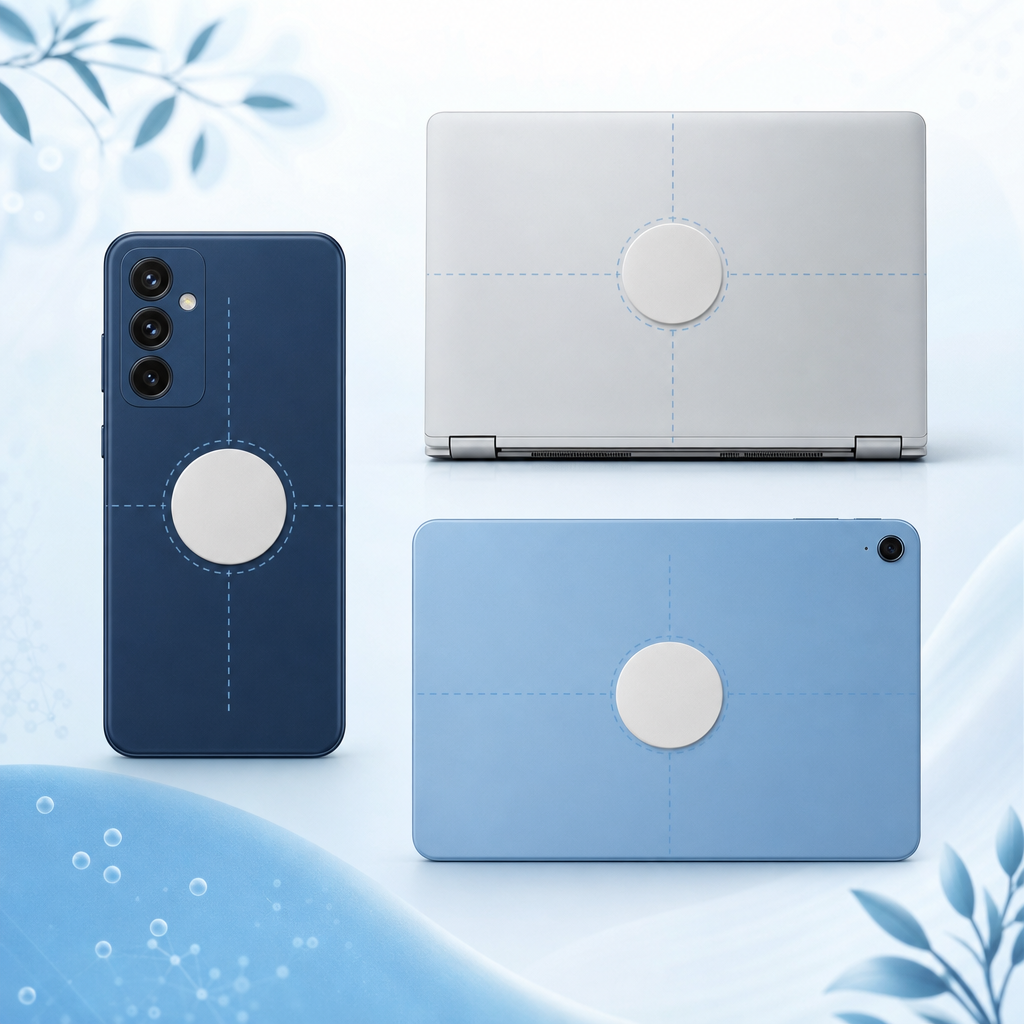
An EMF neutraliser disc should be applied directly to the back of the phone or its case, one disc per device, and left in place permanently rather than moved between devices. The same approach applies to laptops and tablets: one disc adhered to the outer casing, positioned away from ports so it does not interfere with charging or cases.
Placement does not need to be exact to the millimetre, but consistency matters more than people expect. On a phone, the centre of the back panel or the inside of a protective case is the standard spot. On a laptop, the outer lid near the hinge works well and keeps the disc clear of the keyboard deck. On a tablet, the back panel mirrors the phone approach.
One disc is intended for one device. Do not split a single disc's function across multiple devices by moving it back and forth, and do not assume one disc on your phone "covers" a laptop sitting next to it. Each device generating its own field is treated as its own source requiring its own application.
Give it time before judging results. Four weeks is the window we see most consistently referenced in customer feedback, though some people notice a difference within days. This is also the reason a disc that has fallen off unnoticed can be a genuine problem: we have seen customers report a rapid return of symptoms once a disc came loose without them realising, which is itself a reasonable (if anecdotal) signal that the placement was doing something rather than nothing.
Layered EMF Protection Beyond the Phone

The phone is the closest and most constant EMF source most people carry, but it is not the only one. Layered EMF protection extends the same approach to the body, the bedroom and the car, so the cumulative daily load is addressed across every environment you spend meaningful time in, not just the device in your hand.
A pendant or vitality wristband extends the same harmonising approach to your personal field, worn on the body throughout the day rather than fixed to one device. This matters for people who move between multiple EMF-dense environments, an office, a car, a train, a shopping centre, where no single disc on a single device covers the whole picture.
An EMF energy pillow addresses the bedroom specifically, which is worth singling out because sleep is the one period where the body is meant to be recovering, not managing additional load from a phone charging on the nightstand or a router in the next room. A whole-car USB neutraliser covers the commute, which for many Australians driving to and from Sydney, Melbourne or Brisbane CBDs is a daily one-to-two hour block spent close to a dashboard full of electronics.
Our general guidance is to start with the device you hold most, which for almost everyone is the phone, and build outward from there. Shop the Aulterra neutraliser disc for phones and other devices first, then extend coverage to the car, the bedroom and the body as budget and priority allow. There is no requirement to buy everything at once. The point is progressive coverage of a genuinely cumulative problem, not a single silver bullet product.
How to Judge Results Honestly: A Two-Week Self-Assessment
The most honest way to judge whether phone EMF protection is doing anything for you is a simple two-week tracking exercise across three measures: sleep quality, headache frequency, and end-of-day energy. Record a daily score for each before applying anything, then continue the same tracking after application, and compare the two blocks directly.
We recommend this method over relying on general impressions, because general impressions are notoriously unreliable for anything gradual. Use a simple 1-to-10 scale each evening for how you slept the night before, whether you had a headache that day, and how drained you felt by 6pm. Do this for one week before applying any product, as your baseline. Apply the disc, then track the same three scores for a further two weeks.
Be honest about confounding variables. If you also changed your caffeine intake, started exercising, or altered your screen time deliberately during the test period, note that down too, because it will affect your results independently of anything the disc is doing. This is not a clinical trial and it will not produce publishable data, but it will tell you, specifically for your own body and your own environment, whether the change is worth the modest cost of a disc. That is a more useful answer than anything a marketing page can give you.
What a Gold Coast Physiotherapist Found When He Tested It Himself
One of the more convincing pieces of real-world feedback we have received did not come from a typical retail customer, it came from a health professional running his own informal testing. Peter Mitchell, Principal Physiotherapist and owner of Narang Physiotherapy on the Gold Coast, approached us as a customer concerned about EMF exposure at both his clinic and home.
We suggested a whole-house neutraliser alongside discs applied to every device in both environments. Peter didn't stop at using the products himself. He ran his own testing using kinesiology, a muscle-response method he uses professionally, to assess whether stress indicators changed with the discs in place versus without them. Over several months of use across laptops, mobile phones, his children's devices and both the clinic and home neutraliser units, he found the products consistently reduced the stress markers he was measuring around radiofrequency exposure.
He now stocks and sells Aulterra products through his own clinic, which is not a decision a physiotherapist makes lightly. His clients are people trusting him with their physical recovery, and he would not put his name behind something he had not tested to his own satisfaction. We share this not as clinical proof, kinesiology is not a peer-reviewed diagnostic method, but as a genuine example of a sceptical, clinically trained professional running his own scrutiny before recommending anything, which is exactly the standard we think readers of this article should apply too.
Our broader view, built from years of watching how customers actually use these products, is that the people who get the most out of harmonising products are the ones who treat the process the way Peter did: apply it properly, give it a real timeframe, and judge it against your own tracked baseline rather than a marketing claim. Your home and workspace should support your biology, not work against it, and that is a standard you can hold any product to, including ours.
References
- ARPANSA, Australian Radiation Protection and Nuclear Safety Agency, guidance on mobile phones and radiofrequency EME: https://www.arpansa.gov.au/understanding-radiation/radiation-sources/more-radiation-sources/mobile-phones
- World Health Organization, Electromagnetic fields and public health: mobile phones fact sheet: https://www.who.int/news-room/fact-sheets/detail/electromagnetic-fields-and-public-health-mobile-phones
- International Commission on Non-Ionizing Radiation Protection (ICNIRP), Guidelines for limiting exposure to electromagnetic fields: https://www.icnirp.org/en/publications/index.html
- Australian Competition and Consumer Commission (ACCC), guidance on false or misleading claims in advertising: https://www.accc.gov.au/business/advertising-and-promoting-your-business/false-or-misleading-claims
Stay informed on EMF wellness
Get practical tips and product updates in your inbox.
Frequently asked questions
Does an EMF neutraliser disc reduce phone signal or battery life?
No. A harmonising disc contains no shielding material and does not sit between the antenna and the network, so it has no mechanism by which it could reduce signal strength or drain the battery faster.
Do EMF phone stickers actually work?
It depends entirely on the type. Stickers or cases that claim to block radiation while you keep using the phone are working against the physics of how a phone maintains connection. Harmonising discs make a different claim, changing how the field interacts with the body rather than blocking it, and that claim does not run into the same physical contradiction.
How long before I notice a difference after applying a disc?
Most customer feedback references a four-week window for noticeable change, though some people report a difference within days. A structured two-week self-assessment of sleep, headaches and energy is a more reliable way to judge results than relying on general impressions.
Is there scientific proof that phone EMF protection works?
Reported outcomes such as an estimated 60-85% improvement in perceived fatigue and 70-90% reduction in headache frequency are drawn from qualitative customer-reported experience, not peer-reviewed clinical trials. That distinction should be considered when evaluating any EMF protection product.
Can I put more than one disc on the same phone?
One disc per device is the standard recommendation. There is no established benefit to layering multiple discs on a single phone. Protection is better extended outward to other devices, the car and the body.
Are Aulterra neutraliser discs different from radiation-blocking phone cases?
Yes, fundamentally. Radiation-blocking cases attempt to physically stop RF signal, which can force the phone to transmit at higher power. An Aulterra neutraliser disc does not attempt to block anything, it is designed to change how the existing field interacts with the body, leaving signal and battery performance untouched.

Richard Kent
Science-backed EMF wellness education from the EMF Neutralizer team.
Related articles
iPhone vs Android EMF Output: Which Phone Is Actually Safer in Australia?
Direct Answer: Neither iPhone nor Android phones are meaningfully safer by SAR rating. Both must meet Australia's 2.0 W/kg limit, a standard enforced by ACMA an…
Best EMF Protection Sticker for Your Phone in Australia: An Honest Review and Comparison
The best 'EMF protection sticker' for an Australian phone user is the Aulterra Neutralizer Discs 3-Pack — small adhesive discs applied one per device, starting…

Do EMF Pendants Actually Work? An Honest Answer for Australians
EMF pendants are not designed to block or shield electromagnetic fields the way a bed canopy, Faraday enclosure, or device pouch does. They are designed to harm…