Best EMF Protection Sticker for Your Phone in Australia: An Honest Review and Comparison
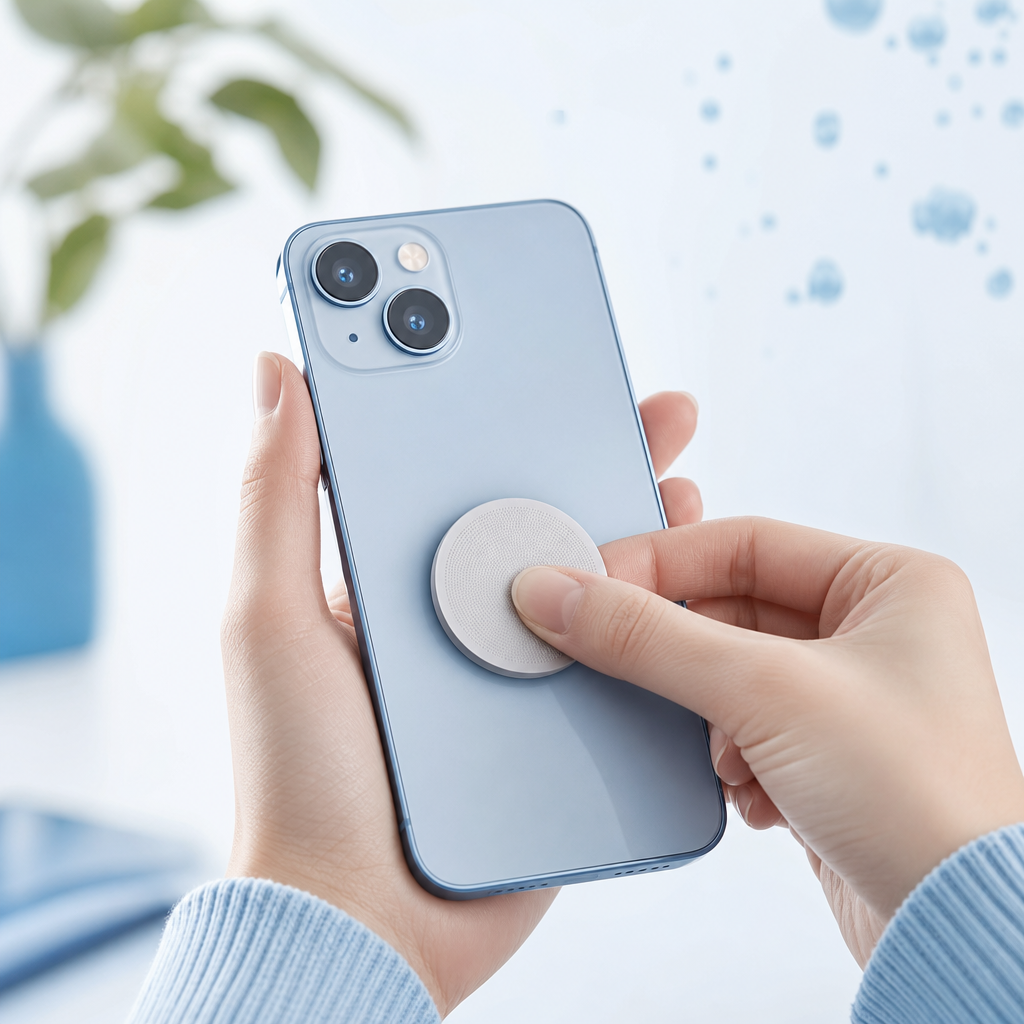
The best 'EMF protection sticker' for an Australian phone user isn't a shield at all. It's the Aulterra neutraliser disc, a small adhesive device applied to the back of your phone or inside the case. It doesn't block signal or reduce radiation output. It's designed to harmonise the field around your device so it interacts with your body differently, not to stop your phone working.
Most people searching for a 'phone EMF sticker' in Australia are trying to solve a real problem: afternoon fatigue, a warm phone that never leaves their pocket, or a bedside table crowded with chargers and a router down the hall. The language of 'blocking' and 'shielding' gets used loosely online, and it's worth untangling before you spend money on the wrong product.
This article explains what these devices genuinely do, reviews the Aulterra neutraliser discs and whole-car USB neutraliser that EMF Neutralizer actually stocks, and sets out why a single disc is rarely the whole answer in a modern Australian home. We'll keep the outcome language honest: qualitative, customer-reported, and clearly labelled as such.
Key Takeaways
- 'EMF protection sticker' is the everyday term, but what actually works is a neutraliser disc, which harmonises a device's field rather than blocking signal.
- A sticker that genuinely blocked RF signal would force your phone to boost transmission power to maintain connection, which is counterproductive.
- The Aulterra disc is applied to the back of a phone or inside the case, and most households need one per active device, not one per family.
- Customers report an estimated 60-85% improvement in perceived EMF-related fatigue and an estimated 70-90% reduction in reported headache frequency in high-device environments (based on qualitative customer outcome descriptions).
- Cumulative daily exposure across multiple simultaneous sources, router, smart meter, laptop, phone, television, is the more realistic measure than any single device's regulated output.
- Discs, pendants, wristbands and EMF energy pillows work best as layered EMF protection rather than a single fix.
Protect your family from EMF exposure
Browse our science-backed neutralizer products.
Shop EMF ProtectionSummary Table
- What It's For
- One phone, tablet or laptop
- Coverage
- One disc per device
- Typical Household Fit
- First step, applied to the most-used device
- What It's For
- Every regularly used device in the home
- Coverage
- One disc per device, applied individually
- Typical Household Fit
- Households with three or more daily-use devices
- What It's For
- Vehicle cabin during commuting or travel
- Coverage
- Entire car interior via USB power
- Typical Household Fit
- Daily commuters, families with children in the car
- What It's For
- Personal, portable coverage that travels with you
- Coverage
- Worn on the body or used at the bedside
- Typical Household Fit
- Added layer alongside device discs, especially for sleep
'EMF Protection Sticker' vs Neutraliser Disc: What the Terminology Actually Means
An 'EMF protection sticker' is the search term most Australians use. What's actually being sold, and what EMF Neutralizer stocks, is a neutraliser disc. It doesn't block, shield or absorb radiofrequency energy. It's designed to harmonise the electromagnetic field around a device so it registers differently with the body.
This distinction matters more than marketing copy suggests. A phone maintains its connection to a mobile tower by transmitting and receiving radio signals. If a sticker genuinely blocked or absorbed that signal, the phone's antenna would compensate by increasing transmission power to hold the connection, which would mean more RF output, not less. That's basic radio physics, and it's why foil-style 'blocker' products marketed elsewhere online should raise questions rather than confidence.
A neutraliser disc takes a different approach entirely. Rather than interrupting the signal path, it's constructed to interact with the field the device generates, aiming to make that field less disruptive to the body without interfering with call quality, data speed or battery charging. This is a harmonising approach, not a shielding one, and it's the honest way to describe what these products do.
We've found that once Australians understand this distinction, the decision gets easier. You're not choosing a product that promises to make your phone 'radiation-free', because no adhesive sticker can do that while the phone still functions as a phone. You're choosing a product designed to change how that unavoidable field interacts with your body, day after day.
What to Look For When Comparing Device Harmonisers
When comparing device harmonisers, focus on four practical factors: adhesive placement and durability, coverage per individual device, expected longevity of the disc, and confirmation that it has no measurable effect on call quality or battery performance. These are the details that separate a considered product from a novelty sticker.
Adhesive placement. The disc needs to sit flush against the back of the phone or inside the case without lifting at the edges, catching on pockets, or peeling after repeated handling. A disc that falls off within weeks isn't doing its job, and as we've seen with customers who've had discs come loose, the change in how they feel is often noticeable almost immediately.
Coverage per device. One disc is built to address one device. A common mistake is buying a single disc and expecting it to somehow cover a phone, a laptop and a tablet at once. It doesn't work that way, and any product claiming otherwise should be treated with scepticism.
Longevity. A genuine neutraliser disc is designed to last for the practical lifespan of the device it's applied to, not a few months. If you upgrade phones, the disc typically needs to move or be replaced.
Effect on function. This is non-negotiable. A legitimate device harmoniser should have zero measurable impact on signal strength, call clarity, data speed or charging behaviour. If a product changes how your phone functions, that's a red flag, not a feature.
Review: Aulterra Neutraliser Discs for Phones, Tablets and Laptops
The Aulterra neutraliser disc is a small, flat, adhesive device applied directly to the back of a phone, tablet or laptop, or placed inside a protective case where it sits against the device body. It's the core product in this category, and most Australian households need more than one.
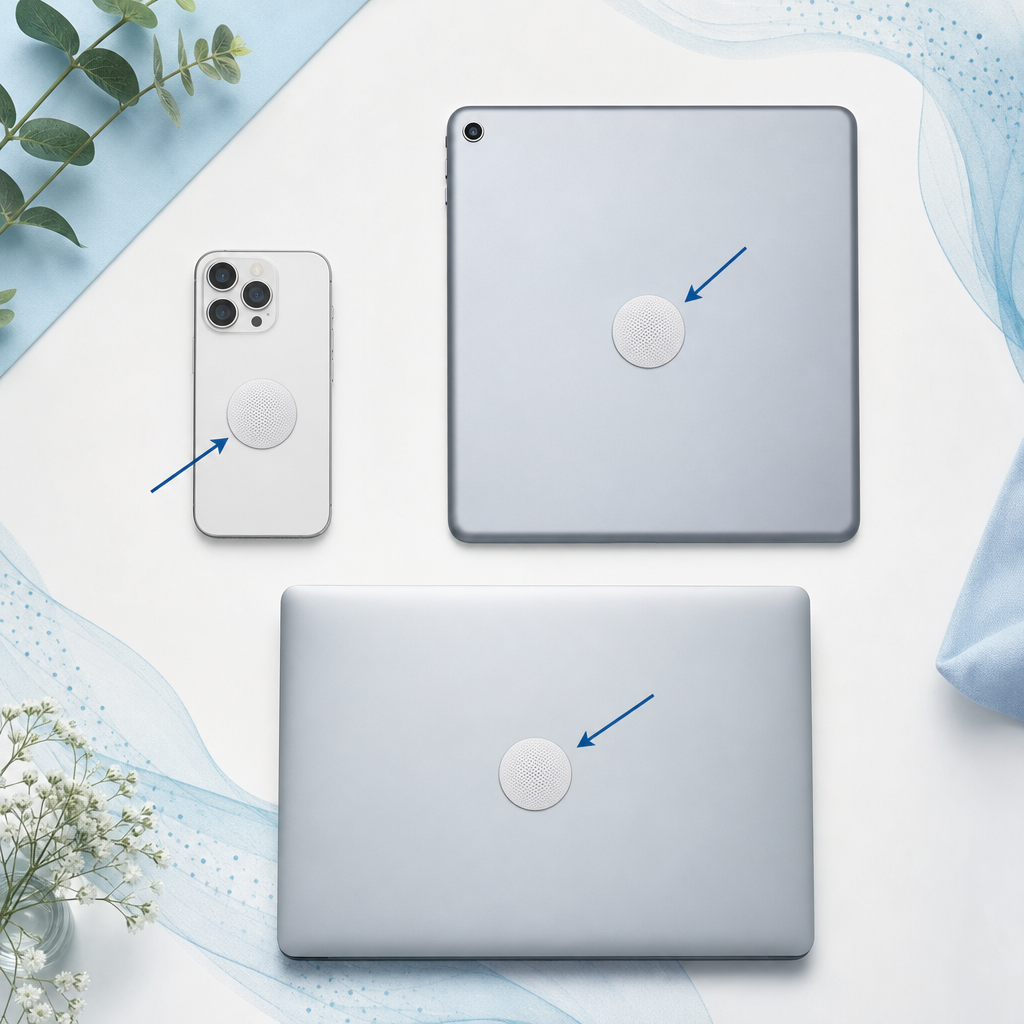
Placement is straightforward. On a phone, the disc goes on the rear panel, ideally centred, or inside a slim case so it makes contact with the device without adding bulk. On a laptop, it's typically applied to the underside near the processor and Wi-Fi antenna, the areas generating the most consistent field. On a tablet, the back panel again works well, particularly for devices used for hours at a time on a lap or propped on a desk.
How many does a household actually need? In our experience, one disc per actively used device is the realistic guide, not one disc per person. A household with two adults and two teenagers, each with a phone, plus a shared laptop and a family tablet, is realistically looking at five or six discs to cover every device that gets meaningful daily use. Treating a single disc as sufficient for a multi-device household is the most common mistake we see, and it's why the cumulative load argument in the next section matters.
Comparison Table: Single Phone Disc vs Multi-Device Coverage vs the Whole-Car USB Neutralizer
The right product depends on where your daily exposure is concentrated: your most-used device, every device in the house, or the car you sit in for a commute. Most Australians benefit from starting with the single device they touch most, then expanding outward.
- Best Option
- Single Aulterra disc on your phone
- Why
- Addresses the device generating the most consistent, close-range field in your day
- Best Option
- Multi-device disc coverage
- Why
- Individual discs on each device address the household's combined daily load
- Best Option
- Whole-Car USB Neutralizer
- Why
- Covers the cabin environment where phones, Bluetooth and vehicle electronics cluster together
- Best Option
- Discs on bedside devices plus a wearable or EMF energy pillow
- Why
- Targets the specific environment where recovery matters most
Why One Disc Is Rarely Enough: The Cumulative Load Argument
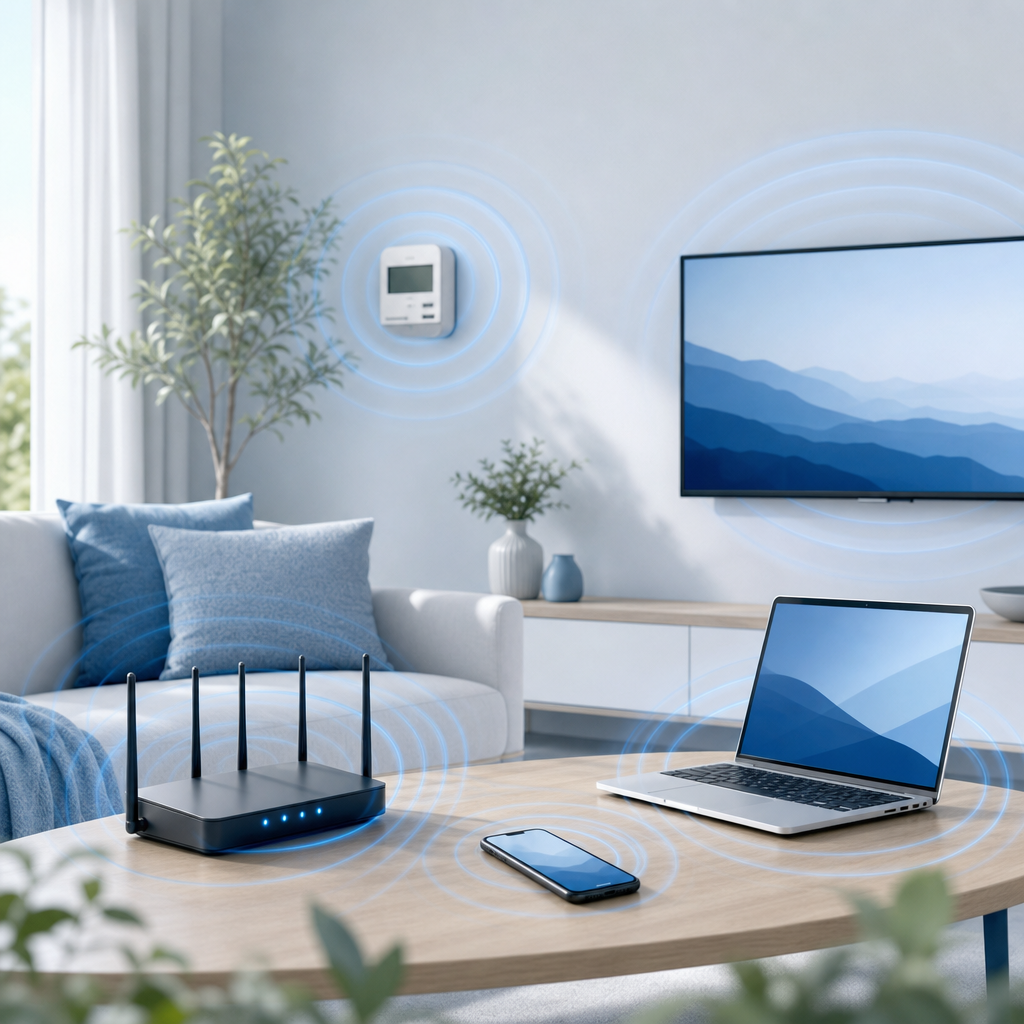
A single disc on a single phone addresses one source out of many. The realistic issue isn't any one device, it's the cumulative daily exposure from a router, smart meter, laptop, phone and television all operating simultaneously for sixteen hours a day in the average Australian home.
Regulatory thresholds for radiofrequency exposure are set for single-device, acute exposure scenarios. They tell you a phone or a Wi-Fi router, tested in isolation, sits under a defined limit. What they don't measure is what happens when a person spends their evening within range of five or six active sources at once, night after night, year after year. We believe this aggregate daily burden, the invisible electromagnetic burden most people have simply learned to live with, is the more relevant measure, regardless of whether any single device passes as safe on its own.
This is why we consistently recommend expanding beyond a single disc. Customers who've applied discs across an entire household's regularly used devices report an estimated 60-85% improvement in perceived EMF-related fatigue (based on qualitative customer outcome descriptions). In high-device environments, such as a home office running a laptop, external monitor, phone and wireless peripherals for eight hours a day, customers have reported an estimated 70-90% reduction in headache frequency over several weeks (based on qualitative outcome descriptions). These are estimates drawn from customer-reported experience, not clinical measurements, and we present them that way deliberately. But the pattern is consistent enough, across enough households, that we don't think it's coincidence.
Taking control of your immediate environment doesn't mean removing every device. It means addressing the sources you can't avoid, one at a time, until the coverage matches the reality of how many devices actually surround you each day.
Stacking With Wearables: Pendants, Wristbands and EMF Energy Pillows
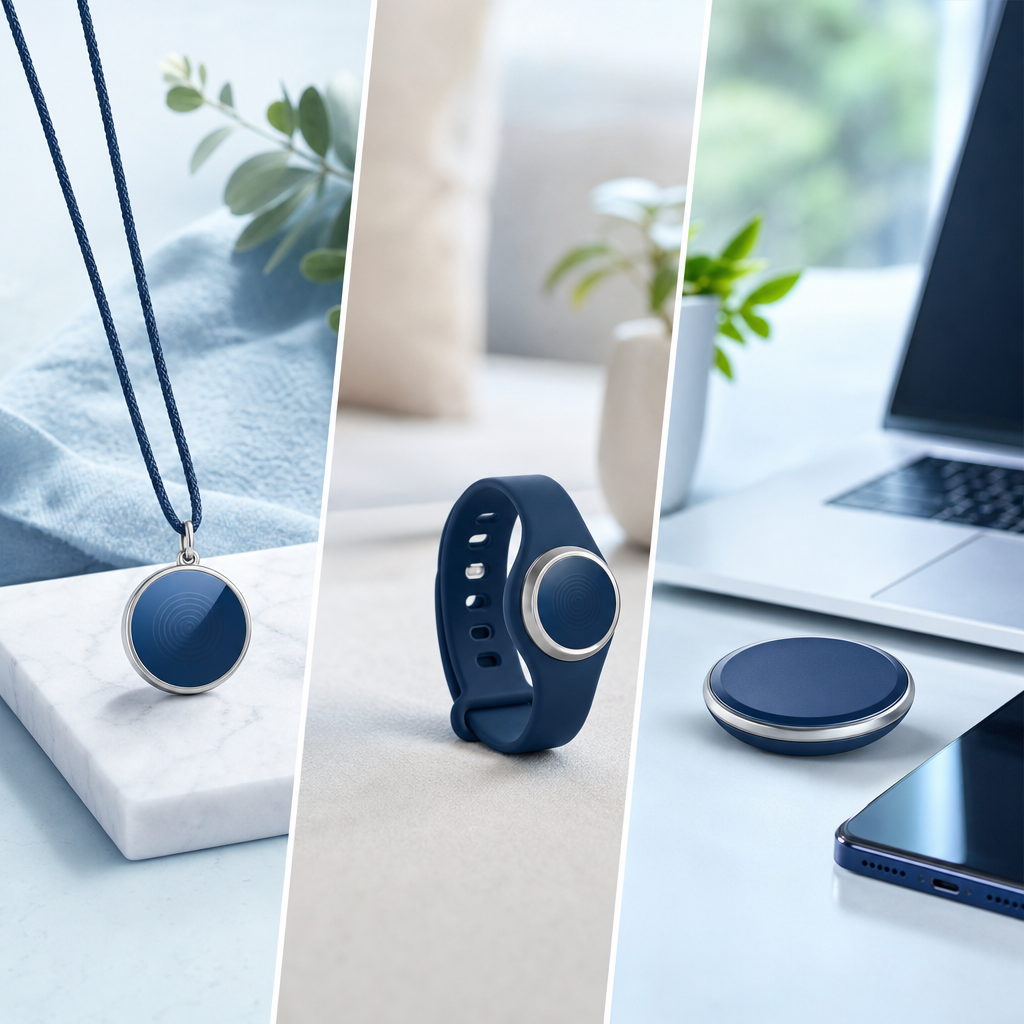
Device discs address the devices themselves, but they don't travel with you once you leave the house or the car. Wearables, pendants, wristbands and bedside EMF energy pillows, extend that coverage to your body directly, which is why we generally recommend combining the two rather than relying on either alone.
A pendant or wristband stays with you through the day, in the car, at work, on public transport, in ways a device disc can't. An EMF energy pillow is worn nightly, positioned to support the hours when your body is meant to be recovering, not fighting an environment working against it. This layered EMF protection approach, device discs for the sources you can identify, wearables for the ones you can't always control, reflects how we think about this whole category: your home and your body should both be working with you, not against you.
If you're weighing up whether a pendant, a wristband or a disc makes more sense for your situation, it usually comes down to where your exposure is concentrated and how portable you need the protection to be.
What We've Seen Across Australian Homes and Workplaces
The pattern we see most often isn't dramatic, it's cumulative. A single disc on a single phone rarely produces the kind of change people describe once every regularly used device in a home or office is covered. That's not a sales pitch, it's what several years of customer feedback across residential and workplace settings has shown us consistently.
One case that's stuck with us involved a home office setup: a laptop, an external monitor, a mobile phone and wireless peripherals, all running for a standard eight-hour working day. The individual was experiencing persistent headaches and difficulty concentrating by early afternoon. After applying discs directly to each device in that cluster, addressing the concentrated group of sources rather than just the phone, headache frequency was estimated to drop by 70-90% over a four-week period (based on qualitative outcome descriptions), alongside reported improvements in concentration and a noticeable reduction in the afternoon mental fatigue that had become routine.
We've also seen this pattern play out at a professional level. A physiotherapist running a clinic on the Gold Coast, concerned about stress levels linked to constant device use across his practice, applied discs to every laptop and phone in the office and added a house-level neutraliser at home. After several months of use, and after running his own kinesiology-based testing across staff and equipment, he became confident enough in the results to start stocking the products in his own clinic for patients. That's not a controlled clinical trial, and we're careful never to present it as one. But when a practitioner who tests things professionally chooses to put his own name behind a product after months of daily use, it tells you something about consistency of experience, even without a peer-reviewed study attached to it.
Our position, and it's not the mainstream one, is that the aggregate load across a modern home or office is the number that matters, not whether any single device clears a regulatory threshold designed for isolated, acute exposure. Addressing that aggregate load, device by device, is what we mean when we talk about neutralising your environment rather than chasing a single silver-bullet sticker.
References
- ARPANSA (Australian Radiation Protection and Nuclear Safety Agency), Radiofrequency Electromagnetic Radiation and Health, arpansa.gov.au
- World Health Organization, Electromagnetic Fields and Public Health: Mobile Phones, who.int
- ACMA (Australian Communications and Media Authority), Mobile Phones and Health, acma.gov.au
Stay informed on EMF wellness
Get practical tips and product updates in your inbox.
Frequently asked questions
Do EMF protection stickers for phones actually work?
Genuine neutraliser discs like the Aulterra range don't block signal, and customers report qualitative improvements in perceived fatigue and headache frequency after applying them. These outcomes are customer-reported and not independently clinically verified, so treat them as a practical first step rather than a guaranteed medical result.
Where should I place an EMF neutraliser disc on my phone?
Apply the disc to the centre of the phone's back panel, or inside a slim case so it sits flush against the device. On laptops, place it near the underside close to the processor and Wi-Fi antenna, where the field is most concentrated.
Will an EMF sticker affect my phone's signal, call quality or battery life?
A properly designed neutraliser disc, such as the Aulterra disc, is built to have no measurable effect on signal strength, call clarity, data speed or battery charging. If a product changes how your phone performs, that's a warning sign rather than a benefit.
How many EMF neutraliser discs does a household need?
Plan for one disc per actively used device rather than one per family. A household with several phones, a shared laptop and a tablet will typically need five or six discs to cover everything used daily.
What's the difference between an EMF disc, a pendant and a wristband?
A disc is applied directly to a specific device and stays with it. Pendants and wristbands are worn on the body and travel with you throughout the day, offering portable, personal coverage that complements device-based protection.
Richard Kent
Science-backed EMF wellness education from the EMF Neutralizer team.
Related articles

Do EMF Pendants Actually Work? An Honest Answer for Australians
EMF pendants are not designed to block or shield electromagnetic fields the way shielding fabric or paint does. They are designed to harmonise the field's effec…
Comparison page: pendant vs wristband vs disc for EMF protection
A pendant is the strongest all-purpose choice for personal EMF protection, while a wristband suits people who prefer a wearable away from the neck. A disc is di…
5G Health Concerns Australia
Australian health authorities say 5G radiofrequency exposure below national limits has not been shown to cause adverse health effects. However, that does not ma…