EMF Protection Bedroom Australia Better Sleep: A Complete Guide to a Low-EMF Sleep Sanctuary (2026)
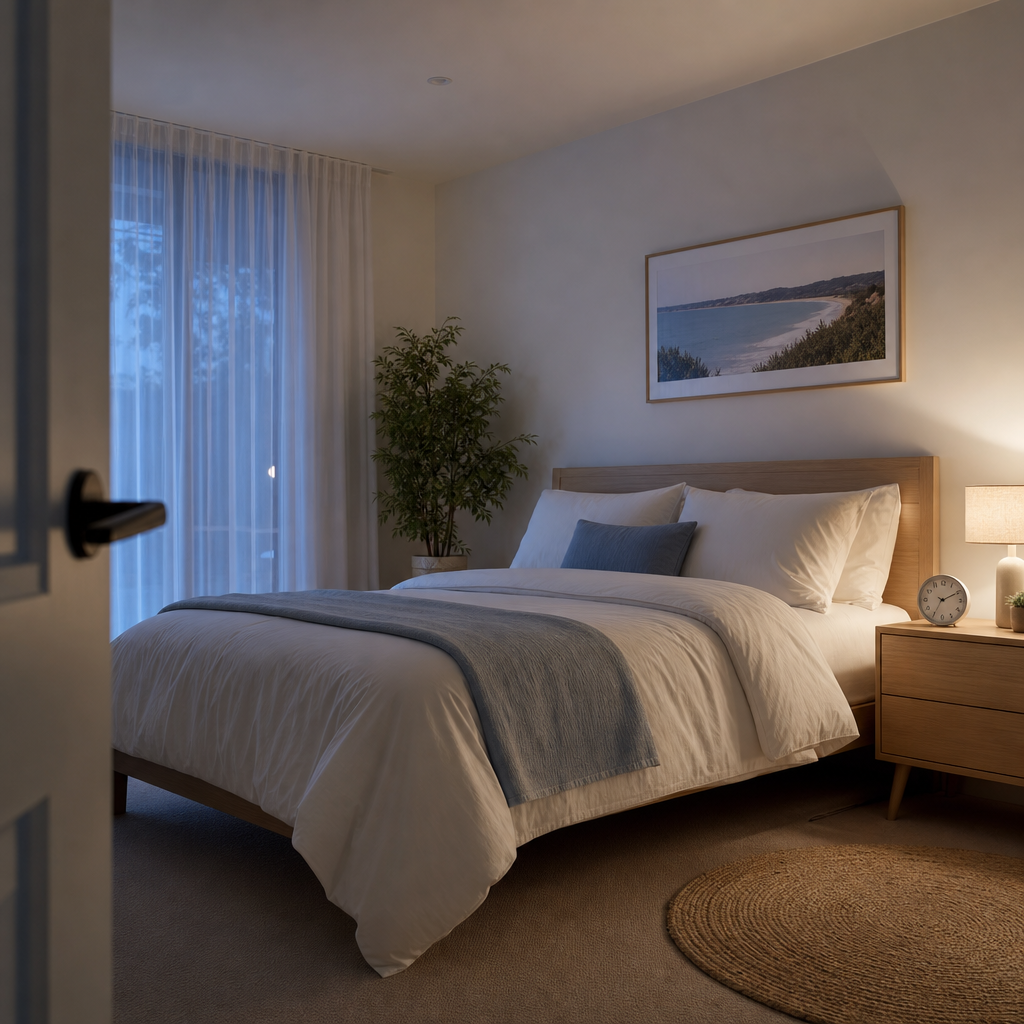
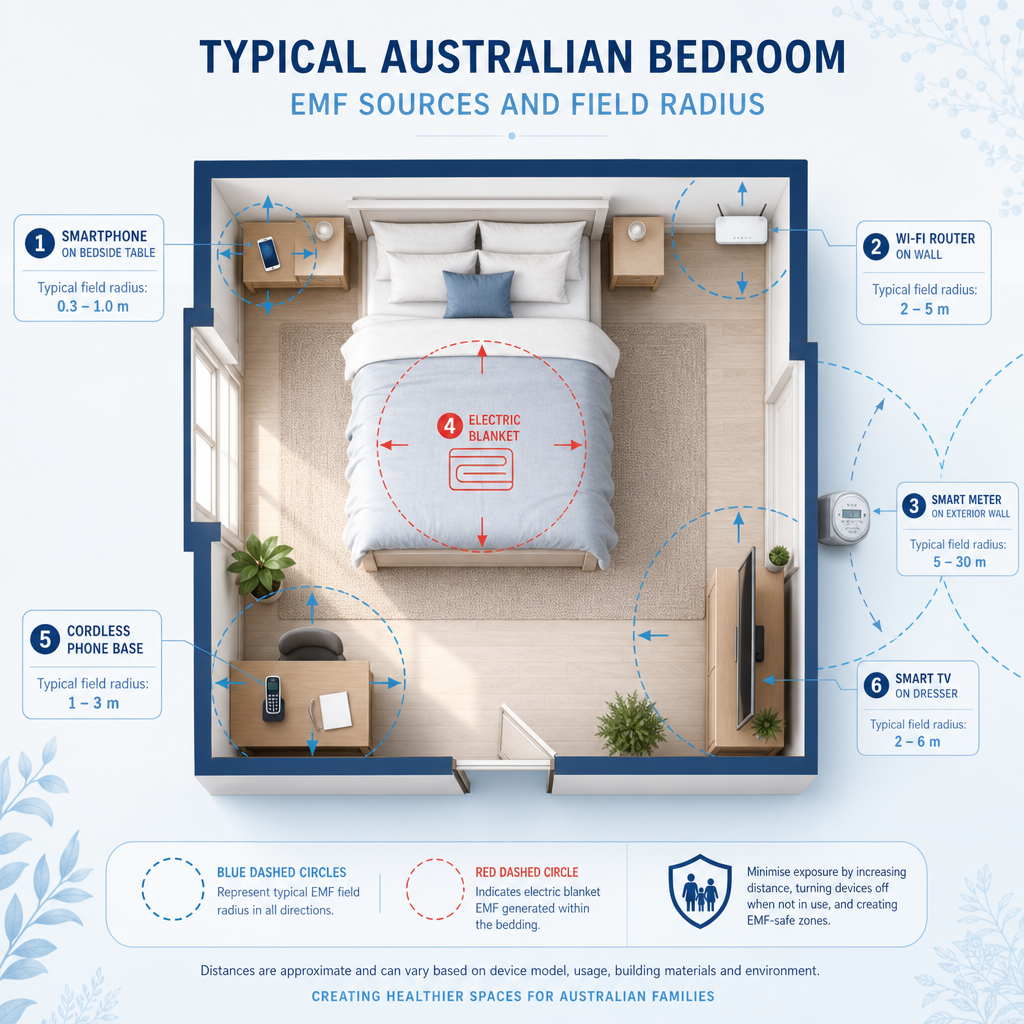
Australians spend roughly 26 years of their lives asleep. That is not a throwaway statistic, it is an argument for treating your bedroom as the most important room in the house from a health perspective. Yet for most people, the bedroom is also the room where the invisible electromagnetic burden is highest: a phone on charge centimetres from your head, a Wi-Fi router broadcasting through the wall, a smart meter on the adjoining exterior, an electric blanket warming the mattress, and a smart TV on standby. All of it running, all night, every night.
The question I hear most often is not "does EMF affect me?" It is "what can I actually do about it?" That is the right question. The goal here is not to frighten you into action but to give you a clear, practical framework for reducing your cumulative daily exposure where it matters most: during the eight hours your body is supposed to be recovering. A low-EMF bedroom is not a fringe idea. It is a logical response to an environment that has changed faster than our biology has.
This guide covers every significant source of bedroom EMF, puts Australian regulatory context around the numbers, gives you a step-by-step reduction plan, explains where neutralisation products fit into a layered strategy, and answers the questions I am asked most often. For overnight phone exposure specifically, see our phone while sleeping guide. For broader context, see EMF protection in Australia or our EMF radiation explainer. By the end, you will have enough to act immediately, and enough to make informed decisions about going further.
Key Takeaways
- The bedroom concentrates multiple simultaneous EMF sources, including the phone charger, router, smart meter, electric blanket, and cordless devices, into the space where your body needs deepest recovery.
- Australian regulatory body ARPANSA sets exposure limits for single devices in isolation, not for the cumulative load of a modern bedroom operating overnight.
- The highest-impact free steps are: moving your phone out of arm's reach or switching to aeroplane mode, placing a router on a timer, and repositioning your bed away from smart meter walls.
- Neutralisation products including the EMF Energy Pillow, Mini EMF Energy Pillows, Aulterra Whole House USB, and Neutralizer Discs provide a second layer of protection that operates where physical separation is impractical — compare the full range on our bedroom EMF products collection page.
- Customers across residential settings report an estimated 60–85% improvement in perceived EMF-related fatigue after applying a layered protection strategy.
- A whole-bedroom checklist approach, covering the phone, router, meter, wiring, and devices, delivers better results than addressing one source in isolation.
Protect your family from EMF exposure
Browse our science-backed neutralizer products.
Shop EMF ProtectionBedroom EMF Sources at a Glance
- Type of Field
- RF + ELF magnetic
- Typical Proximity to Sleeper
- 20-50 cm
- Can You Eliminate or Reduce?
- Yes: move or use aeroplane mode
- Type of Field
- RF (2.4 GHz / 5 GHz)
- Typical Proximity to Sleeper
- 1-6 m
- Can You Eliminate or Reduce?
- Yes: timer or relocate
- Type of Field
- RF + ELF magnetic
- Typical Proximity to Sleeper
- 30-200 cm through wall
- Can You Eliminate or Reduce?
- Partially: reposition bed; disc on meter panel + Whole House USB
- Type of Field
- ELF magnetic
- Typical Proximity to Sleeper
- Direct contact
- Can You Eliminate or Reduce?
- Yes: use to warm, then unplug
- Type of Field
- RF + ELF
- Typical Proximity to Sleeper
- 1-3 m
- Can You Eliminate or Reduce?
- Yes: unplug at wall
- Type of Field
- RF continuous
- Typical Proximity to Sleeper
- 1-5 m
- Can You Eliminate or Reduce?
- Yes: remove from room
- Type of Field
- RF low
- Typical Proximity to Sleeper
- 20-50 cm
- Can You Eliminate or Reduce?
- Yes: replace with battery clock
- Type of Field
- ELF electric
- Typical Proximity to Sleeper
- 30-100 cm
- Can You Eliminate or Reduce?
- Partially: switch off circuits
Why the Bedroom Is the Highest-Priority Room
Most conversations about EMF focus on the device in your hand or the router in your lounge room. That framing misses something important. In the lounge room you are exposed for a few hours and then you move. In the bedroom, you are stationary and largely motionless for seven to nine hours at a stretch, night after night, for decades.
Sleep is the period when the body runs its most intensive repair processes. The glymphatic system, which clears metabolic waste from the brain, is almost exclusively active during deep sleep. Melatonin production peaks in the early hours of the morning in a light-free, low-stimulation environment. Heart rate variability, a marker of autonomic nervous system recovery, is at its most sensitive during sleep. These are exactly the biological functions that research increasingly links to disruption by electromagnetic fields.
A 2007 study published in the journal Pathophysiology by Bioinitiative Working Group contributors found that RF exposure at levels well below ARPANSA's maximum public exposure limits was associated with measurable changes in melatonin production and sleep architecture in a subset of sensitive individuals. A 2018 study in Electromagnetic Biology and Medicine found associations between chronic ELF-EMF exposure and reduced sleep quality, with elevated field levels documented near high-voltage electrical infrastructure.
I am not saying every person who sleeps near a router will develop a sleep disorder. I am saying that the bedroom concentrates multiple simultaneous EMF sources around a body that is running its most vulnerable and essential recovery processes, and that the cumulative daily exposure in that context deserves serious attention.
The Cumulative Load Problem That Regulators Are Not Measuring
ARPANSA (the Australian Radiation Protection and Nuclear Safety Agency) sets exposure limits based on ICNIRP guidelines. Those guidelines are built around single-device, acute exposure scenarios. They ask: what level of output from this one device, for this duration, causes measurable tissue heating in a standard-size adult male? That is a reasonable engineering question for a product safety standard. It is not an adequate model for a person lying in a room with a router, a smart meter, a phone charger, a cordless phone base, and powered wiring in the walls, simultaneously, for eight hours.
Regulatory thresholds are not designed to account for that aggregate load. When I talk about building an EMF safe bedroom, I am working from the position that the relevant measure is the total environmental field your body is sitting inside night after night, not whether each individual device clears its own certification test. That distinction matters enormously when you are deciding how seriously to take this, and how much effort to put into mitigation.
Identifying Your Bedroom EMF Sources: A Practical Audit
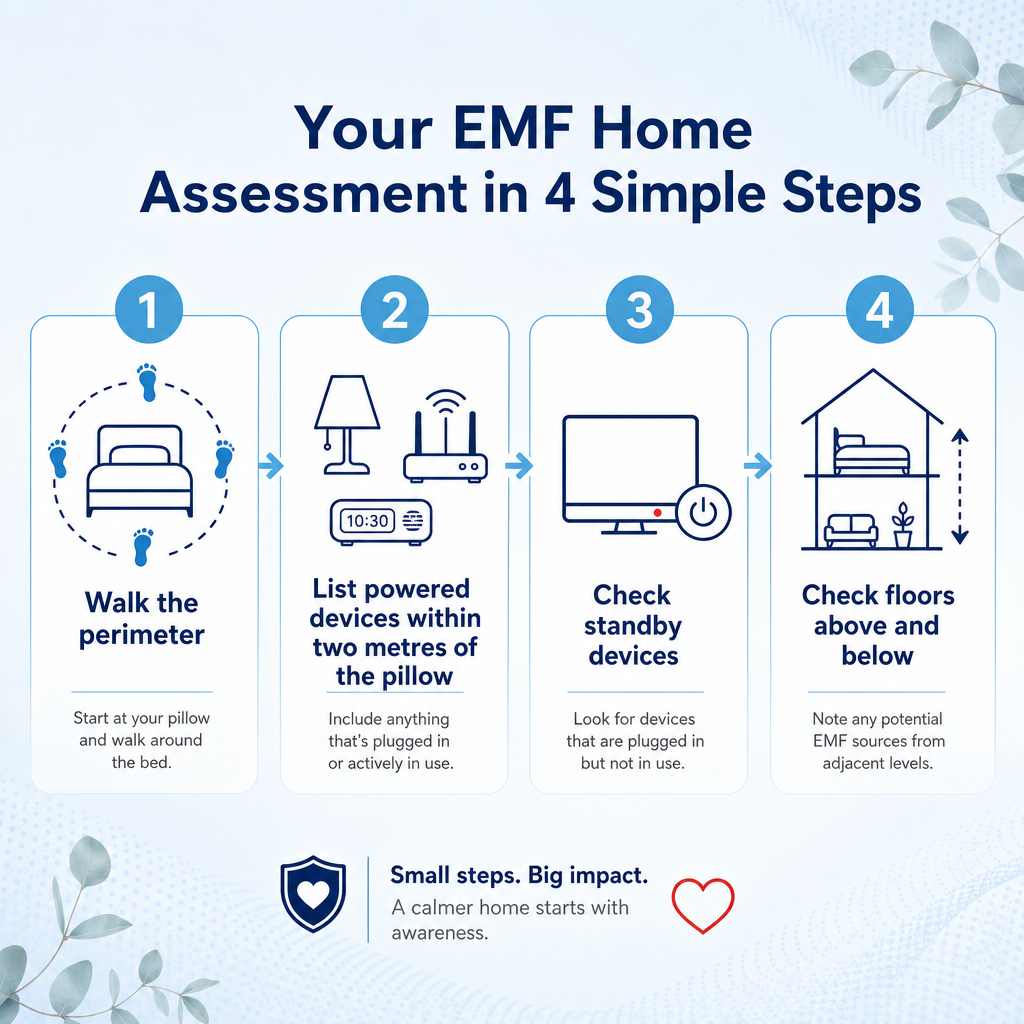
Before you change anything, it helps to know what you are dealing with. A basic bedroom EMF audit takes about fifteen minutes.
Step 1: Walk the perimeter. Identify every wall that is shared with a neighbour, a garage, or an exterior where a smart meter might be located. In Australian homes built or renovated since 2010, smart meters are increasingly standard across most states. Victoria led the rollout, and as of 2026 the majority of Victorian households have interval meters installed. NSW, Queensland, and South Australia are in various stages of rollout. Your smart meter may be broadcasting RF pulses every few minutes to report usage data, and if your bed head is against that external wall, you are sleeping within a metre of it.
Step 2: List every powered device within two metres of your pillow. This typically includes the phone, the charger, a lamp, an alarm clock, and often a television or tablet. In a smaller bedroom, the router may also fall within this radius, especially in apartments where the router is in a hallway or second bedroom directly behind the wall.
Step 3: Check what is running on standby. A smart TV on standby continues to broadcast RF as it listens for remote commands and maintains network connectivity. A Google Home or Amazon Echo on the bedside table is listening continuously. A DECT cordless phone base station transmits a continuous RF signal regardless of whether you are on a call.
Step 4: Think about the floor below and the ceiling above. In a multi-storey home or apartment, a router or smart meter one floor below can still produce measurable field strength at the level of a sleeping body, particularly for ELF magnetic fields which do not attenuate through building materials the way RF fields do.
Once you have this list, you have a prioritised target list. The goal is to address the sources closest to your body first, because field strength follows an inverse square law: halve the distance, quadruple the exposure. That is why the phone on your bedside table matters more than the router in the next room.
Practical Steps to Build a Low-EMF Bedroom
1. The Phone: The Single Biggest Win
The average Australian adult sleeps with their phone within arm's reach. A smartphone actively connected to a cellular network produces RF output throughout the night as it pings towers, syncs apps, receives notifications, and monitors Bluetooth peripherals. When charging, it also produces ELF magnetic fields from the transformer in the charger.
The highest-impact single action you can take is to move the phone to the other side of the room or, better still, out of the room entirely before sleep. If you rely on the phone as an alarm, replace the alarm function with a battery-powered clock and leave the phone in the hallway.
If keeping the phone in the room is non-negotiable, switch it to aeroplane mode before sleep. Aeroplane mode disables cellular, Wi-Fi, and Bluetooth transmission. The device still runs its local processor, but the radiating antenna is off. You can set a morning alarm while in aeroplane mode and it will fire normally.
Applying a Neutralizer Disc directly to the phone adds a layer of neutralisation that works regardless of transmission state. I will come back to how that works in the product section below.
2. The Wi-Fi Router: The Most Overlooked Night-Time Source
A standard home Wi-Fi router broadcasts a continuous RF signal at 2.4 GHz and/or 5 GHz around the clock. Most Australians leave their router on permanently. During daylight hours, that is a reasonable trade-off for convenience. During the seven to nine hours you are asleep, there is no device in your home that needs the internet actively enough to justify a router running at full output.
The most practical solution is a mains timer. A simple mechanical timer plug costs under $20 from any hardware store and will cut the router's power during your sleep window. Set it to go off 30 minutes before your typical bedtime and come back on 30 minutes before you wake. No configuration change on the router is needed, it simply loses and regains power like a brief outage.
If your router has a built-in schedule function, you can use that instead. Most modern routers running firmware from Netgear, TP-Link, or Asus allow you to set wireless broadcast schedules through the admin panel. The router stays powered but stops broadcasting RF during the scheduled window.
For those in apartments where the router cannot be relocated far from the bedroom wall, combining a timer with the Aulterra Whole House USB plugged into a wall outlet via a USB adaptor provides a layered approach that addresses both broadcast hours and the field environment through your home wiring — see our home EMF protection collection for plug-in and stick-on options that pair with it.
3. Smart Meters: What You Can and Cannot Control
This is the source of most frustration, because you largely cannot turn it off. Smart meters in Australia are installed and maintained by distribution network service providers (DNSPs), not by the homeowner. Requesting a non-communicating meter may be possible in some jurisdictions, but it is not guaranteed, and the administrative process can be slow.
What you can control is your proximity to it. If your smart meter is on an external bedroom wall and your bed head is flush against that wall, repositioning the bed even 60-90 centimetres further away produces a meaningful reduction in field strength at the pillow. Aim to have no wall shared between your sleeping position and a smart meter location if possible.
In Victorian homes where the smart meter is in a fixed external enclosure, some occupants have also used dedicated shielding materials on the internal wall surface. This is a more involved and higher-cost intervention, but it can be appropriate in EHS (electromagnetic hypersensitivity) cases.
A common pattern we see: bed head against the exterior smart meter wall, waking unrefreshed despite a full night's sleep. Repositioning the bed 60–90 centimetres away is the first step. Where access allows, applying a Neutralizer Disc to the meter panel and plugging in an Aulterra Whole House USB via a wall outlet completes the layered approach for a source you cannot turn off. Customers in this setup often report improved sleep quality within one to two weeks. Individual results vary.
4. Electric Blankets and Heated Mattress Pads
Electric blankets are common in southern Australian states through winter. An electric blanket in use produces a significant ELF magnetic field across the entire sleeping surface. Because the field source is in direct contact with the body, the exposure is high by definition.
The practical recommendation is to use the blanket to warm the bed before sleep, then unplug it at the wall before you get in. An unplugged blanket produces no field. If you are using a dual-zone electric blanket with controls on the bedside table, the cable and control unit also contribute to the field environment while the device is active.
For those who need continuous overnight warmth, an alternative is a heated water mattress system, which uses a small water pump and heating element remote from the bed and circulates warm water through tubes. These produce much lower ELF magnetic fields at the sleeping surface than resistance-element electric blankets.
5. Wiring in Walls and Powerpoints
Alternating current wiring in Australian homes runs at 50 Hz and produces ELF electric and magnetic fields that radiate outward from the cable and from any powered outlet. These fields drop off relatively quickly with distance, but in a bedroom with a powerpoint strip or extension cord running behind the headboard, the exposure at pillow height can be measurable.
The simplest mitigation is to switch off the relevant circuit breakers for the bedroom at night, or to unplug everything that is not essential. For bedrooms where the circuit also runs lighting and built-in wardrobes, a dedicated isolation switch is a more practical option, and one that electricians in Australia can install relatively inexpensively.
6. Other Devices: The Less Obvious Sources
Baby monitors: DECT baby monitors transmit continuously and at relatively high power levels. Placing the monitor unit more than two metres from the infant's head, or choosing a monitor that only transmits when sound is detected, reduces exposure significantly.
Smart speakers: A Google Nest Mini or Amazon Echo is listening for a wake word continuously, which requires an active RF receiver. These should not be in the bedroom during sleep. If you use a smart speaker as a white noise or music source, consider a simple Bluetooth speaker connected to a phone in aeroplane mode instead.
Gaming consoles on standby: A PlayStation or Xbox in standby mode connects to the internet to download updates and communicates with controllers. These should be switched off at the wall overnight.
Where Neutralisation Products Fit: A Layered EMF Protection Strategy
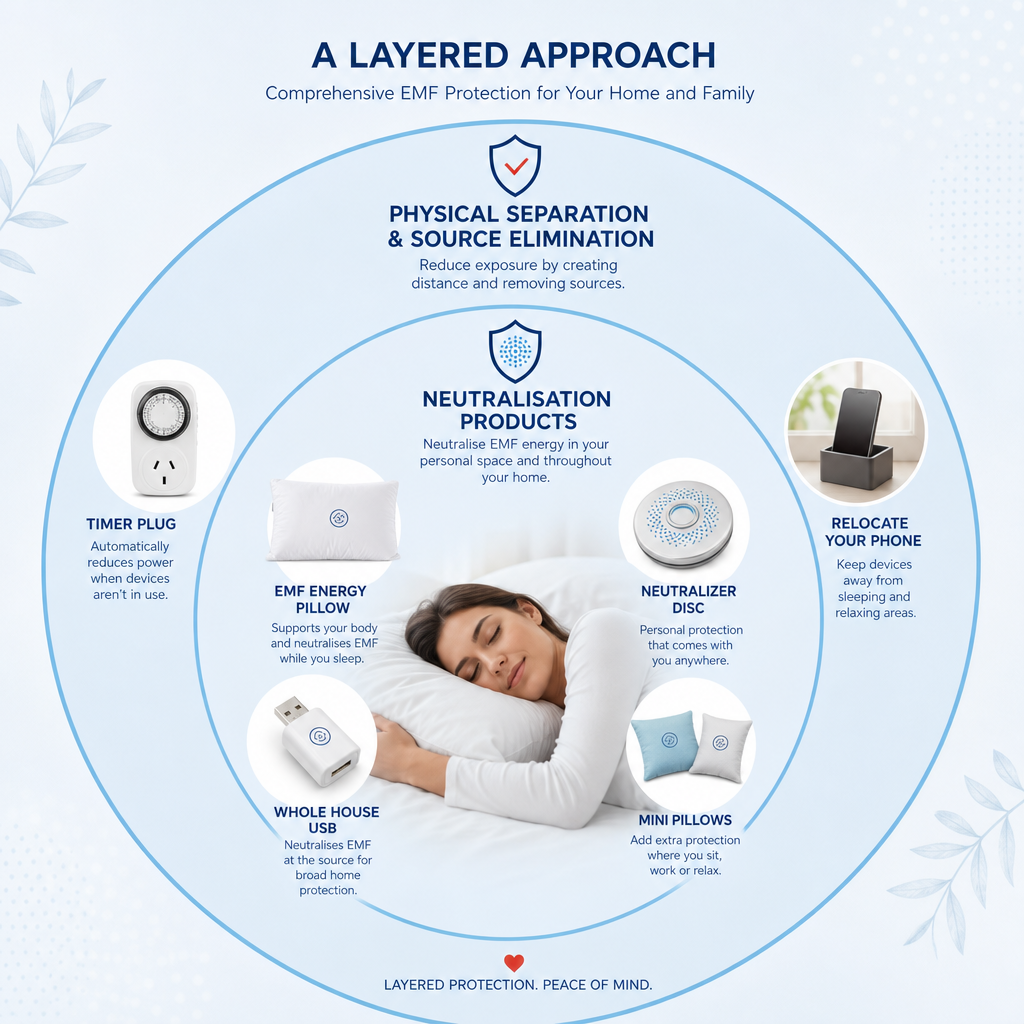
Physical separation and source elimination are the first layer of any good EMF protection plan. They are free, they are effective, and they should be done first. But there are real-world limits. You cannot always move the smart meter. You cannot always relocate the router. In an apartment, you cannot control what your neighbours' devices are doing on the other side of a shared wall. And some devices, like your phone, are genuinely hard to fully separate from if your life and work depend on them.
This is where neutralisation products provide a second, complementary layer. The way I think about it: physical reduction lowers the total field load; neutralisation addresses the fields you cannot eliminate. The science and evidence behind this approach is covered in depth on our website.
The EMF Energy Pillow is commonly used for the sleep environment. It sits under or near your regular pillow and works throughout the night to neutralise the ambient electromagnetic fields in your immediate sleeping space. For a bedroom where source elimination alone is incomplete, the Energy Pillow targets exactly the zone where your body is most vulnerable and most stationary.
The Aulterra Whole House USB plugs into a wall outlet via a USB adaptor. It works through your home's AC wiring to retune incoherent electromagnetic fields toward a more coherent state across the circuit, including fields from plugged-in devices and ambient EMF distributed through the building's electrical framework — without blocking Wi-Fi, mobile signal, or device function. For smart-meter concerns, use it alongside a Neutralizer Disc on the meter panel: the disc targets the point source; the USB supports broader whole-home coverage. Any switched-on outlet on the circuit works; many customers place it near the meter or in a central living area.
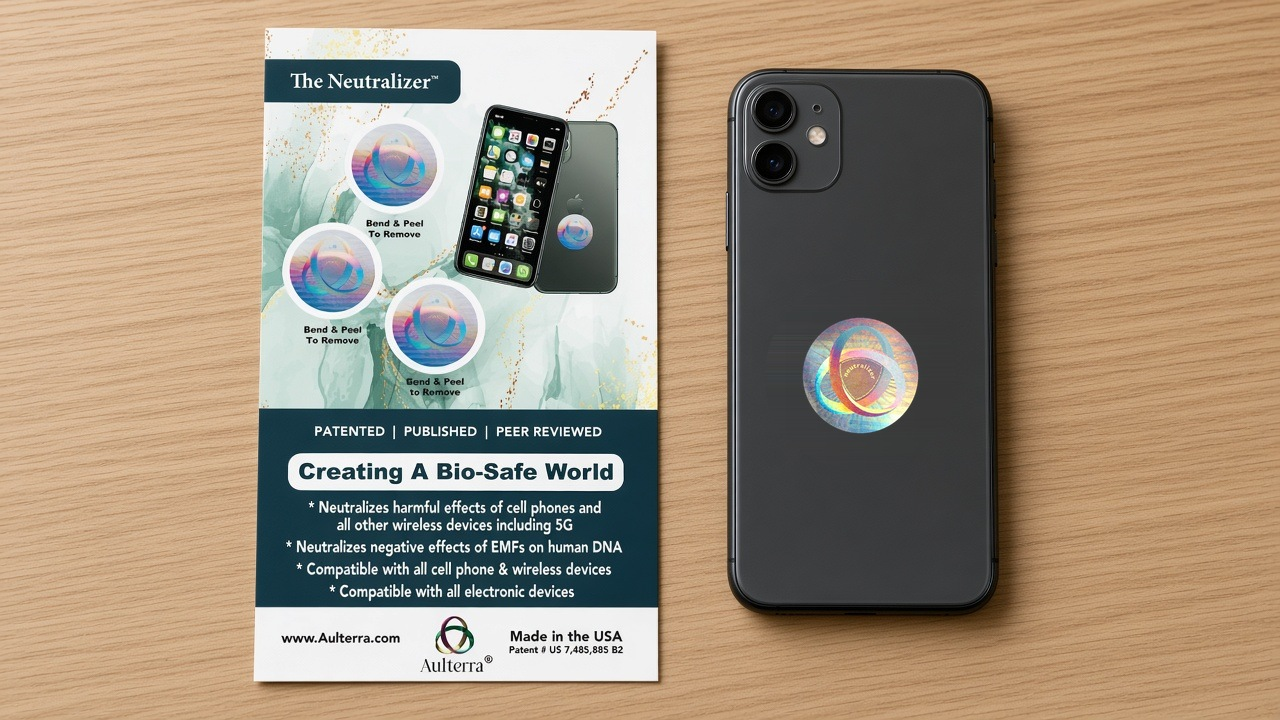
Neutralizer Discs are applied directly to individual devices: the phone, the router, the smart TV, the tablet, and the smart meter panel or switchboard where access allows. They are thin enough to be unobtrusive and remain effective indefinitely with normal care, provided they stay firmly attached and undamaged. For a bedside phone that you genuinely cannot remove from the room, a Disc on the back of the handset is a practical first line of defence. For a smart meter on the bedroom wall you cannot relocate, a Disc on the meter panel addresses the source at the point of emission.
The pattern I recommend across residential cases combines all four layers: Energy Pillow at the sleep surface, Discs on each bedside and in-room device plus the smart meter panel where practical, a Whole House USB plugged into a wall outlet via a USB adaptor, and Mini Pillows near any specific concentrated sources. Customers who take this whole-room approach rather than addressing one device at a time consistently report better outcomes. Across residential use cases, the estimated improvement in perceived EMF-related fatigue following a layered product strategy runs at 60–85% based on qualitative customer outcome descriptions. Individual results vary.
Your Complete Bedroom EMF Reduction Checklist
- Action
- Move to other side of room or out of room at night
- Priority
- High
- Cost
- $0
- Action
- Switch to aeroplane mode if keeping bedside
- Priority
- High
- Cost
- $0
- Action
- Apply Neutralizer Disc
- Priority
- High
- Cost
- Low
- Action
- Put on mains timer or set schedule to switch off during sleep
- Priority
- High
- Cost
- $0-$20
- Action
- Plug in Aulterra Whole House USB (wall outlet via USB adaptor)
- Priority
- Medium-High
- Cost
- Medium
- Action
- Reposition bed at least 60 cm further from meter wall
- Priority
- High
- Cost
- $0
- Action
- Apply Neutralizer Disc to meter panel (where access allows)
- Priority
- Medium-High
- Cost
- Low
- Action
- Warm bed, then unplug before sleep
- Priority
- High
- Cost
- $0
- Action
- Unplug at wall overnight
- Priority
- Medium
- Cost
- $0
- Action
- Remove from bedroom
- Priority
- Medium
- Cost
- $0
- Action
- Remove from bedroom
- Priority
- Medium
- Cost
- $0
- Action
- Switch off non-essential circuit breakers or unplug powerboards
- Priority
- Medium
- Cost
- $0
- Action
- Add EMF Energy Pillow under or near pillow
- Priority
- High
- Cost
- Medium
- Action
- Switch off at wall, not standby
- Priority
- Low-Medium
- Cost
- $0
- Action
- Position more than 2 m from infant's head
- Priority
- High (if applicable)
- Cost
- $0
ARPANSA, Regulatory Context, and What It Means for You
ARPANSA publishes its Radiation Protection Standard for Maximum Exposure Levels to Radiofrequency Fields based on ICNIRP guidelines. For the general public, the reference level for RF fields at 900 MHz (the frequency of many cellular transmissions) is 450 microwatts per square centimetre (uW/cm2). At 2.4 GHz (standard Wi-Fi), it is 1000 uW/cm2. Most home devices produce field strengths measured in tenths or hundredths of uW/cm2 at typical distances, which is why regulators say individual devices are safe.
Here is the problem with that framing. A router at 0.1 uW/cm2 plus a phone at 0.1 uW/cm2 plus a smart meter at 0.05 uW/cm2 plus a TV on standby at 0.02 uW/cm2, operating simultaneously and continuously for eight hours, is not the same biological situation as a single device at 0.27 uW/cm2 for a few seconds. The body does not experience them independently, and the regulatory framework was not designed to model that combined scenario.
I want to be clear about the state of the evidence: the research on low-level chronic EMF exposure and health outcomes is genuinely contested. There are well-designed studies showing associations with disrupted sleep architecture and biological markers, and there are well-designed studies that find no effect. The science is not settled in the way that, say, the science on cigarette smoke is settled. What I can say with confidence is that the argument for caution in the bedroom, the place of maximum stationary exposure, is strong even under a conservative reading of the evidence. And the cost of the mitigation steps I have described is minimal.
Taking the Next Step
Building an EMF safe bedroom is not a single purchase or a single afternoon's work. It is a series of deliberate decisions about your immediate environment, starting with the free and easy wins and building toward a layered protection strategy that covers the sources you cannot eliminate through distance alone.
EMF Neutralizer products are not a cure for any medical condition. If you are experiencing persistent symptoms that concern you, see a general practitioner. The improvements people describe are their subjective experience after reducing or neutralising their EMF load. Individual results vary.
Your home should work with you, not against you. The bedroom is the place to start.
References
-
ARPANSA, Radiation Protection Standard for Maximum Exposure Levels to Radiofrequency Fields (RPS S-1) — Primary Australian regulatory document setting public exposure limits for RF fields based on ICNIRP guidelines.
-
BioInitiative Report: A Rationale for a Biologically-based Public Exposure Standard for Electromagnetic Fields — Compilation of peer-reviewed studies on biological effects of EMF below regulatory thresholds, including sleep disruption and melatonin pathways cited in the Pathophysiology (2007) literature.
-
Pall, M.L. (2016). "Microwave frequency electromagnetic fields (EMFs) produce widespread neuropsychiatric effects including depression." Journal of Chemical Neuroanatomy, 75(B), 43-51 — Peer-reviewed study examining neurological effects of non-ionising EMF, including impacts on sleep architecture and melatonin production.
-
Australian Energy Regulator, smart meter rollout hub — AER guidance and reporting on accelerated smart meter deployment across Australian distribution networks, including Victoria's advanced rollout status.
-
Hosseinabadi, M.B. et al. (2018). "The effect of chronic exposure to extremely low-frequency electromagnetic fields on sleep quality, stress, depression and anxiety." Electromagnetic Biology and Medicine, 38(2), 96-101 — Cross-sectional study finding poorer sleep quality among workers with chronic ELF-EMF exposure; relevant to prolonged overnight exposure near electrical infrastructure.
-
WHO, Electromagnetic Fields and Public Health: Electromagnetic Hypersensitivity — WHO position on EHS, acknowledging reported symptoms while noting contested evidence for direct causal links to EMF fields.
Stay informed on EMF wellness
Get practical tips and product updates in your inbox.
Frequently asked questions
What does our "emf protection bedroom australia better sleep" guide identify as the biggest EMF source in an Australian bedroom?
This guide identifies the smartphone on charge at the bedside as the single highest-impact EMF source for most Australians — combining RF transmission from cellular and Wi-Fi antennas with ELF magnetic fields from the charging transformer, all within centimetres of the head. The Wi-Fi router is the second most significant source, particularly when it is in an adjacent room or hallway with no power schedule applied.
Does a Wi-Fi router really produce significant EMF while you sleep?
Yes. A standard home router broadcasts a continuous RF signal at 2.4 GHz and 5 GHz regardless of whether any device is actively using the connection. Over a seven to eight hour sleep period, this constitutes a substantial portion of your total cumulative daily exposure. Putting the router on a timer to switch off during sleep hours is one of the most cost-effective changes you can make.
Are smart meters dangerous to sleep near?
ARPANSA and the networks that install smart meters state that the RF output from smart meters falls well below regulated exposure limits. The practical concern for bedroom health is that the meter may be on a wall directly behind your bed head, producing RF pulses every few minutes throughout the night, and its output combines with every other source in the room. Repositioning the bed away from the meter wall is a simple precaution that costs nothing. Where access allows, pairing a Neutralizer Disc on the meter panel with an Aulterra Whole House USB plugged into a wall outlet via a USB adaptor addresses what repositioning alone cannot.
What is electromagnetic hypersensitivity (EHS) and is it recognised in Australia?
Electromagnetic hypersensitivity (EHS) refers to a reported condition in which individuals experience physical symptoms they attribute to exposure to electromagnetic fields. The World Health Organization acknowledges that EHS symptoms are real and can be disabling, while noting that scientific evidence for a direct causal link to EMF exposure is not yet established. In Australia, individuals with severe EHS may be entitled to disability accommodations depending on the nature and severity of their symptoms.
How do EMF neutralisation products work?
As explained on our How it works page, EMF neutralisation products work by retuning incoherent electromagnetic fields toward a more coherent state, reducing disruptive biological interaction rather than blocking the signal. In a bedroom, the EMF Energy Pillow sits under or beside your regular pillow to neutralise ambient fields at head height; Neutralizer Discs stick to the phone, router, smart TV, tablet, and smart meter panel or switchboard where you can reach them. The Aulterra Whole House USB plugs into a wall outlet via a USB adaptor and works through the home's electrical wiring to address fields propagating through the circuit environment.
Can I use my phone as an alarm and still reduce bedroom EMF?
Yes. The simplest solution is to set your alarm and then switch the phone to aeroplane mode before sleep. The alarm function operates locally and does not require network connectivity, so it will fire normally in the morning even with all antennas disabled. Alternatively, replacing the phone alarm with a battery-powered clock and leaving the phone in the hallway is the most thorough option.
How much can I expect my sleep to improve by reducing bedroom EMF?
Outcomes vary depending on individual sensitivity and the extent of the changes made. Across our residential customer base, those who implement a layered approach combining source reduction with EMF neutralisation products report an estimated 60–85% improvement in perceived EMF-related fatigue. Sleep quality improvements including faster sleep onset and fewer night-time wakenings are among the outcomes most commonly described. Individual results vary.
Is it worth testing my bedroom with an EMF meter before buying any products?
A basic EMF meter can be a useful starting point for identifying the highest-output sources in your specific room. Entry-level meters capable of detecting both RF and ELF magnetic fields are available in Australia for $80-$300. That said, the practical reduction steps in this guide, particularly moving the phone and timing the router, are so low-cost and high-impact that most people benefit from acting on them immediately without waiting for meter readings.

Richard Kent
Science-backed EMF wellness education from the EMF Neutralizer team.
Related articles
EMF Levels Inside Cars Australia: What Drivers Need to Know
EMF levels in cars come from several sources at once: low-frequency magnetic fields from wiring, motors and batteries in every vehicle type, plus radiofrequency…

Electric Vehicle EMF Exposure Australia: What EV Drivers Should Know About In-Car Fields
Published measurements generally place electric vehicle magnetic fields within ICNIRP and ARPANSA reference levels, so there is no regulatory basis for alarm. F…
How to Apply EMF Neutraliser Disc: A Step-by-Step Guide for Phones and Home Devices
To apply an Aulterra EMF neutraliser disc, clean and dry the back of your phone, peel the disc, and press it on firmly, clear of camera lenses and ports, then f…