EMF From Phone While Sleeping Australia: Should You Keep It in the Bedroom? (2026)
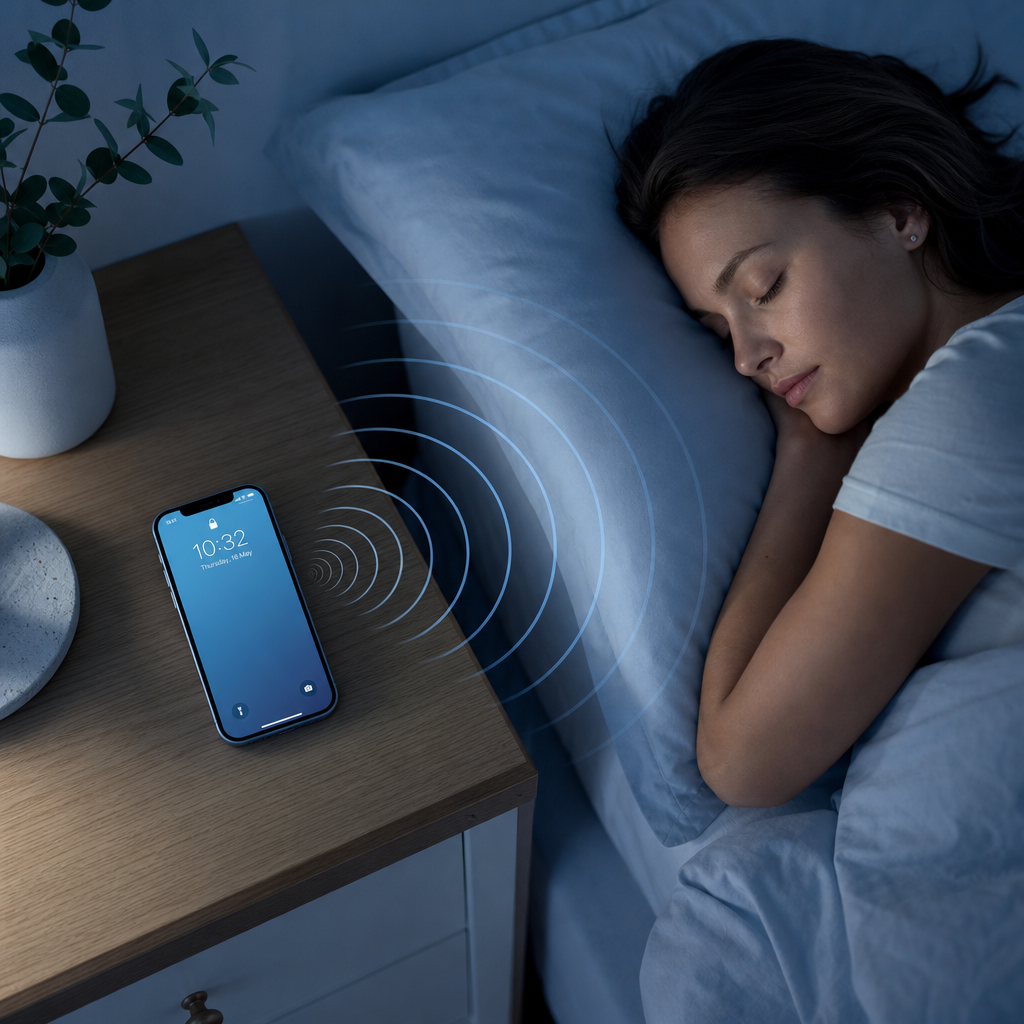
Most Australians charge their phone on the bedside table. It is one of those habits that crept in without a deliberate decision: the phone became the alarm clock, then the last thing checked before sleep, then the first thing reached for in the morning. Surveys suggest a large majority of Australian adults keep their smartphone within arm's reach while they sleep. That bedside device does not go quiet when you close your eyes. It continues to communicate with cell towers, exchange Wi-Fi packets with your router, and ping Bluetooth devices throughout the night.
The question I get asked constantly is: does any of that matter? Is the electromagnetic field (EMF) your phone produces at night genuinely affecting your sleep, your health, or your energy levels? The honest answer is more nuanced than the mainstream conversation usually allows. Official Australian regulators state that phones operating within approved limits pose no proven risk. That position is technically accurate for single-device, short-term exposure. Where it falls short is in accounting for the reality most Australians actually live: a bedroom containing a smartphone, a Wi-Fi router active all night, possibly a smart TV, a smart meter on the other side of the wall, and Bluetooth earbuds on the charging dock. Cumulative daily exposure across multiple simultaneous sources is a different scenario from the one regulators test for, and it is the one your body is actually dealing with.
This guide covers what your phone is actually emitting at night, what the science and ARPANSA say (including the honest caveats), why your bedroom environment specifically matters for sleep biology, and the practical steps you can take right now to reduce your exposure. Whether you are a sceptic taking a first look or someone who has already noticed a difference when you change your bedroom setup, the information here will help you make an informed decision about your own environment. For product choices by setting, see our EMF protection guide.
The products discussed here are environmental wellbeing products. Claims in this guide describe general wellbeing support based on documented customer experiences and published research—not therapeutic outcomes regulated by the TGA in Australia, and not a substitute for medical advice or treatment.
Key Takeaways
- Your phone emits radiofrequency (RF) radiation, Bluetooth signals, and Wi-Fi pulses throughout the night, even when the screen is off.
- ARPANSA sets limits based on thermal effects from single devices. Chronic, combined exposure from multiple sources is not covered by the same framework.
- Peer-reviewed studies have reported associations between RF-EMF exposure near the head during sleep and reduced melatonin production and disrupted sleep architecture.
- Behavioural changes—more distance, less overnight RF from your phone and router—cost nothing and often matter most before you buy anything.
- Aulterra-based neutralising products work by altering the coherence of EMF fields rather than blocking signals, making them compatible with device functionality.
- Small, deliberate changes to your bedroom environment can produce reported differences in sleep quality and how you feel the next day.
Protect your family from EMF exposure
Browse our science-backed neutralizer products.
Shop EMF ProtectionSummary Table: Phone Placement Scenarios and Their EMF Impact
- RF Exposure Level
- Very high (proximity effect)
- Bluetooth/Wi-Fi Active
- Yes
- Melatonin Risk
- High
- Practical Disruption
- Alarm function retained
- RF Exposure Level
- Moderate-high
- Bluetooth/Wi-Fi Active
- Yes
- Melatonin Risk
- Moderate-high
- Practical Disruption
- Alarm function retained
- RF Exposure Level
- Low
- Bluetooth/Wi-Fi Active
- Yes (reduced)
- Melatonin Risk
- Low-moderate
- Practical Disruption
- Alarm still audible
- RF Exposure Level
- Low (residual EMF from hardware)
- Bluetooth/Wi-Fi Active
- No
- Melatonin Risk
- Low
- Practical Disruption
- Alarm retained; no overnight calls
- RF Exposure Level
- Very low
- Bluetooth/Wi-Fi Active
- No
- Melatonin Risk
- Very low
- Practical Disruption
- Alarm audible; no overnight calls
- RF Exposure Level
- Moderate signal present but bioactive coherence altered
- Bluetooth/Wi-Fi Active
- Yes (field coherence altered; signal still present)
- Melatonin Risk
- Reduced
- Practical Disruption
- Full device function retained
What EMF Does Your Phone Actually Emit at Night?
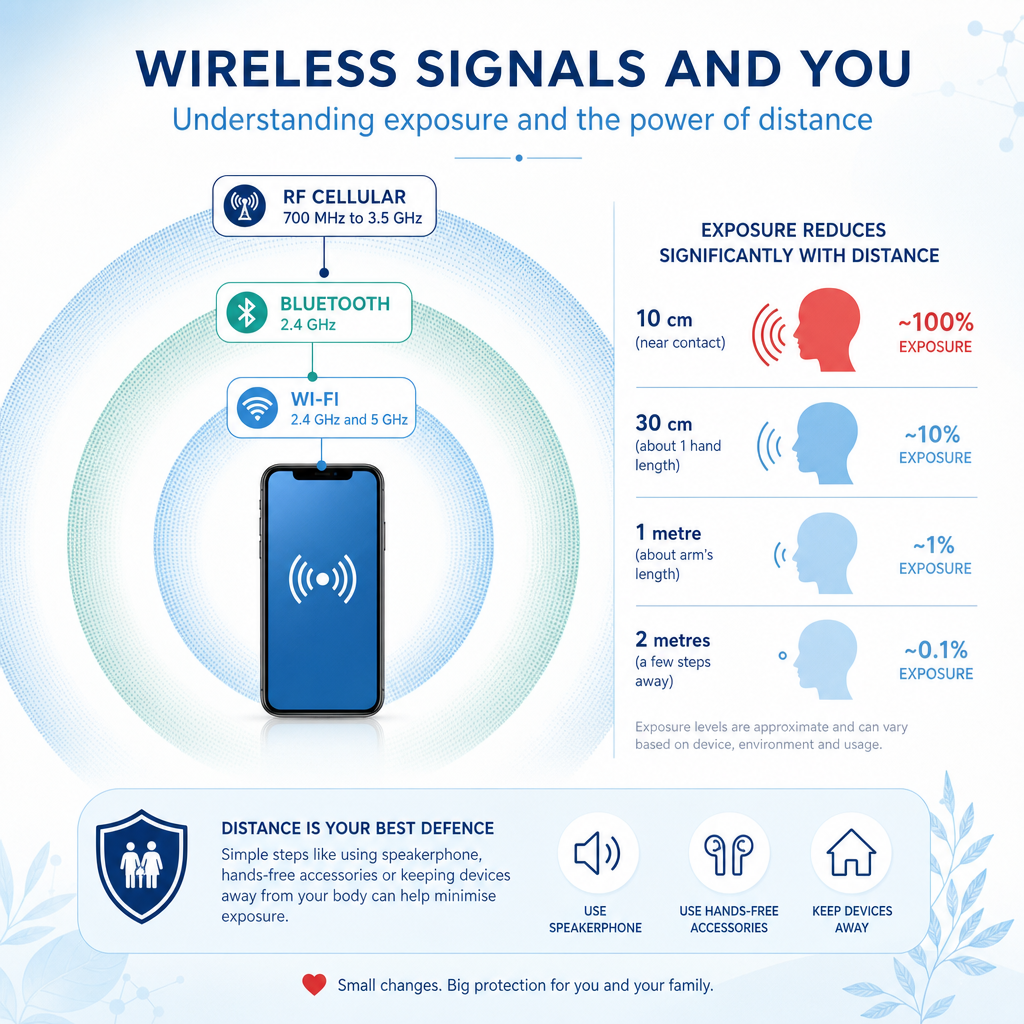
When people talk about phone radiation, they are usually referring to three distinct types of electromagnetic field output. Understanding each one matters because they behave differently and require different mitigation strategies. For a broader primer on how EMF is classified and measured in Australian homes, see our What Is EMF Radiation explainer.
Radiofrequency Radiation (RF)
Your phone communicates with mobile cell towers using radiofrequency radiation, typically in frequency bands between 700 MHz and 3.5 GHz for current 4G/5G networks operating in Australia. This communication does not stop when your screen locks. Throughout the night, your phone performs what are called "background tasks": checking for messages, syncing email, reporting its location to apps with location access enabled, and maintaining its connection to the network. Each of these tasks triggers a burst of RF transmission.
The intensity of that RF output varies based on how far your phone is from the nearest cell tower. A phone struggling to maintain signal in a building with poor coverage will transmit at higher power than one sitting next to a strong tower signal. This is a point most people overlook: the weaker your indoor coverage, the harder your phone works to connect, and the more RF it emits. If you live in a suburb with patchy mobile coverage, your bedside phone may be transmitting at or near its maximum output all night.
The specific absorption rate (SAR) is the measure used to express how much RF energy body tissue absorbs per kilogram. ARPANSA's limit is 2 W/kg averaged over 10 grams of tissue, consistent with the ICNIRP guidelines Australia follows. Most current Australian-market phones operate below this threshold under standard use. The critical qualifier there is "standard use": SAR values are tested at a specific distance from the body, not with the phone on your pillow or pressed against your head for eight hours.
Bluetooth
Bluetooth operates at 2.4 GHz and uses frequency hopping across 79 channels. Its output power is significantly lower than cellular RF (typically 1-100 mW compared to up to 2W for cellular), but it is continuously active if your phone is paired with any devices, including wireless earbuds sitting in a charging case nearby, a smart speaker, or a fitness tracker on your wrist. That low-level constant signal is not zero, and proximity matters significantly: signal strength falls with the square of distance, so a Bluetooth-active phone two centimetres from your head is delivering far more energy to your brain tissue than one sitting two metres away.
Wi-Fi
If your phone has Wi-Fi enabled overnight, it maintains an active connection to your home router, again transmitting and receiving data continuously for background app tasks. Wi-Fi operates at 2.4 GHz or 5 GHz. In a standard Australian home where the router runs through the night, the phone contributes to a two-way EMF conversation that neither party stops until you intervene.
The combined picture: a phone on your bedside table with cellular, Wi-Fi, and Bluetooth all active is not a passive device. It is an active transmitter maintaining multiple simultaneous wireless connections throughout the eight hours you are supposed to be recovering.
What ARPANSA Says (and What the Caveats Actually Mean)
ARPANSA, the Australian Radiation Protection and Nuclear Safety Agency, is the federal body responsible for setting radiation limits in Australia. Their official position is that there is no established evidence of health effects from the use of mobile phones complying with the Australian Standard (which references ICNIRP limits). They recommend following international guidelines and acknowledge that research is ongoing.
That is an accurate summary of the regulatory position, and I am not going to misrepresent it. What I will point out is what that position does not cover.
First, regulatory limits are designed around acute exposure from a single device. The testing protocol for SAR values does not model someone lying in a room with a cellular phone, an active Wi-Fi router, Bluetooth devices, and a smart meter running simultaneously for eight hours. The aggregate electromagnetic environment of a modern Australian bedroom is not what the safety frameworks were designed to assess.
Second, the IARC (International Agency for Research on Cancer, part of the WHO) classified radiofrequency electromagnetic fields as "possibly carcinogenic to humans" (Group 2B) in 2011, a classification that has not been downgraded since. In 2024, the IARC's updated review of the evidence maintained scientific interest in the long-term effects of chronic low-level RF exposure, particularly on sleep and neurological function. The research remains active precisely because the question is not fully settled.
Third, the regulatory threshold is set for thermal effects, meaning the level at which RF can heat body tissue. Non-thermal biological effects, including impacts on melatonin synthesis, cellular stress responses, and sleep architecture, are a separate category of research that is not addressed by the current SAR framework. This does not mean those effects are proven at everyday exposure levels. It means the threshold was not designed to account for them.
My position, based on years of working with Australians on their home EMF environments, is that the cumulative daily exposure from multiple simultaneous sources is the relevant measure. The invisible electromagnetic burden in a modern bedroom is not a single device operating within limits. It is a layered accumulation that the body responds to even when each individual source clears regulatory thresholds.
Why Your Bedroom EMF Environment Specifically Matters for Sleep
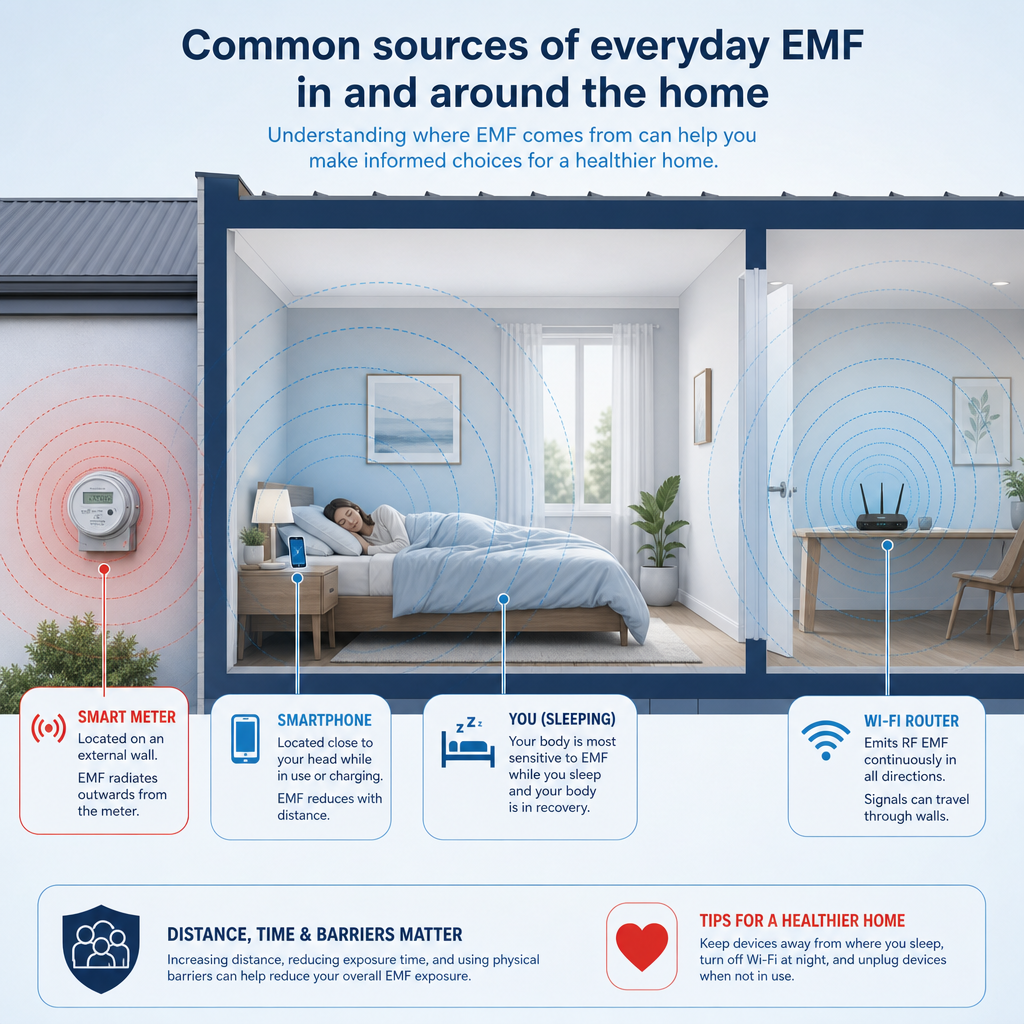
The bedroom is the most biologically sensitive space in your home, because sleep is when your body performs its most critical repair and regulatory functions. The connection between EMF exposure and sleep quality operates through several mechanisms, and the melatonin pathway is the most robustly studied.
Melatonin Suppression
Melatonin is produced by the pineal gland in response to darkness and is the primary signal your body uses to initiate and regulate sleep. The pineal gland is exquisitely sensitive to electromagnetic fields. Multiple peer-reviewed studies, including work published in the journal Bioelectromagnetics and research reviewed in a 2023 meta-analysis, have found associations between RF-EMF exposure and suppressed melatonin production. The biological mechanism proposed involves the disruption of radical pair chemistry in the pineal gland by oscillating magnetic fields, which interferes with the enzyme processes that convert serotonin into melatonin.
Lower melatonin does not just mean difficulty falling asleep. It means lighter, less restorative sleep, reduced immune function overnight, and impaired cellular repair processes that depend on deep sleep stages to operate. In the long term, chronically suppressed melatonin has been associated with elevated cancer risk in research literature, which is one reason the IARC classification of RF fields is taken seriously by researchers even if it remains contested in mainstream consumer conversation.
Sleep Architecture Disruption
Beyond melatonin, studies measuring brain activity during sleep in environments with active RF exposure have found changes in EEG patterns, particularly reduced slow-wave sleep (the deep, physically restorative stage) and altered REM sleep duration. A 2022 study from the journal Sleep Medicine Reviews examining thirteen controlled studies found that while results were mixed, the majority of higher-quality studies showed some measurable effect of RF-EMF exposure on sleep architecture, particularly when exposure occurred during the first sleep cycle.
The Cumulative Load Your Body Carries Overnight
Here is the point that does not get enough attention in mainstream articles about phone safety. Your phone is not your only overnight EMF source. In most Australian homes, the bedroom EMF environment includes:
- The active Wi-Fi router (often in a central location, transmitting through walls).
- A smart meter on the external wall, transmitting usage data to the network at regular intervals (typically every 30 minutes but sometimes more frequently).
- Any smart appliances in adjacent rooms maintaining their wireless connections.
- Powerline wiring running through the walls generating extremely low frequency (ELF) magnetic fields.
The phone on your bedside table is adding to this existing load, not creating it from scratch. That is why addressing bedroom EMF requires a layered approach rather than a single fix.
One Reported Bedroom Experience
One of the clearest illustrations I have seen of bedroom EMF impact on sleep involved a customer in her late forties who came to me after years of struggling with what she described as "never feeling rested, regardless of how long she slept." She had also experienced persistent low-grade headaches throughout the day. Her bedroom setup: smartphone charging on the bedside table, Wi-Fi router in the adjacent room, smart meter on the shared wall with her neighbour. She introduced three changes simultaneously: an Aulterra-based EMF Energy Pillow positioned under her pillow, aeroplane mode on her phone at night, and a router timer that cut the Wi-Fi from 10 pm to 6 am. Within four weeks, she reported sleeping through the night consistently for the first time in years and described her mornings as "a different experience entirely." Her headache frequency dropped substantially. She attributed the change to the combination of steps rather than any single one, which reflects how layered EMF protection actually works in practice. Individual results vary — this is one reported account, not a controlled clinical trial. Persistent sleep problems and daily headaches have many possible causes; if you are experiencing something similar, it is worth discussing your symptoms with your GP or another qualified health professional alongside any changes to your bedroom environment.
Practical Steps to Reduce Bedroom EMF at Night
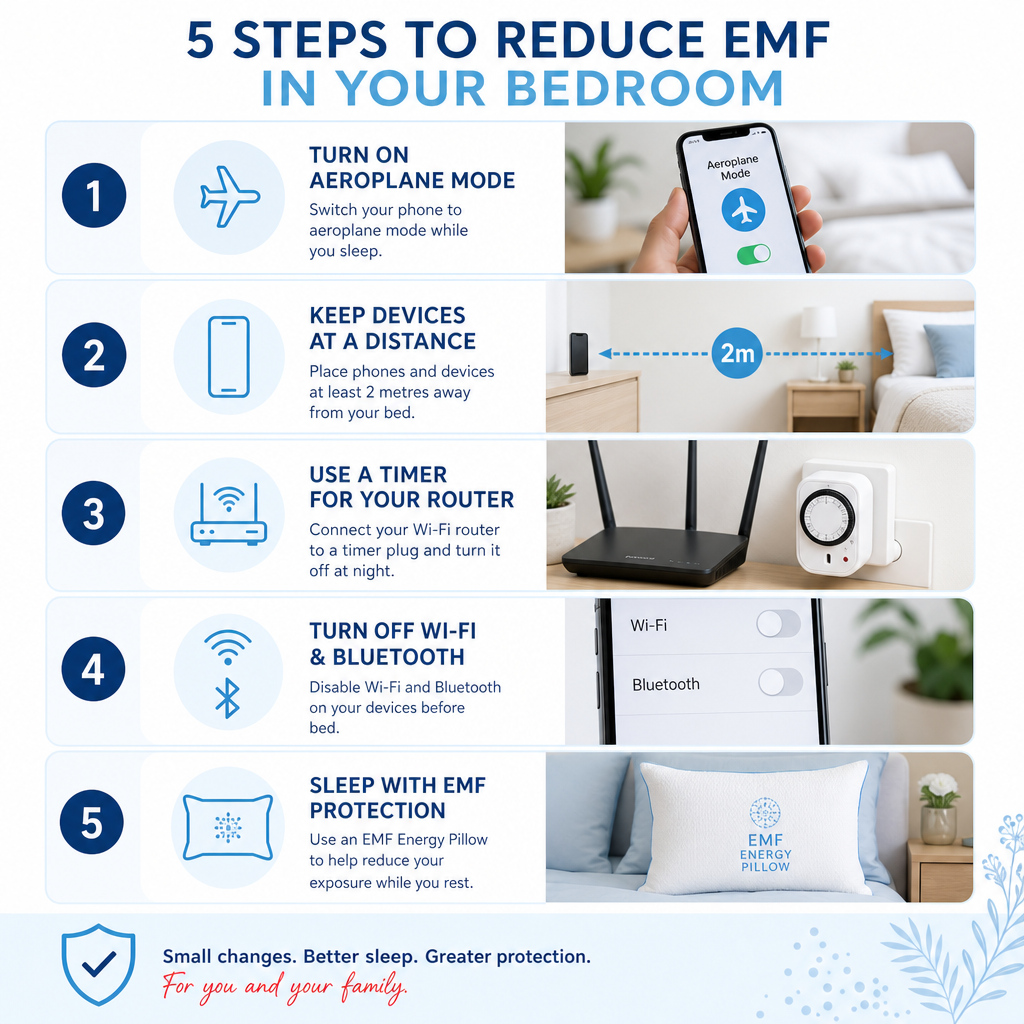
The infographic above summarises five high-impact steps; the written guide that follows adds a sixth — repositioning your bed away from a smart meter on an adjacent wall — which the graphic does not show.
Reducing your overnight EMF exposure does not require expensive equipment or a complete bedroom overhaul. The most impactful steps are straightforward and cost nothing beyond a few minutes of setup.
Step 1: Use Aeroplane Mode
Switching your phone to aeroplane mode before sleep disables all cellular, Wi-Fi, and Bluetooth transmissions. This is the single most effective step for reducing phone-specific EMF exposure overnight. Your phone's alarm function continues to work in aeroplane mode. For most people who do not need overnight calls, it is the simplest high-impact step. If you are on call for work, this option may not be available to you, which is where the combination of increased distance and neutralising products becomes more relevant.
Step 2: Move the Phone Across the Room
If aeroplane mode is not practical, distance is your next most powerful tool. EMF intensity decreases with the square of distance. A phone two metres from your head delivers a fraction of the exposure of one on your pillow. Use a separate alarm clock (a $15 investment from any Australian hardware store) and charge your phone across the room. Even this single change meaningfully reduces your overnight RF exposure.
Step 3: Use a Router Timer
Your Wi-Fi router transmits continuously unless you intervene. A simple plug-in timer switch (available at Bunnings or any electrical retailer for $15-30) set to cut power to the router at your bedtime and restore it in the morning eliminates overnight Wi-Fi transmission from one of the highest-output EMF sources in your home. This has the added benefit of extending your router's lifespan.
Step 4: Disable Wi-Fi and Bluetooth on Devices
If a timer is not practical, manually disabling Wi-Fi and Bluetooth on your phone before sleep achieves a similar result. This can be done through the control centre on both iOS and Android devices in seconds. Note that some apps will re-enable these connections at scheduled sync times unless background app refresh is also disabled.
Step 5: Consider Your Smart Meter Position
Smart meters are installed by energy retailers across Australia and are not something you can easily remove. However, if your smart meter is on the wall adjacent to your bedroom, repositioning your bed away from that wall can reduce your exposure to the ELF and RF fields the meter generates. This is a simple, no-cost adjustment that many people overlook.
Step 6: Apply Aulterra-Based Neutralising Products
The steps above reduce overnight RF transmission from your phone and router where you can control it. Neutralising products take a complementary approach: they alter how the EMF that remains interacts with biological tissue, without blocking or interfering with device signals.
For devices you want to keep functional overnight (the phone that needs to be reachable, the router that serves the household), Aulterra-based products offer a practical addition to distance and mode changes. I will explain the mechanism in the next section.
How Aulterra-Based Products Neutralise Without Blocking Signal
There is a lot of confusion about what EMF neutralisers actually do. They are not signal blockers. A product that blocked your phone's RF signal entirely would also prevent it from making calls, which is not the goal. Neutralising works differently.
Aulterra products are built around a proprietary blend of rare-earth highly paramagnetic minerals. When applied to or near a device, the compound interacts with the coherence of the electromagnetic field the device produces. The mechanism, supported by peer-reviewed research published in the International Journal of Acupuncture & Electrotherapeutics Research and work by molecular biologist Dr. Glen Rein, involves the restructuring of the incoherent, random-phase oscillations characteristic of man-made EMF into a more coherent field pattern. The body's own bioelectric systems are far more compatible with coherent field patterns (as produced by nature) than with the incoherent chaotic fields produced by electronic devices. By changing the field's coherence without reducing its amplitude, the neutraliser maintains full signal functionality while reducing the biological stress response the field would otherwise trigger.
This is not a claim about blocking radiation. It is a claim about changing the quality of the field the body encounters. The distinction matters, and it is why Aulterra-based products can be applied to a device that continues to operate normally.
For the bedroom specifically, Aulterra's EMF Energy Pillow is designed to create a neutralised zone around the sleeping area, addressing the ambient EMF load from multiple sources simultaneously — browse our sleep and wellness collection for pillows and other overnight-focused options. For households wanting whole-home coverage that includes overnight router emissions, the Whole House USB plugs into any USB port or adaptor and works through the home's electrical wiring to extend the coherence effect throughout the property — browse our home EMF protection collection for the full plug-in and stick-on range. For targeted device coverage, Aulterra's Neutralizer Discs can be applied to individual devices on the bedside table or in the bedroom.
The science behind these products is detailed on our Science and Evidence page and in our research library. For the full mechanism with citations, see our How Aulterra Technology Works guide.
Real-World Outcomes from Neutralising Products
Across our residential customer base, estimated reduction in perceived EMF-related fatigue following product application runs at 60-85% improvement based on qualitative customer outcome descriptions. Headache frequency in high-device environments shows an estimated 70-90% reduction in the weeks following product application, based on the same qualitative customer-reported data.
A named account on our testimonials page illustrates the phone-and-sleep connection directly. Roberta B reported that her eyes were swelling and itching badly every night after using her iPhone. After about a week with an EMF Neutralizer Disc applied to her phone, she noticed a significant improvement in her sleep, and her eyes were no longer as swollen or itchy. That pattern matches what many people describe when the phone stays active near the bed overnight: symptoms that worsen through the evening and into the morning, then ease once the near-field exposure is addressed. Individual results vary; this is one customer's reported experience, not a clinical outcome. Eye irritation at night can also overlap with allergies, dry eye, and other conditions — seek appropriate medical assessment if symptoms persist rather than attributing them to EMF alone.
What a Bedroom Setup Actually Looks Like
Once aeroplane mode and a router timer are in place (Steps 1 and 3 above), a typical product layer for most Australian households looks like this:
- An EMF Neutralizer Disc applied to each device in the bedroom — phone, tablet, baby monitor, or any other powered electronics that stays in the room overnight.
- An EMF Energy Pillow positioned near the sleeping area to neutralise residual ambient fields from wiring, the smart meter, and any devices that must remain active.
- A Whole House USB unit plugged in to extend coverage through the home's electrical system.
This product layer addresses ambient fields and sources you cannot easily switch off. Combined with the free steps above, it is not about fear. It is about taking control of your immediate environment and giving your body the conditions it needs to actually recover overnight. If you are comparing protection options before you buy, our How to Vet an EMF Protection Brand guide walks through what to look for in products and claims.
References
-
ARPANSA (Australian Radiation Protection and Nuclear Safety Agency): Radiation Protection Standard for Maximum Exposure Levels to Radiofrequency Fields - 3 kHz to 300 GHz (2021). The primary Australian regulatory document setting RF exposure limits for consumer devices, based on ICNIRP guidelines. Sets the SAR threshold of 2 W/kg and explains the thermal-effects basis for the standard.
-
IARC Monographs on the Evaluation of Carcinogenic Risks to Humans, Volume 102: Non-Ionizing Radiation, Part 2: Radiofrequency Electromagnetic Fields (World Health Organization / International Agency for Research on Cancer, 2013, updated review 2024). The source of the Group 2B "possibly carcinogenic" classification for RF-EMF. Covers the evidence base for biological effects of RF exposure and ongoing research priorities.
-
Lewczuk B, Redlarski G, Zak A, Ziółkowska N, Przybylska-Gornowicz B, Krawczuk M: Influence of Electric, Magnetic, and Electromagnetic Fields on the Circadian System: Current Stage of Knowledge. BioMed Research International (2014). A peer-reviewed review of evidence linking electromagnetic field exposure to circadian disruption, including melatonin suppression via pineal gland effects. Frequently cited in discussions of EMF and sleep biology.
-
Halgamuge MN: Pineal melatonin level disruption in humans due to electromagnetic fields and ICNIRP limits. Radiation Protection Dosimetry (2013). Examines the evidence that RF and ELF magnetic field exposure suppresses pineal melatonin output and argues that existing ICNIRP limits do not account for non-thermal biological effects relevant to melatonin.
-
Rein, G., In-vitro studies on the effect of coherent and non-coherent EMF on DNA replication in cell cultures; International Journal of Acupuncture & Electrotherapeutics Research. Research by biochemist Dr Glen Rein examining biological responses to electromagnetic field coherence and paramagnetic mineral compounds in the presence of EMF. Forms part of the scientific basis for Aulterra-based neutralising technology.
Stay informed on EMF wellness
Get practical tips and product updates in your inbox.
Frequently asked questions
What does our "emf from phone while sleeping australia" guide recommend for a phone on the nightstand?
This guide recommends maximising distance, using aeroplane mode where possible, and considering neutralising products for sources that must stay active. Your phone is an active RF transmitter throughout the night unless switched to aeroplane mode. Closer proximity means greater exposure to radiofrequency radiation, which peer-reviewed research has reported associations with disrupted melatonin production and changes in sleep architecture. The concern is cumulative nightly exposure over months and years, not a single night.
Does aeroplane mode completely stop EMF from your phone?
Aeroplane mode disables all wireless transmissions including cellular, Wi-Fi, and Bluetooth, eliminating the radiofrequency component of your phone's EMF output. A very low level of ELF field remains from the battery, processor, and active hardware, but this is orders of magnitude lower than active wireless emissions. For practical purposes, aeroplane mode is the single most effective step for reducing overnight phone EMF exposure.
How far should your phone be from your bed while you sleep?
As far as practical. EMF intensity decreases with the square of distance. Moving your phone from 0.3 metres to 1 metre reduces exposure by approximately 90%. Moving it to 2 metres reduces it by approximately 97.5% relative to the bedside position. Placing your phone across the room (2 or more metres away) and combining that with aeroplane mode is the most effective non-product approach to reducing overnight exposure.
Do EMF Energy Pillows actually work?
Aulterra-based products including the EMF Energy Pillow work by altering the coherence of electromagnetic fields in the surrounding area rather than blocking signals. The mechanism has been studied in peer-reviewed research examining how paramagnetic mineral compounds affect the biological response to EMF at a cellular level. Qualitative customer outcome descriptions report an estimated 60-85% improvement in perceived EMF-related fatigue following product application.
Does your Wi-Fi router affect EMF exposure in the bedroom?
Yes, significantly. A home Wi-Fi router is one of the highest-output RF sources in most Australian homes, transmitting continuously at 100 mW to 1W output power. Using a plug-in timer to cut router power from 10 pm to 6 am is one of the most impactful low-cost steps you can take. Combined with aeroplane mode on your phone, it eliminates the two largest RF sources in your immediate sleep environment.
What does ARPANSA say about sleeping near your phone?
ARPANSA's formal position is that mobile phones complying with Australian standards do not present an established health risk, and they recommend reducing unnecessary exposure as a precautionary practice. ARPANSA does not specifically address cumulative overnight exposure in a multi-device bedroom environment. Their safety limits are based on preventing thermal effects in tissue and do not address potential non-thermal effects such as melatonin suppression relevant to sleep quality.
Is EMF from a phone worse during pregnancy or for children?
Regulatory bodies including ARPANSA and the WHO acknowledge that children may warrant additional consideration due to developing nervous systems and thinner skull bones. For pregnant women, the general principle of reducing unnecessary exposure is particularly applicable. A precautionary approach during pregnancy and for children's bedrooms is consistent with international health body guidance, even in the absence of a proven harm threshold. For pregnancy-specific sources, limits, neutralisation and cautious habits, see our EMF and pregnancy risks guide.
Can you use your phone as an alarm clock and still protect yourself from overnight EMF?
Yes. Switch your phone to aeroplane mode before sleep: the alarm function works entirely independently of wireless connections and will still trigger at the set time. This eliminates overnight RF transmission while retaining the alarm. If you need to receive overnight calls, placing the phone across the room at maximum distance and adding an EMF Neutralizer Disc on the phone and/or an EMF Energy Pillow near your sleeping area gives you a practical combination of reduced exposure and neutralised near-field and ambient fields without losing functionality.

Richard Kent
Science-backed EMF wellness education from the EMF Neutralizer team.
Related articles
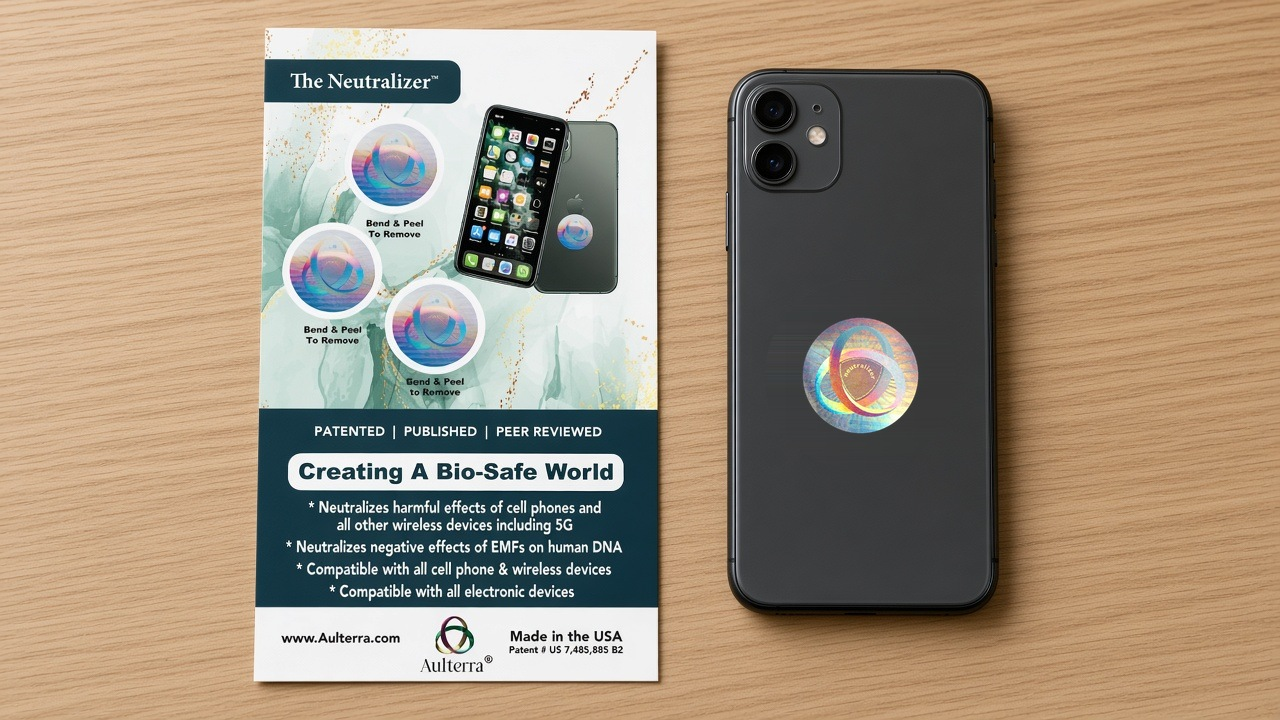
How to Apply EMF Neutraliser Disc: A Step-by-Step Guide for Phones and Home Devices
To apply an Aulterra EMF neutraliser disc, clean and dry the back of your phone, peel the disc, and press it on firmly, clear of camera lenses and ports, then f…
Does Phone EMF Protection Actually Work? An Evidence-Based Look for Australians
Phone EMF protection products such as the Aulterra neutraliser disc do not block or reduce mobile radiation, and they are not designed to. Genuine harmonising d…
iPhone vs Android EMF Output: Which Phone Is Actually Safer in Australia?
Direct Answer: Neither iPhone nor Android phones are meaningfully safer by SAR rating. Both must meet Australia's 2.0 W/kg limit, a standard enforced by ACMA an…