EMF Protection for the Bedroom: How to Create a Calmer Sleeping Space in Australia
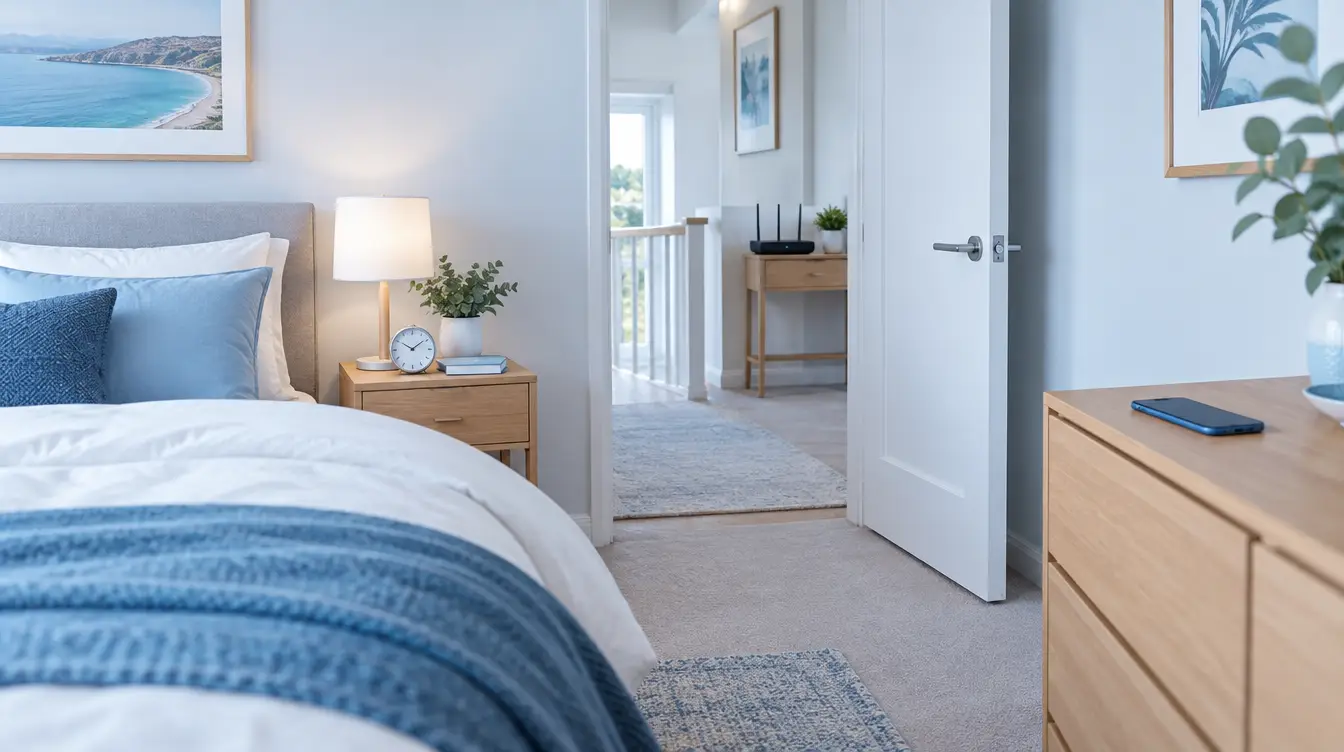
The most effective EMF protection for a bedroom is to reduce what sits closest to your head at night. Put your phone on flight mode and out of reach. Move chargers away from the bedhead. Switch the Wi-Fi router off on a timer. Then add layered options such as an EMF energy pillow.
Most Australians sleep within arm's reach of a phone, with a router on the other side of the wall and a smart meter on the outside of the house. Each of these is built to sit within regulated limits. At EMF Neutralizer, our question is a different one: what does the combination add up to across a full night, in the one room where you are still and close to every source?
This is a sleep-focused deep dive, not a repeat of our room-by-room home guide. You will get a clear list of bedroom EMF sources, an honest summary of what the research says (including where it is mixed), free habits you can start tonight, and the Aulterra options we suggest for the sleeping area.
Key Takeaways
- The bedroom matters because exposure is long, close to the body and uninterrupted by movement.
- Phones, chargers, routers, smart meters on shared walls, baby monitors, electric blankets and smart speakers all contribute to the bedroom environment.
- Research on EMF and sleep is mixed. Huber et al. (2002) reported sleep EEG changes, but further research is needed and regulators maintain that exposure within limits is acceptable.
- Our view is that cumulative daily exposure is the relevant measure, even when each device sits below regulated limits. This is our position, not settled science.
- Free habits come first: flight mode, phone off the bedside table, chargers away from the bedhead, Wi-Fi on a timer.
- For a simple next step, start with an EMF energy pillow plus a neutraliser disc on the bedside phone.
Protect your family from EMF exposure
Browse our science-backed neutralizer products.
Shop EMF ProtectionSummary Table
- What it addresses
- Phone wireless signals
- Effort
- Very low
- Cost
- Free
- Best for
- Everyone who uses a phone alarm
- What it addresses
- Proximity to the head
- Effort
- Low
- Cost
- Free (or a basic alarm clock)
- Best for
- Anyone who scrolls in bed
- What it addresses
- Low-frequency fields from power supplies
- Effort
- Low
- Cost
- Free
- Best for
- Shared bedheads with multiple cords
- What it addresses
- Overnight router transmission
- Effort
- Low to medium
- Cost
- Low
- Best for
- Homes with a router near the bedroom
- What it addresses
- Individual devices, such as the bedside phone
- Effort
- Low
- Cost
- Low
- Best for
- Devices you cannot switch off
- What it addresses
- The sleeping position itself
- Effort
- Low
- Cost
- Moderate
- Best for
- Those wanting a simple, layered addition
- What it addresses
- Overnight wear on the body
- Effort
- Low
- Cost
- Moderate
- Best for
- Those who also want daytime coverage
Why does the bedroom matter for EMF exposure?
The bedroom matters because you spend roughly a third of your life there, close to your devices and lying still. Unlike a desk or kitchen, exposure is continuous, close to the head and body, and uninterrupted by movement. That combination is why we treat the bedroom as the first room to address.
Three factors make the bedroom different from every other room in the house.
Duration. Most adults sleep for hours each night, night after night. A source you would barely notice in the lounge room becomes a long, repeated exposure when it sits beside your pillow.
Proximity. Field strength falls away quickly with distance from a source. That is basic physics, and it is why a phone on the bedside table is a different proposition to a router in the hallway. Anything within arm's reach of your head deserves attention first.
Stillness. During the day you move around. You walk away from the laptop, leave the phone in another room, step outside. At night you are lying in one position, in one spot, with the same sources around you.
We also think about recovery. Sleep is when the body repairs and resets. Our view is that your sleeping space should support your biology, not work against it. That is a belief we hold and the reason we start here, not a proven medical claim.
What are the most common EMF sources in an Australian bedroom?
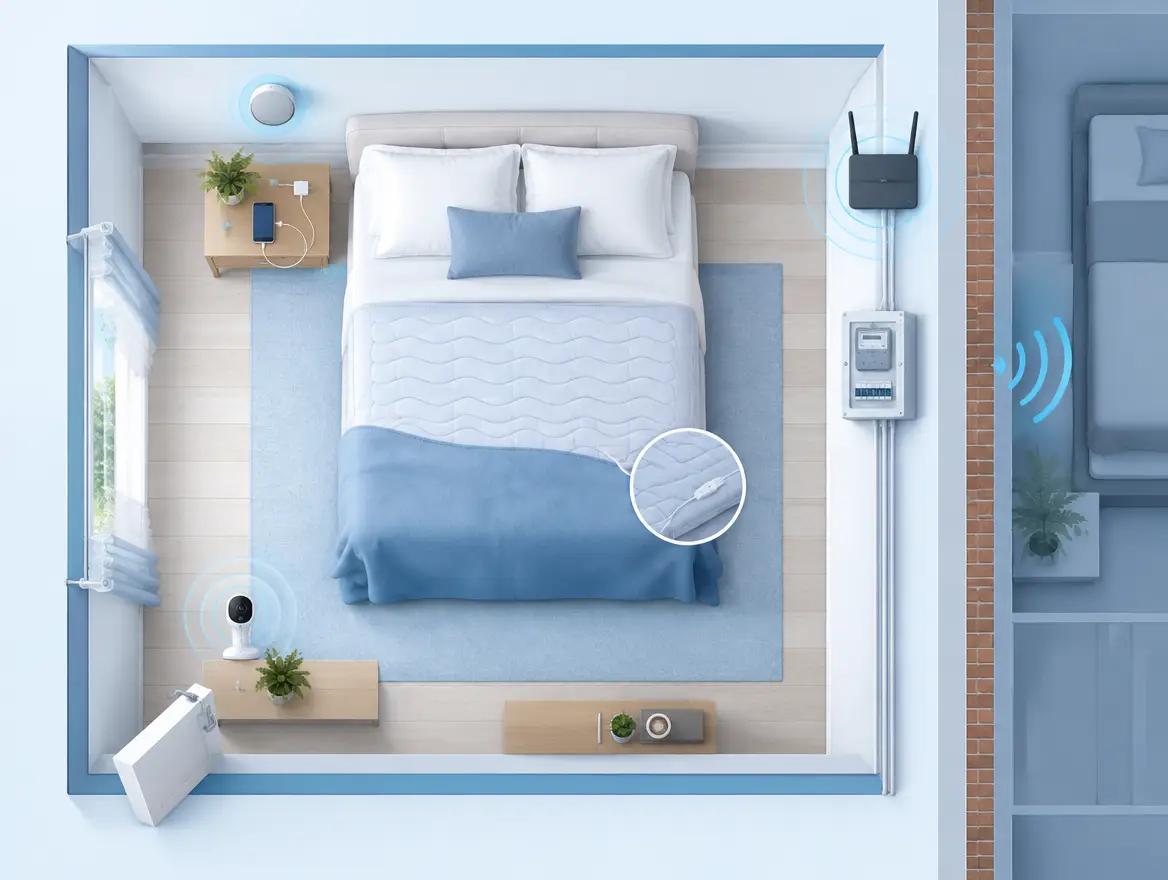
The most common bedroom EMF sources are mobile phones, chargers and power supplies, Wi-Fi routers, smart meters on shared or external walls, baby monitors, electric blankets and smart speakers. Some produce radiofrequency signals, others low-frequency fields from wiring and power. Most bedrooms have several active at once.
It helps to separate two types. Wireless devices emit radiofrequency (RF) energy to communicate. Electrical wiring and appliances produce low-frequency fields from mains power. Your bedroom probably has both.
Phones and tablets
A phone beside the bed is the closest and most constant source for most people. Even when you are not using it, it keeps checking for networks, syncing and receiving notifications. This is the phone next to bed EMF question we hear most often.
Chargers and power supplies
Plug-in chargers, power boards and bedside lamps with transformers all draw mains power close to the bedhead. Wireless charging pads add another layer.
Wi-Fi routers and mesh nodes
A router in the hallway, study or lounge room can sit just on the other side of the bedroom wall. Mesh systems often put a node in or near the bedroom.
Smart meters and switchboards on shared walls
In many Australian homes the meter box is on an outside wall, sometimes directly behind the bedhead. In apartments and townhouses, shared walls can mean a neighbour's router, meter or appliances sit a few centimetres from your pillow. Regulators including ARPANSA maintain that smart meter emissions fall within the limits in the standard. Our concern is not any single meter, it is what it adds to the rest of the room.
Baby monitors
Many monitors transmit continuously and sit close to a cot. A wired option, or placing the unit as far from the cot as the cord allows, is a sensible adjustment.
Electric blankets
Electric blankets run mains power through wiring across the whole bed. A common habit is to heat the bed, then switch the blanket off at the wall before getting in.
Smart speakers and smart watches
These stay connected to Wi-Fi or Bluetooth all night. A smart speaker on the bedside table is another always-on transmitter within arm's reach.
What does the research say about EMF and sleep?
The research on EMF and sleep is mixed, and more is needed. Huber et al. (2002) reported changes in sleep EEG after mobile phone-type exposure in healthy volunteers. Other studies have not found consistent effects, and ARPANSA's standard says exposure within its limits is acceptable. Nobody can claim the question is settled.
Here is what we can say plainly.
Huber et al. (2002). Huber R and colleagues published a laboratory study in the Journal of Sleep Research examining mobile phone-type exposure before sleep. They reported changes in the sleep EEG and in regional cerebral blood flow. It was a small, controlled study with healthy volunteers. An EEG change is not the same as poorer sleep or a health outcome, and the authors did not claim it was.
IARC (2011). The International Agency for Research on Cancer classified radiofrequency electromagnetic fields as Group 2B, possibly carcinogenic to humans. That decision was based on limited evidence about wireless phone use and cancer. It is not a finding about sleep, and Group 2B means the evidence is limited, not conclusive.
ARPANSA RPS S-1 (2021). Australia's radiofrequency standard sets exposure limits intended to protect against established health effects. ARPANSA's position is that exposure within those limits is not known to cause harm. The WHO takes a similar line: current evidence does not confirm health effects from exposure below international guidelines, while research continues.
Our position. We hold that limits built around established, short-term effects do not fully answer the question of a combined, chronic, overnight environment. Several low-level sources at once form a single environment, even when each device sits below its limit. That is our view, and it is not settled science. We are not asking you to fear your bedroom. We are suggesting that reducing cumulative daily exposure is a reasonable, low-cost precaution, especially where you already feel unrested.
If you have ongoing sleep problems, speak to your GP. EMF is one possible factor among many, including light, noise, stress, caffeine and sleep schedule.
What free habits reduce EMF in the bedroom?
The four most useful free habits are putting your phone on flight mode overnight, keeping it off the bedside table, moving chargers away from the bedhead, and switching Wi-Fi off on a timer. Together they cost nothing, take minutes to set up, and cut the sources closest to your head.
1. Flight mode overnight. Flight mode switches off the cellular, Wi-Fi and Bluetooth radios, so the phone stops transmitting. Your alarm still works. If you need to be reachable for emergencies, set a favourites-only exception or keep a landline or second phone elsewhere.
2. Phone off the bedside table. Distance does most of the work. Charge the phone across the room, or in the hallway, and use a basic alarm clock. If the phone must stay close, face the screen down and keep it at least an arm's length from your head.
3. Chargers away from the bedhead. Move power boards, charging cables and lamps from the wall behind your head. Charge devices in the kitchen or lounge room instead of beside the bed.
4. Wi-Fi off on a timer. Most modern routers have a schedule setting. If yours does not, a simple plug-in timer switch works. Most households do not need the internet between midnight and morning.
A few extras are worth doing.
- Unplug the electric blanket after warming the bed.
- Move the smart speaker to another room.
- Check what is on the other side of the bedhead wall: a meter box, a fridge, a neighbour's router.
- If the bed can move, shift it away from any wall that has a heavy cluster of sources behind it.
We cover phone-specific habits in more detail in our guide to reducing phone radiation exposure without a case, and the whole-home view in our room-by-room guide to reducing EMF in your home.
What Aulterra options suit a sleeping area?
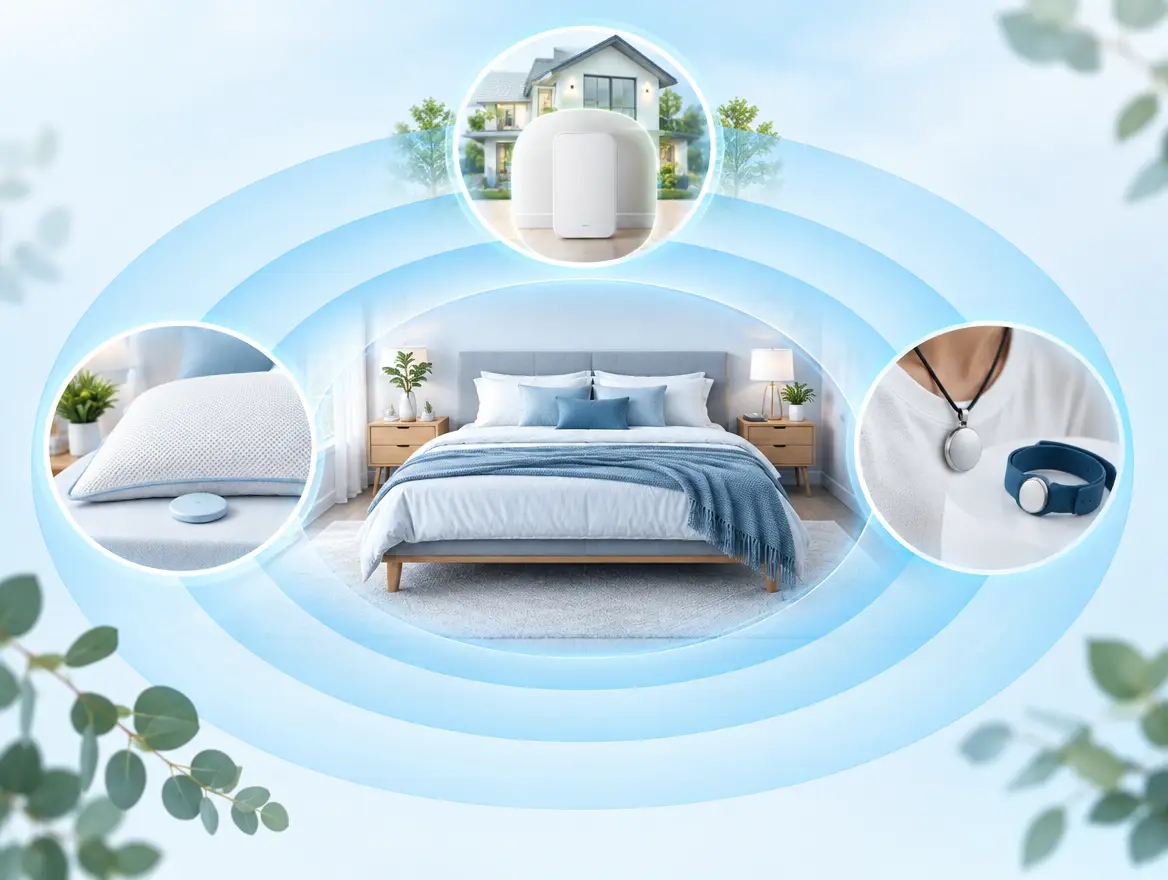
For a sleeping area, Aulterra offers the EMF energy pillow in two sizes, neutraliser discs for phones, routers and other devices, and pendants or vitality wristbands you can wear overnight. We suggest layered EMF protection: free habits first, then a pillow and disc, then wearables if you want coverage beyond the bedroom.
These are designed to complement the free habits, not replace them. If you want to reduce EMF in the bedroom without rearranging your whole life, here is how we think about each option.
EMF energy pillow. The pillow is built for the sleeping position itself, which is where the body is closest to the room for the longest time. We offer it in two sizes. The product page has the specifics, and we do not publish specifications beyond what is listed there.
Neutraliser discs. Discs apply directly to a device, such as the bedside phone, a router, a tablet or a smart speaker. They suit the devices you cannot switch off or move. Our guide on how to apply an EMF neutraliser disc shows placement.
Pendants and vitality wristbands. These are worn on the body, so they come with you overnight and through the day. They suit people who move between rooms and environments and want one consistent layer.
How the Aulterra process works, in general terms. As described on our product pages, Aulterra products are not shields and do not block your phone or Wi-Fi signal. Your devices keep working as normal. The products are designed to neutralise the way the surrounding electromagnetic field interacts with the body. We do not publish more technical detail than our product pages state.
A simple starting point. If you want one clear first step, start with the EMF energy pillow plus a disc on the bedside phone. That covers the sleeping position and the closest device. You can add a pendant or a disc on the router later.
To be clear: none of these products treats, prevents or cures insomnia, headaches or any other condition. They are designed to help you neutralise your environment as a precaution. If you are worried about your sleep or your health, see your GP.
If your question is whether phone EMF protection works at all, we address that directly in our article on whether phone EMF protection actually works.
What do customers report about sleeping with EMF protection?
Customers most often describe feeling more settled and more rested after adding EMF protection to the sleeping area. These are individual, qualitative accounts, not clinical results, and experiences vary. We share them because they shape how we recommend products, not as proof of any health effect.
One account stands out because of the setting. A customer I advised had just moved into a new apartment. There was a hum in the wall shared with her neighbour and an electrical substation box right outside her bedroom window. She told us sleeping in that room was unsettling, and that she had felt scattered and drained since the move. I recommended the Whole House EMF Neutralizer plus discs. Her mother bought her the plug-in unit and a long pendant. After one night, she wrote: "I actually felt refreshed today for the first time in weeks." She then ordered discs for her phone, tablet, microwave, router and electric fireplace.
She was sceptical at the start, and she said so. That one night does not prove anything on its own, and she was clear she was looking forward to seeing how it went over a longer period.
More generally, the feedback we hear most often is about feeling more settled at night, waking less tired, and, for people in desk-heavy settings, fewer headaches. We treat these as general customer feedback. We do not publish percentages from them because they come from qualitative descriptions, not measured data.
Why we treat the bedroom as a stack, not a list of devices
Most advice treats each bedroom device on its own: is this phone within limits, is this router within limits. We think that framing misses the point. At 2am, your bedroom is a stack of sources running at once, and the stack is what your body sits inside.
Here is the method we use, and it is not in the top-ranking guides.
Step 1: Sit on the bed and map 360 degrees, including through walls. Most people list what they can see. Add what is behind the bedhead, under the floor and on the other side of each wall. Meter boxes, neighbours' routers, fridges and hot water systems count.
Step 2: List what is actually active at 2am. The phone is searching for signal. The router is transmitting. The smart speaker is listening. The charger is drawing power. The smart watch is syncing. The meter is on. Write the list down. It is usually longer than people expect.
Step 3: Remove what you can. Flight mode, distance, timers, unplugging. This is free, and it shortens the list.
Step 4: Neutralise what you cannot remove. Walls, meters and neighbours cannot be switched off. That is where discs, the pillow or a wearable earn their place.
Consider a hypothetical one-bedroom apartment in Sydney. The phone charges beside the bed, the router sits in the lounge on the other side of the bedhead wall, the meter board is in the hallway cupboard and the neighbour's bedroom backs onto yours. No single device is unusual. But the person sleeping there lives inside all of them for the whole night, every night. That is the cumulative daily exposure we mean.
This is our position, and we are open about that. Regulators and many researchers do not accept that low-level combined exposure causes harm, and the evidence for sleep effects is limited and mixed. We think the combined environment is the relevant thing to measure, and that it is worth addressing proactively. Your home should work with you, not against you.
References
- Huber R et al., Electromagnetic fields, such as those from mobile phones, alter regional cerebral blood flow and sleep and waking EEG, Journal of Sleep Research (2002)
- IARC, IARC classifies radiofrequency electromagnetic fields as possibly carcinogenic to humans, Press Release No. 208 (2011)
- ARPANSA, Radiation Protection Series S-1: Radiation Protection Standard for Limiting Exposure to Radiofrequency Fields, 100 kHz to 300 GHz (2021)
- World Health Organization, Electromagnetic fields and public health: mobile phones
Ready to start? Begin with the EMF energy pillow plus a disc for the bedside phone, browse the full Aulterra range, and contact the EMF Neutralizer team if you have questions about what suits your bedroom.
Stay informed on EMF wellness
Get practical tips and product updates in your inbox.
Frequently asked questions
Is it safe to have a phone next to the bed?
Phones sold in Australia must comply with exposure limits, and ARPANSA says exposure within its limits is not known to cause harm. Research on sleep effects is mixed. Many people choose to keep the phone across the room or on flight mode as a low-cost precaution.
Does EMF affect sleep?
The evidence is mixed. Huber et al. (2002) reported sleep EEG changes after mobile phone-type exposure in a small laboratory study, but other research has not found consistent effects. More research is needed. Our view is that reducing cumulative exposure in the bedroom is a reasonable precaution.
Does flight mode stop EMF from my phone?
Flight mode switches off the phone's cellular, Wi-Fi and Bluetooth transmissions, so it stops the main wireless signals. It does not remove other sources in the room, such as a router, smart meter, charger or wiring. Alarms usually still work in flight mode.
What is an EMF pillow?
An EMF energy pillow is an Aulterra product designed for the sleeping position. It is offered in two sizes and is part of a layered approach for the bedroom. It does not treat or cure any condition. See the product page for specific details.
Should I turn off Wi-Fi at night?
For most households, yes, if it is practical. Most routers have a schedule setting, and a plug-in timer works if yours does not. It removes one always-on transmitter that may sit close to the bedroom. Keep it on if you rely on connected medical or security devices.

Richard Kent
Science-backed EMF wellness education from the EMF Neutralizer team.
Related articles
WiFi Router EMF Exposure: How to Reduce It in Your Australian Home
WiFi router EMF exposure comes from radiofrequency fields at 2.4 GHz and 5 GHz that a router emits around the clock. You can reduce it by moving the router away…
Car USB EMF Neutraliser How It Works, How to Install It and What to Expect
A car USB EMF neutraliser is a small plug-in device that sits in your vehicle's USB port. Its harmonising technology works with the electromagnetic environment…
How to Reduce EMF in Your Home Australia: A Practical Room-by-Room Guide
You cannot make a home fully EMF-proof, but you can lower your household's combined EMF load. Start with free changes: move devices away from beds, put the rout…