Car USB EMF Neutraliser: How It Works, How to Install It and What to Expect
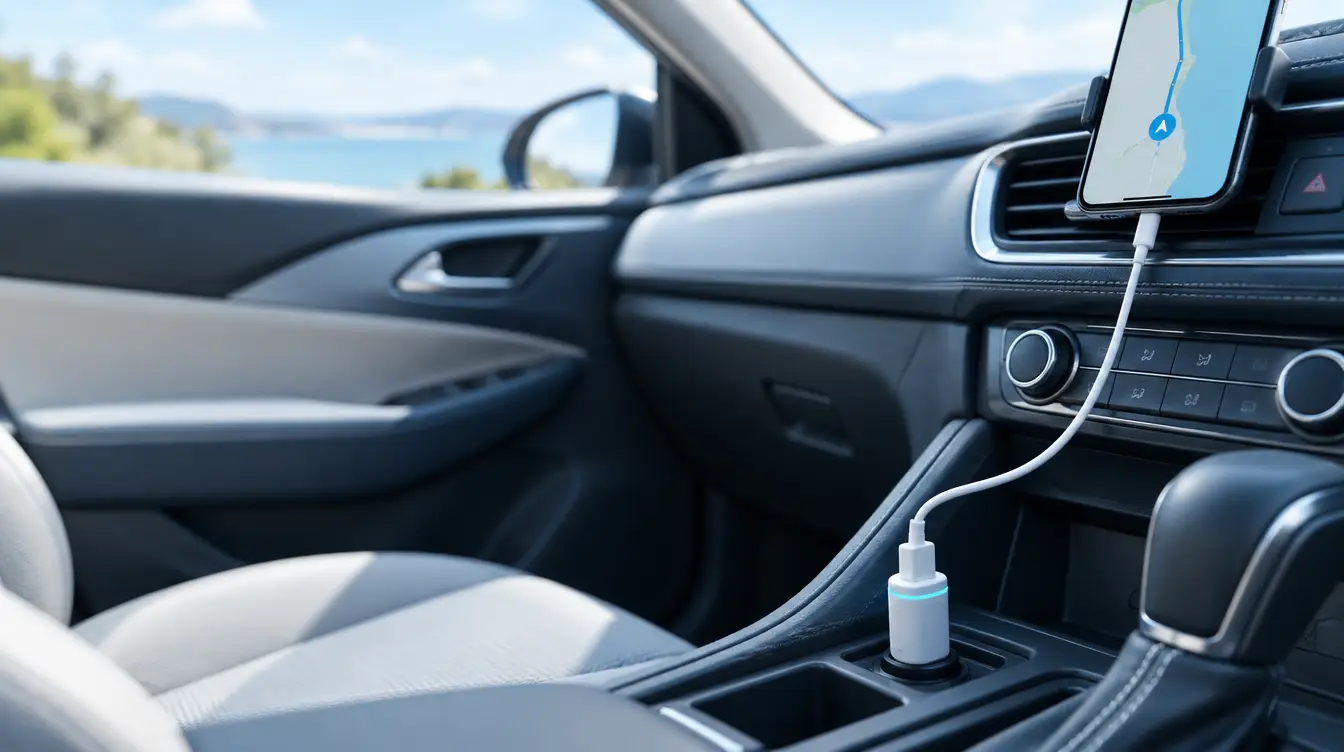
A car USB EMF neutraliser is a small plug-in device that sits in your vehicle's USB port. It does not shield or block signals. Aulterra says its harmonising technology works with the electromagnetic environment across the whole cabin. That is the manufacturer's explanation, and independent scientific evidence for harmonising products remains limited.
If you spend an hour or more a day behind the wheel, you have probably noticed how many devices travel with you. Phones, Bluetooth, a touchscreen, a dash cam and, in an EV, a high-power drivetrain all share one small metal cabin. USB car neutralisers have started to appear as a simple way to address that, and the questions I hear most are practical ones: what does it do, where does it go, and what should I expect?
This guide is about the device itself. I will explain what it is and is not, how Aulterra describes its technology, how to install it, what customers tell us and where its limits sit. I will be clear about what is the manufacturer's claim, what is our view and what is simply not proven.
Key Takeaways
- The Aulterra whole-car USB neutraliser is not a shield. It does not block signals, and it is not designed to interfere with Bluetooth, GPS, mobile reception or charging.
- How it works is the manufacturer's explanation: a harmonising approach rather than blocking. Independent scientific evidence for EMF harmonising products is limited.
- Installation is simple. Plug it into a USB port, leave it there and move it between vehicles if you need to.
- Customer figures quoted here are estimates drawn from qualitative descriptions. They are not clinical results, and nothing here is a health or medical claim.
- For door-to-door coverage, many customers pair the car unit with a neutraliser disc on the phone and a wearable such as a vitality wristband or pendant.
Protect your family from EMF exposure
Browse our science-backed neutralizer products.
Shop EMF ProtectionSummary Table
- Short answer
- A USB-powered-format accessory designed for whole-cabin use, per the manufacturer
- Short answer
- No. It does not block signals
- Short answer
- Not designed to interfere with any of them
- Short answer
- Aulterra describes a harmonising effect on the cabin's electromagnetic environment
- Short answer
- Limited. Treat it as a considered personal choice
- Short answer
- Petrol, hybrid and electric, wherever a suitable USB port exists
- Short answer
- Minimal. Plug in and leave it
- Short answer
- A phone disc and a wearable for layered EMF protection
What a Car USB EMF Neutraliser Is, and What It Is Not
A car USB EMF neutraliser is a small accessory that plugs into a USB port and is designed to address the electromagnetic environment inside your cabin. It is not a shield, a signal blocker or a phone charger. It does not interfere with Bluetooth, GPS, mobile reception or vehicle charging.
The most common misunderstanding is that anything with EMF in the name must block something. Shielding products, such as signal-blocking pouches or metallic liners, work by reducing or reflecting radiation. They can also reduce your phone's ability to connect, which is a poor trade in a car where you rely on navigation and hands-free calls.
A neutraliser sits in a different category. Aulterra's position is that it harmonises rather than blocks, so your devices keep working exactly as normal. That is why the product suits a vehicle, where connectivity matters for safety as well as convenience.
The table below sets the two approaches side by side. It is qualitative, because the point is the design difference rather than any number.
- Shielding products
- Block or reflect radiation
- Harmonising devices (Aulterra's approach)
- Work with the environment rather than block
- Shielding products
- Can reduce reception
- Harmonising devices (Aulterra's approach)
- Not designed to affect signal
- Shielding products
- Often impractical
- Harmonising devices (Aulterra's approach)
- Designed for it
- Shielding products
- Physical principle is well understood
- Harmonising devices (Aulterra's approach)
- Independent evidence limited
What it is not matters just as much. It will not remove your phone, your car's electronics or the wider network from the world. It is one layer in a sensible approach, not a cure-all.
How Does a Car EMF Neutraliser Work? Aulterra's Explanation
According to Aulterra, the neutraliser uses a harmonising technology that works with the electromagnetic fields around it instead of blocking them. The company says one unit covers the whole cabin. This is the manufacturer's description. Independent scientific evidence for EMF harmonising products is limited, so treat the mechanism as a claim, not an established fact.
Here is the concept in Aulterra's own terms. The company describes the technology as bringing the electromagnetic environment into a more coherent, harmonised state, one it says is more compatible with the human body. The aim is to change how the field environment behaves around you, not to stop devices from emitting.
I want to be direct about the evidence. Mainstream bodies such as the World Health Organization and ARPANSA assess radiofrequency exposure against established safety limits, and they do not recognise harmonising products as a protective measure. Aulterra's mechanism has not been confirmed by independent, peer-reviewed research that I can point you to. If a seller tells you otherwise, ask to see the study.
Why a USB port?
The format is practical rather than mysterious. A USB port is in virtually every modern car, it sits close to the centre of the cabin, and a small plug-in unit is easy to fit and easy to move. Aulterra presents this as a whole-cabin product, meaning one unit is intended to cover the entire vehicle interior, not just the seat next to it.
For exact specifications, including connector type and how the unit uses the port, rely on the manufacturer's product page. I would rather you read the current figures there than rely on my paraphrase.
Why the Car Cabin Matters for Cumulative Daily Exposure
Our view at EMF Neutralizer is that a car cabin concentrates several electromagnetic sources into a small metal space. Phones, Bluetooth, infotainment and, in EVs, the drivetrain all operate at once. Each source may sit below regulated thresholds, but we believe the combined load is the more relevant measure.
This is a position, not a consensus. Regulatory limits are set by bodies such as ARPANSA, and they are generally based on individual sources. The mainstream view is that everyday consumer devices fall well within those limits and need no extra protection. We disagree on one point: nobody lives with a single source. Across a day, you move from a router and laptop at home to a phone in your pocket to a cabin full of electronics.
That cumulative daily exposure is the invisible electromagnetic burden we focus on. A car is a useful place to address it because the exposure there is predictable. You know when you will be in the vehicle, and the device is fixed in place.
I have covered the measured detail elsewhere. Our EMF Levels Inside Cars article goes through what is actually present in a cabin, and our guide to the best EMF protection for electric cars covers EV-specific considerations. I will not repeat that here. The point for this article is simple: if you accept that the car is a concentrated environment, a whole-cabin device is a logical thing to consider.
How to Install and Use a Car USB EMF Neutraliser
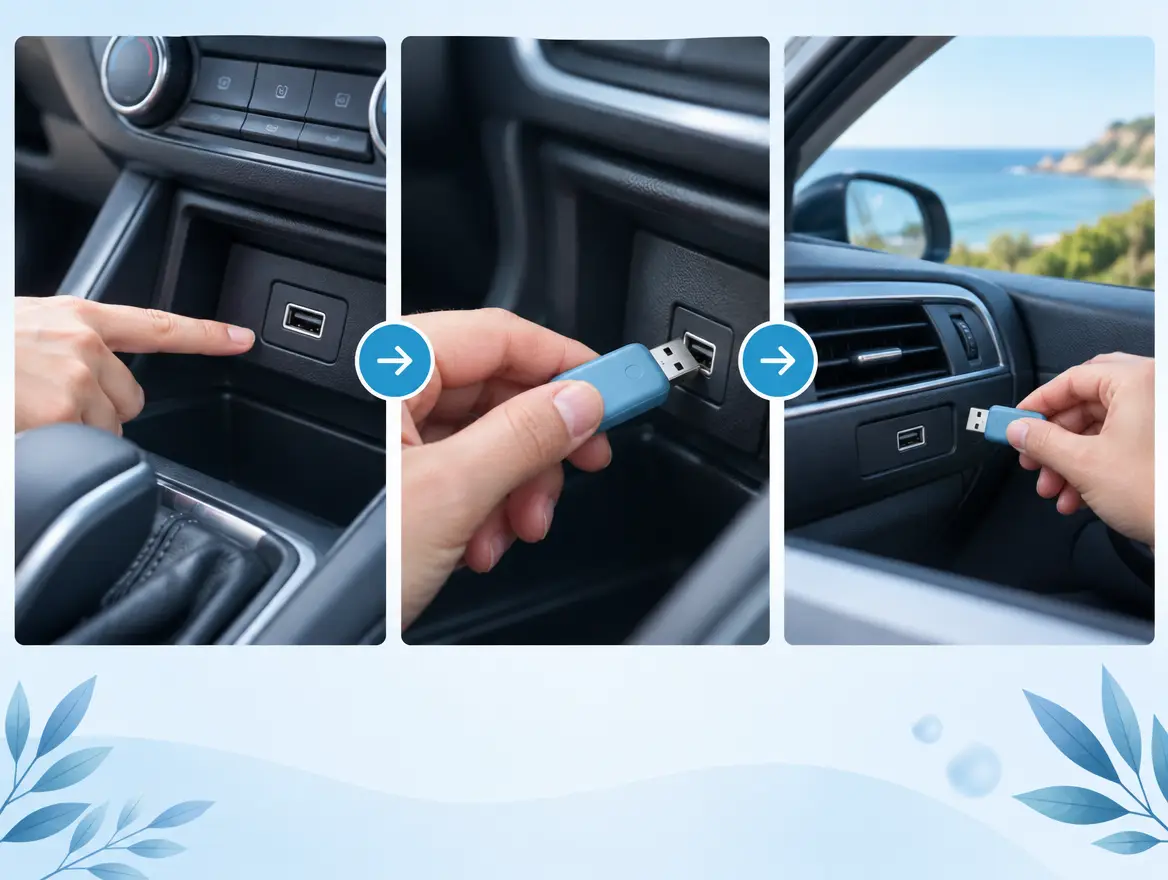
Installation takes seconds. Plug the neutraliser into a suitable USB port, ideally one near the centre of the cabin such as the console, and leave it there. It is intended to stay plugged in during normal use, and you can move it between vehicles whenever you need to.
Which port to use
Choose the port that is most central. A console or front-dash port generally gives the most even position relative to the seats. Because Aulterra describes the coverage as whole-cabin, placement is not meant to be fussy, but central is a sensible default. Check that the connector matches the port, as some cars use USB-A and others USB-C.
If your car cuts USB power when the ignition is off, that is normal behaviour for many vehicles. Confirm with the product page how the unit is intended to operate, so you know whether this matters.
Leaving it plugged in
The simplest approach is to treat it as a fixture. Plug it in once and forget about it. Unlike habits such as switching a phone to flight mode, there is nothing to remember, and that is one reason cars suit this kind of product well.
Moving it between vehicles
If you drive a work car and a personal car, or you swap between a family vehicle and a rental, the unit can move with you. Rideshare drivers and families on road trips often find this useful. The only practical caution is not to leave it behind in a car you hand back.
Petrol, hybrid and electric cars
- Suitability
- Suitable wherever a compatible USB port exists
- Suitability
- Suitable, same port requirement
- Suitability
- Suitable, same port requirement. Check connector type
The practical requirement is the same in every case: a working USB port. For specific model questions, check the product page or contact our team before buying.
What Customers Report (and How to Read These Numbers)
Based on our own records, we estimate customers describe a 60-85% improvement in perceived fatigue and a 70-90% reduction in reported headache frequency in high-device environments. These are estimates drawn from qualitative customer descriptions across residential and workplace use. They are not clinical results, not controlled trials and not medical claims.
Here is how to read those figures. They come from EMF Neutralizer's own book of business, where customers describe how they feel after using our products. We turn those descriptions into estimated ranges. There is no control group, no blinding and no independent measurement. People who buy these products also expect to feel better, and expectation is a real effect.
The headache estimate comes from home office and workplace settings, not cars specifically. I mention it because it shows the pattern customers describe: a cluster of devices, long hours and a sense of being worn down by mid-afternoon. In one case I am familiar with, a desk worker surrounded by a laptop, external monitor, phone and wireless peripherals reported estimated headache frequency falling by 70-90% over four weeks, along with better concentration. That is one person's account of their own experience.
An illustrative example
Consider a rideshare driver doing long shifts with two phones mounted, Bluetooth running and a touchscreen on the whole time. This is a hypothetical scenario, not a real customer. If that driver added a car neutraliser and noticed feeling less drained at the end of a shift, would the device be the cause? Possibly. It could equally be a better sleep, a changed routine or simple expectation. That uncertainty is exactly why I ask you to treat customer reports as context, not proof.
If you want a fair test, there is a method later in this article.
Pairing for Door-to-Door Coverage
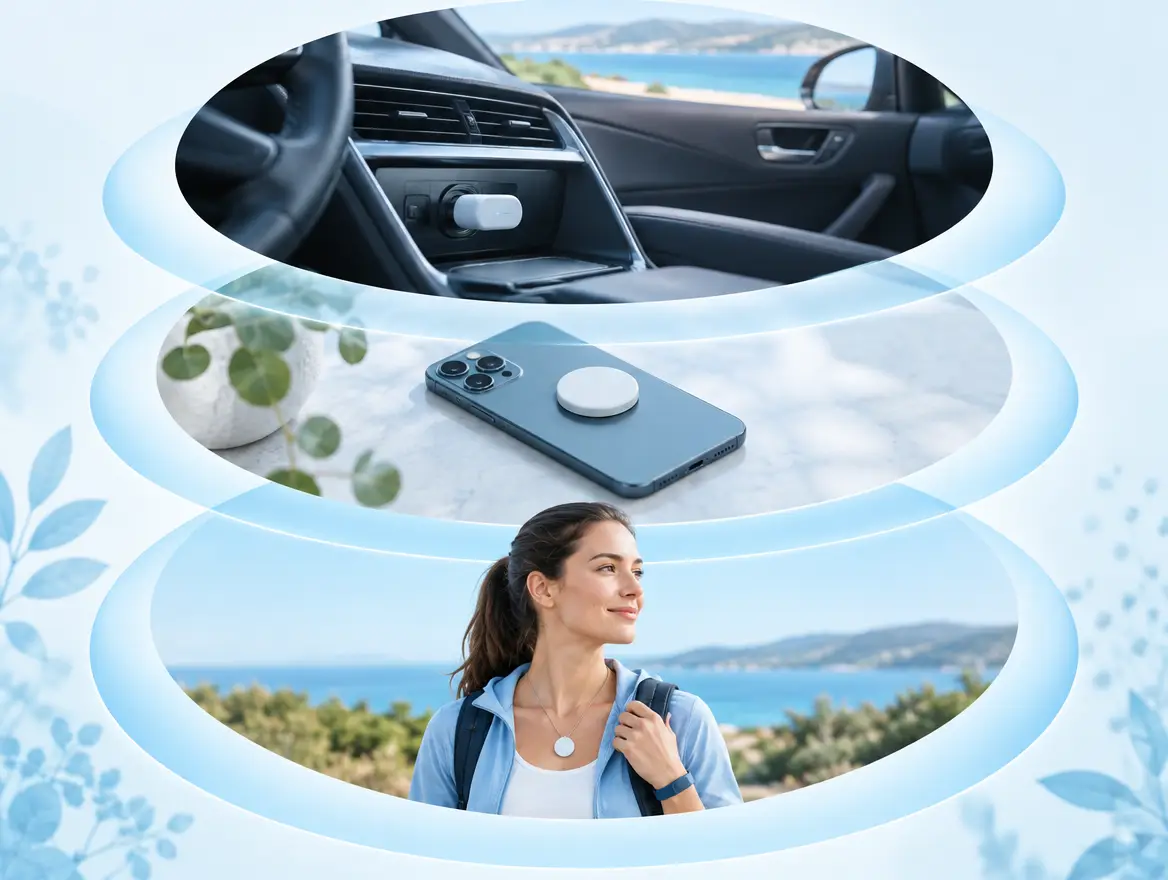
A car unit only covers the time you spend in the vehicle. For door-to-door coverage, many customers add a neutraliser disc on the phone and a vitality wristband or pendant to wear. That gives layered EMF protection: the cabin, the device closest to your body and something you carry with you.
The logic is straightforward. Your phone travels with you from the house to the car to the office, so a disc on the phone follows the main source. A wearable follows you rather than the device. The car unit then handles the shared space.
If you have not applied a disc before, our guide on how to apply an EMF neutraliser disc walks through placement. For a broader look at whether phone-level products are worth your money, see our article Does Phone EMF Protection Actually Work? It takes the same honest approach as this one.
One customer's experience illustrates why people like the wearable layer. She is highly sensitive to her environment and had long avoided built-up areas. She started with a disc on her phone and later added a Pillar EMF Energy Pendant. In her words, she can now drive through the city and feel fine, and she has travelled on an international flight to see family. That is her personal account. I share it because it shows how people use these products, not as evidence of any medical effect.
- What it covers
- The vehicle cabin
- Where it fits
- Plugged into a USB port
- What it covers
- The phone
- Where it fits
- Applied to the device
- What it covers
- You, wherever you go
- Where it fits
- Worn on the body
What a Car EMF Neutraliser Cannot Do
A car EMF neutraliser cannot block radiation, cannot cut your exposure to zero and cannot replace medical advice. It also cannot make your car's electronics or your phone emit less. It is designed as a harmonising accessory, and its benefits remain unproven by independent research.
Let me be plain about the limits, because trust matters more than a sale.
- It is not a shield. Signal strength, reception and charging should stay as they are.
- It does not treat or prevent any condition. If you have a health concern, speak to a doctor.
- It does not change regulated exposure levels. Those are measured and set by bodies such as ARPANSA, and the product does not alter them.
- It cannot guarantee an outcome. Customer experiences vary widely, and some people notice nothing.
- It is not a substitute for sensible habits. Using hands-free calling, keeping a phone out of your pocket and taking breaks all still make sense.
If a seller promises certainty, be cautious. Our brand rests on the opposite approach: take control of your immediate environment with practical steps, and be honest about what each step can and cannot do.
How I Would Test a Car Neutraliser Fairly
My honest view is that most people judge these products badly. They buy one, feel something or nothing, and conclude. A better method costs nothing. Before you plug the unit in, spend a week noting how you feel at the end of each drive or shift: energy, focus, and anything you would normally put down to a long day. Then plug it in and keep the same notes for two to four weeks without changing anything else.
That will not give you a clinical result. It will give you something more useful than a hunch, which is your own baseline. If you can, ask a partner or a colleague who does not know when you made the change to comment on how you seem.
There is a second point I hold more firmly than most in this industry. The car is the easiest place to start, because it asks nothing of you. You do not need to remember to put anything on or change a habit. A device that works passively in the background, in a space where you spend predictable hours, is simply a low-effort way to neutralise your environment. If it helps, you will notice. If it does not, you have lost very little, and you will have learned that without fear or pressure.
That is the stance I want EMF Neutralizer to take: calm, practical and honest about the evidence. Your home should work with you, not against you, and the same goes for your car.
Where to Start
If the idea makes sense to you, start with the Aulterra whole-car USB neutraliser. You can view it on the product page on the EMF Neutralizer website, where the current specifications, connector details and manufacturer information are listed. If you want to cover your phone as well, consider bundling it with a phone neutraliser disc so you have both the cabin and your closest device covered. You can read about the Aulterra technology on the same site if you want more of the manufacturer's explanation first.
References
- World Health Organization, Electromagnetic fields and public health: mobile phones
- ARPANSA, Mobile phones and radiofrequency EMF
- ICNIRP, Guidelines for Limiting Exposure to Electromagnetic Fields (100 kHz to 300 GHz), 2020
Stay informed on EMF wellness
Get practical tips and product updates in your inbox.
Frequently asked questions
Does a car USB EMF neutraliser drain the car battery?
We do not quote a power figure we cannot verify. The manufacturer's product page carries the current specification. Many cars switch off USB power when the ignition is off, which would limit any draw in practice. Our team can confirm for a specific vehicle before you buy.
Does it suit a Tesla or a BYD?
The practical requirement is a working USB port, and both brands fit them. Check whether your model uses USB-A or USB-C and confirm compatibility on the product page. Aulterra positions the unit for petrol, hybrid and electric vehicles.
How long does the neutraliser last?
Aulterra's product information and warranty details on the product page are the authority on durability. Ask the EMF Neutralizer team if you need written confirmation before purchasing.
Will it interfere with Bluetooth, GPS or charging?
It is not designed to. It is not a shield and does not block signals, so Bluetooth, GPS, mobile reception and charging should work as normal. If you notice any change after installing it, unplug it and contact us.
Is there scientific proof that EMF neutralisers work?
Not in the form of independent, peer-reviewed evidence. Aulterra's explanation is the manufacturer's own, and independent scientific evidence for EMF harmonising products is limited. Customer reports are not clinical results, so treat the purchase as a considered personal choice.

Richard Kent
Science-backed EMF wellness education from the EMF Neutralizer team.
Related articles
How to Reduce EMF in Your Car: 8 Practical Tips for Australian Drivers
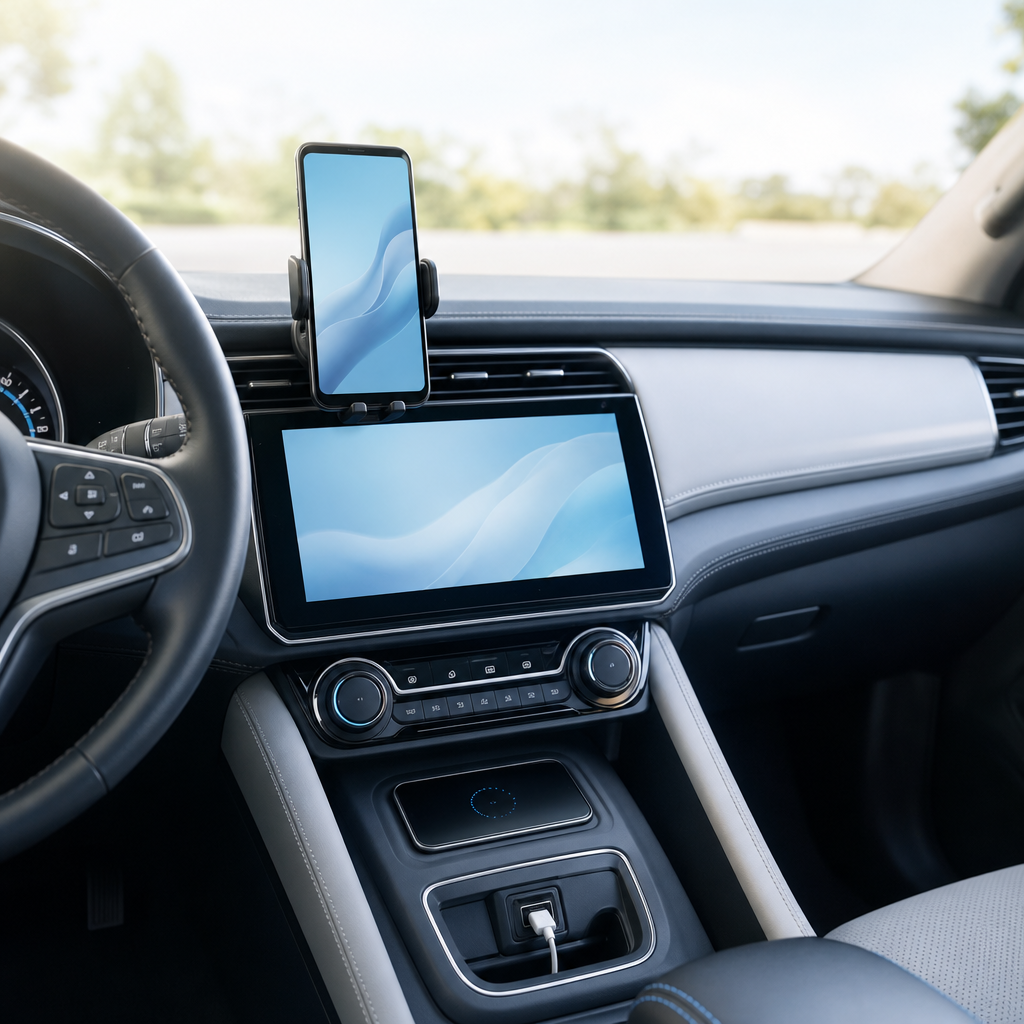
To reduce EMF in your car, mount your phone on the dash instead of carrying it in a pocket, switch off unused hotspots, Bluetooth and wireless charging pads, us…
EMF Levels Inside Cars Australia: What Drivers Need to Know
EMF levels in cars come from several sources at once: low-frequency magnetic fields from wiring, motors and batteries in every vehicle type, plus radiofrequency…
Electric Vehicle EMF Exposure Australia: What EV Drivers Should Know About In-Car Fields
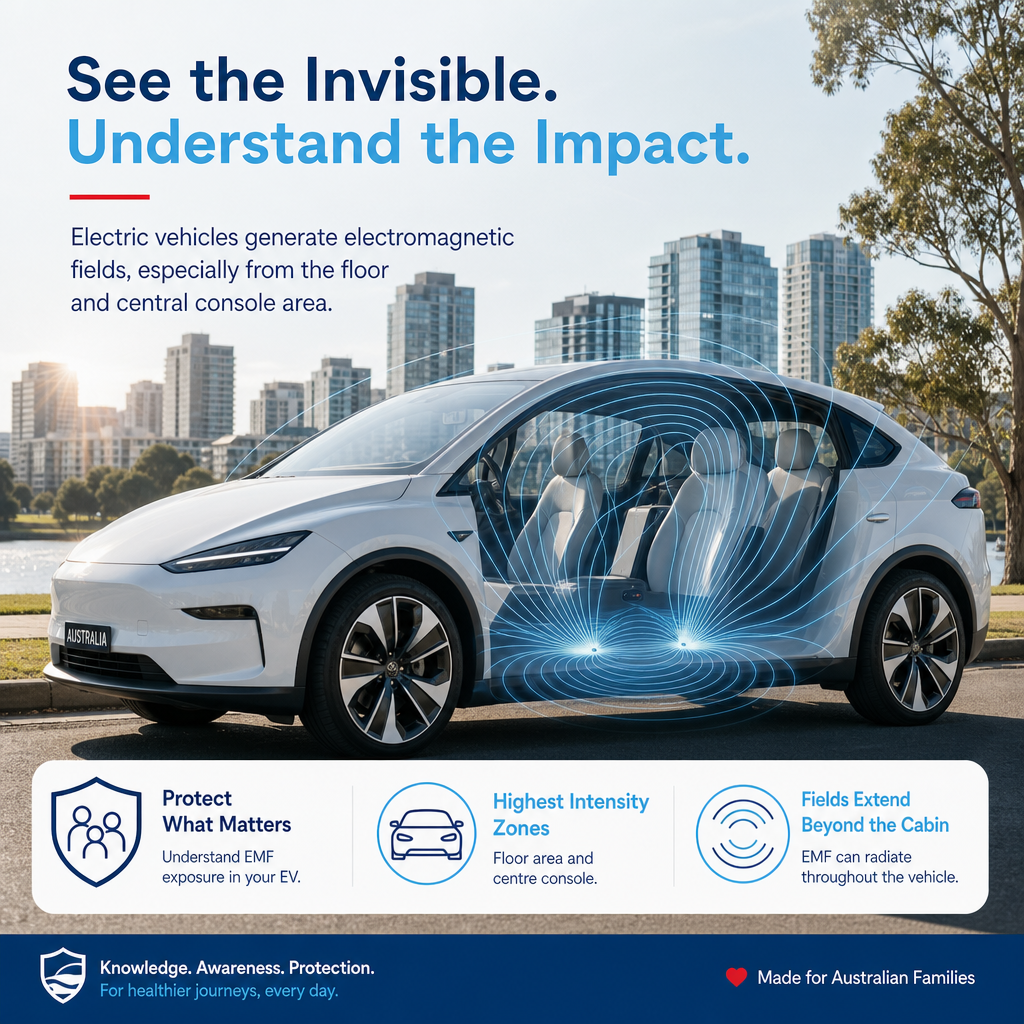
Published measurements generally place electric vehicle magnetic fields within ICNIRP and ARPANSA reference levels, so there is no regulatory basis for alarm. F…