Electric Vehicle EMF Exposure Australia: What EV Drivers Should Know About In-Car Fields
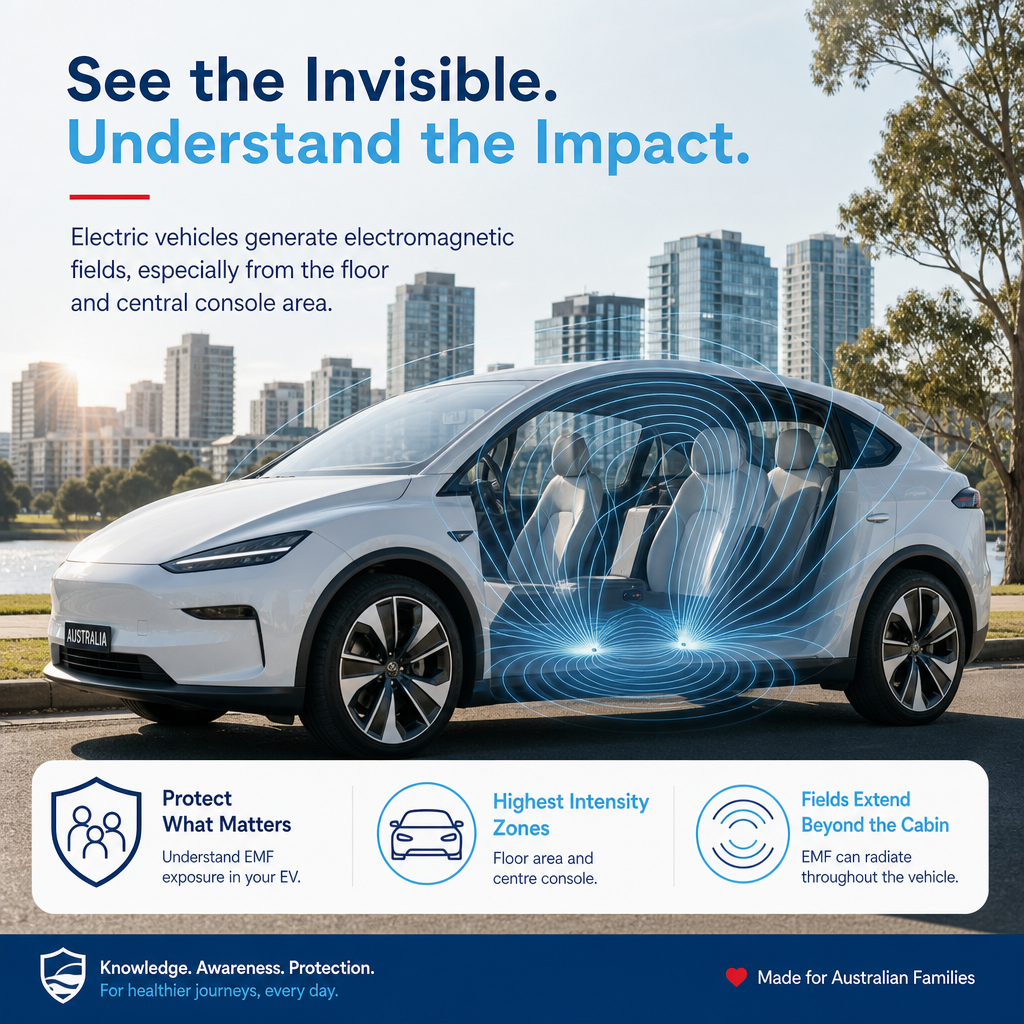
Published measurements generally place electric vehicle magnetic fields within ICNIRP and ARPANSA reference levels, so there is no regulatory basis for alarm. Fields are usually highest near the floor and front footwell, and vary by model. Whether stacked sources in the cabin matter when many overlap for hours is an open question, not a settled one.
Electric and hybrid cars are now a normal sight on Australian roads, and the people driving them are spending serious hours inside. Commuters, rideshare drivers and families on long regional trips are asking a fair question: what is sitting under the floor, and does it matter?
This article gives you the calm version. We cover where in-car fields come from, what the Australian standards actually say, and where our view at EMF Neutralizer differs from the mainstream position. We label that view as a belief, not a proven health effect. For petrol, hybrid and EV field levels together, see our guide to EMF levels inside cars in Australia. Then we move to simple actions you can take today.
Key Takeaways
- Published measurements generally place EV fields inside ICNIRP and ARPANSA reference levels. We are not claiming otherwise.
- An EV cabin combines a battery, inverter, motor, high-current cabling, Bluetooth, wi-fi, mobile phones and charging in one small space.
- Readings tend to be higher near the floor and front footwell, and they vary by make and model.
- Our position is that cumulative daily exposure, not any single source, is the relevant measure for anyone assessing total exposure, not one reading. This is a belief, not clinical evidence.
- Simple habits cost nothing: less phone use on the move, devices off laps, and thoughtful child seat placement.
- The Aulterra Whole Car USB is a layered harmonising option for people who want to go further. We make no medical claims and do not claim it lowers measured field strength.
Protect your family from EMF exposure
Browse our science-backed neutralizer products.
Shop EMF ProtectionSummary Table
- Type of field
- Static and low-frequency magnetic
- Where you notice it most
- Floor, under seats
- Practical response
- Awareness of seating position; nothing to do while driving
- Type of field
- Low-frequency magnetic, with switching components
- Where you notice it most
- Front footwell, front floor
- Practical response
- Keep feet clear; avoid storing active devices on the floor
- Type of field
- Changing current flow, low-frequency magnetic
- Where you notice it most
- Varies with driving style
- Practical response
- Smooth driving; no action needed
- Type of field
- Radiofrequency
- Where you notice it most
- Dash, console, whole cabin
- Practical response
- Switch off what you do not use
- Type of field
- Radiofrequency
- Where you notice it most
- Hands, lap, console
- Practical response
- Phone off lap; don't leave devices in the footwell; wired over wireless.
- Type of field
- Low-frequency and radiofrequency near the charger
- Where you notice it most
- Near the vehicle and charger
- Practical response
- Limit time inside during fast charge; wait outside when practical
Why is EV EMF becoming a bigger conversation in Australia?
EV EMF is getting attention because more Australians are buying electric and hybrid vehicles, and they spend long stretches inside them. A cabin is a small, enclosed space with a battery underneath you and wireless devices around you. People reasonably want to know what that means.
The Electric Vehicle Council publishes regular State of EVs reports tracking Australian uptake, and the direction is clear: more electric cars, more hybrids, and more households with one in the driveway. Add Australian driving distances and the time spent in the cabin climbs. A Western Sydney commuter, a Melbourne rideshare driver and a family doing the Brisbane to Gold Coast run each spend hours in the same enclosed environment.
Low-frequency magnetic fields versus radiofrequency
Two different things get lumped together as EMF, and the distinction matters.
Low-frequency magnetic fields come from electric current moving through conductors. In an EV, that means the battery cabling, the inverter and the motor. These fields fall off quickly with distance, but in a car you are never far away.
Radiofrequency (RF) fields come from wireless signals. Bluetooth, wi-fi, cellular connections, key fobs and your phone all produce them. They travel through the air and are governed by different standards.
Most headlines blur the two. A fair discussion keeps them apart, because the evidence, the standards and the practical responses are different for each.
Where do EMF fields come from inside an electric vehicle?
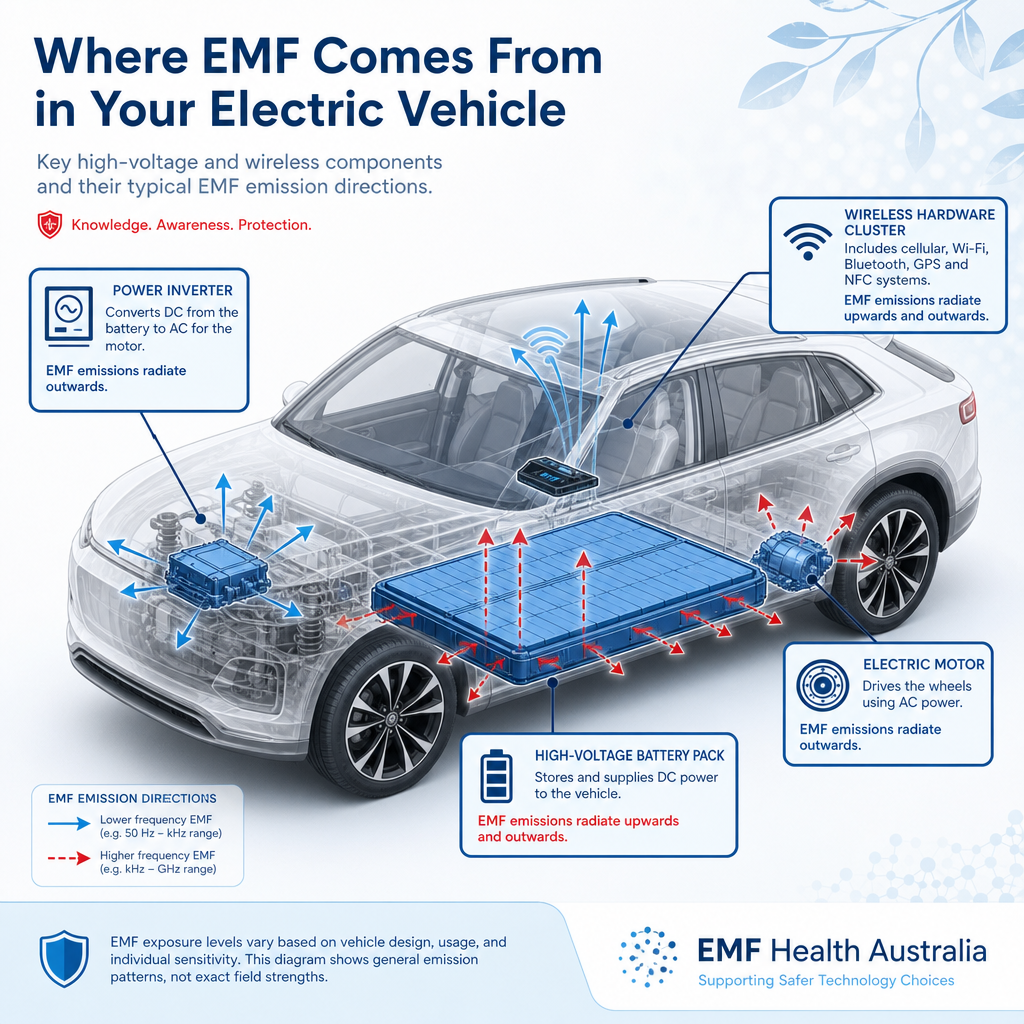
The main sources are the battery pack, the inverter and motor, the high-current cabling between them, regenerative braking, and the wireless systems in the cabin. Readings tend to be higher near the floor and front footwell. They vary by make, model and how the manufacturer routes its cabling.
Battery pack and cabling
The battery sits low in most EVs, usually spread across the floor. It delivers direct current through heavy cables to the inverter. Direct current produces mainly static fields, but the current changes with acceleration, so low-frequency components appear too. Manufacturers typically shield and twist cabling to reduce stray fields, and the quality of that work differs between vehicles.
Inverter and motor
The inverter converts battery power into the alternating current the motor needs. It does this by switching rapidly, which creates fields across a range of frequencies. The motor then adds its own field that changes with speed. In many cars, these components sit at the front axle, which is why front footwell readings often differ from the rear cabin.
Regenerative braking
When you lift off or brake, the motor acts as a generator and current flows back into the battery. That reverses and changes the current path, so the field profile shifts with your driving. It is part of why a single measurement tells you little. A reading at a standstill is not a reading at 100 km/h.
Wireless systems and phones
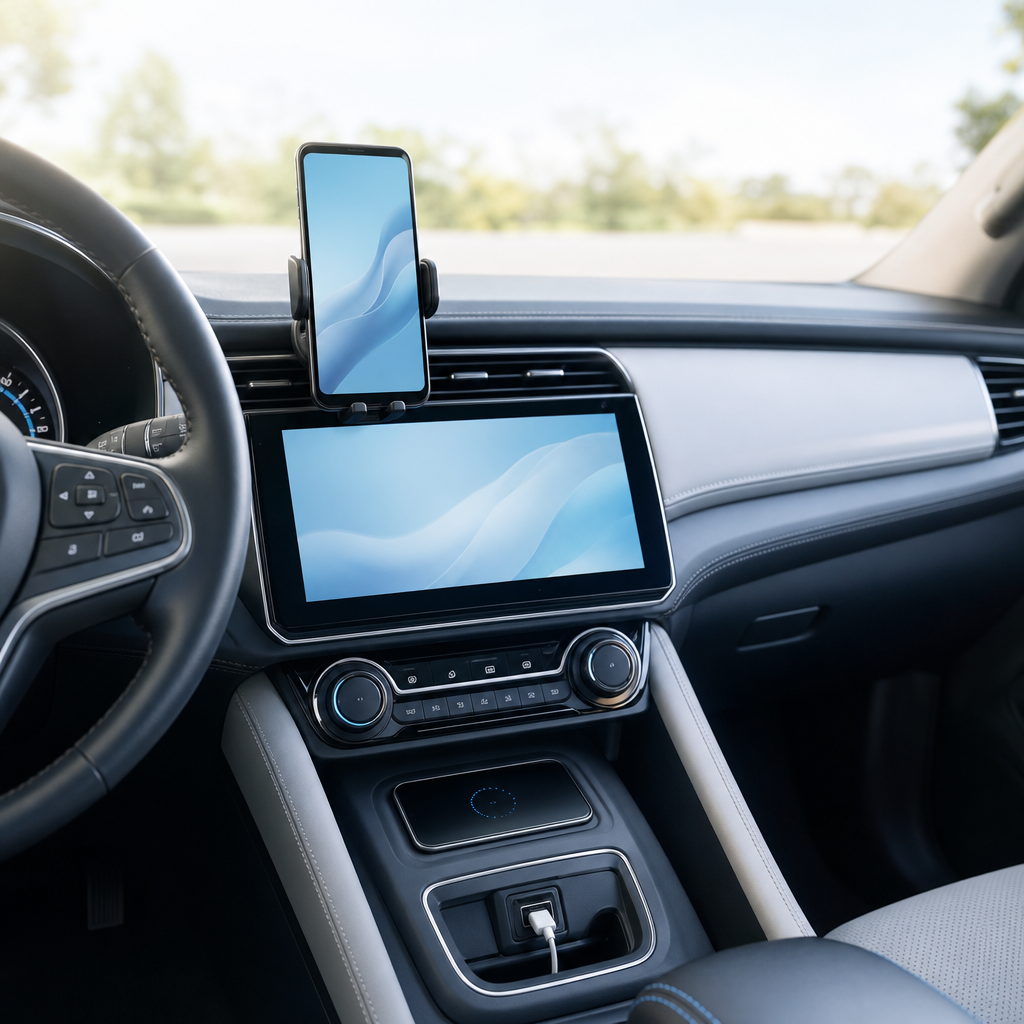
Then come the RF sources. Bluetooth for calls and audio, a wi-fi hotspot, cellular telematics, key fobs, your phone and a wireless charging pad can all be active at once. A phone searching for signal while you drive through a patchy regional stretch works harder, and that is worth knowing.
What the measurements show
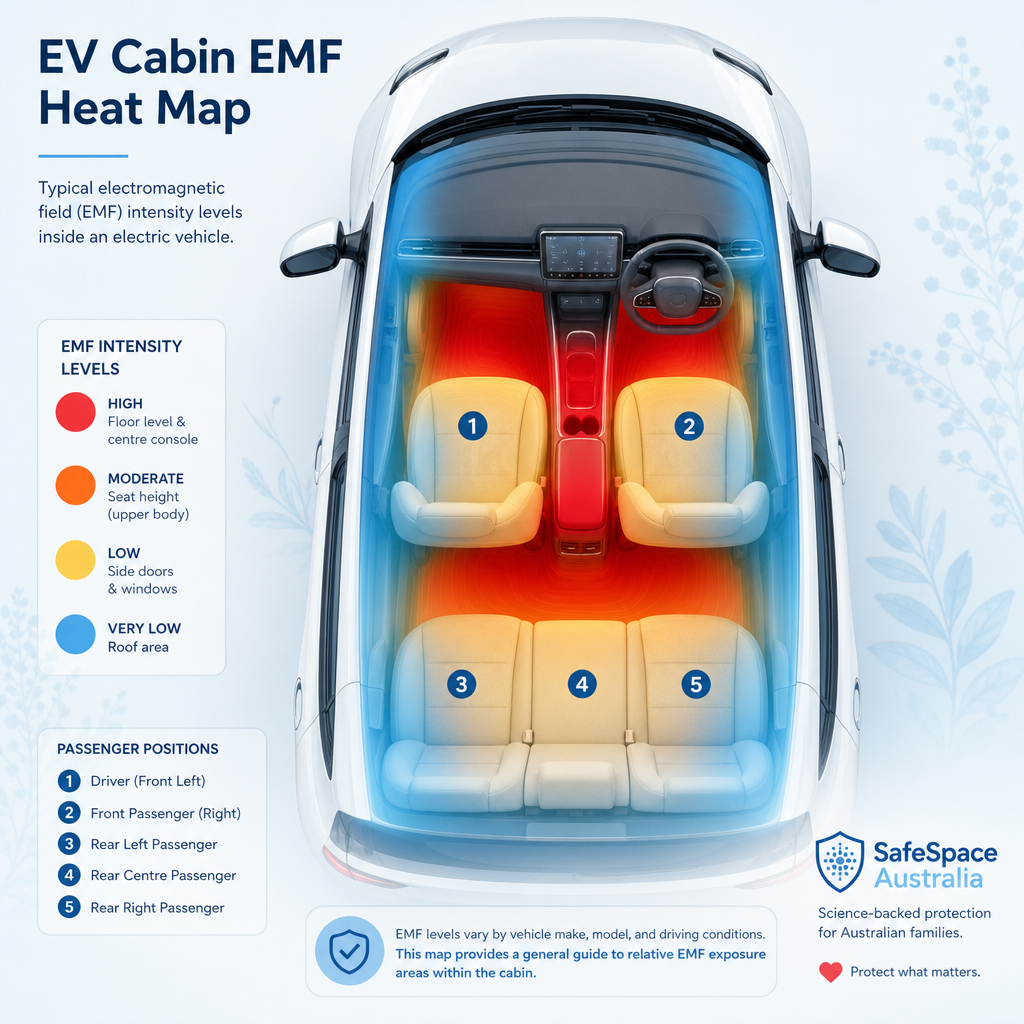
Published measurements vary by model and by where the meter sits. The consistent pattern is that readings are higher closer to the floor and front footwell, and lower toward the roof and rear seats. We would not give you a single number for "an EV", because one does not exist. If you want real data about your own car, a quality meter and a systematic walk-through of the cabin will tell you more than any generic claim.
What do ARPANSA and ICNIRP say about EV fields?
ARPANSA and ICNIRP set reference levels designed to prevent established health effects, and individual EV sources typically sit below them. ARPANSA's radiofrequency standard is RPS S-1 (2021). For low-frequency fields, ICNIRP's 2010 guidelines are the international benchmark. We state this plainly because it is the honest starting point.
ARPANSA is the Australian Radiation Protection and Nuclear Safety Agency. Its radiofrequency standard (RPS S-1, 2021) covers RF from about 3 kHz to 300 GHz, including Bluetooth, Wi-Fi and cellular signals in your cabin. For low-frequency magnetic fields from the drivetrain, see ARPANSA's page on extremely low frequency electric and magnetic fields and ICNIRP's 2010 low-frequency guidelines.
In those guidelines, ICNIRP sets a general public reference level of 200 microtesla (µT) for 50 Hz magnetic fields, the frequency of the Australian grid. Reference levels vary by frequency, so the exact figure that applies to an EV motor depends on what the motor is doing at that moment. ICNIRP also published updated 2020 radiofrequency guidelines.
The World Health Organization and ARPANSA both state that, at levels below these guidelines, there is no established evidence of harm. The International Agency for Research on Cancer classified extremely low frequency magnetic fields as possibly carcinogenic to humans (Group 2B) in 2002, based on limited evidence from epidemiological studies, and did the same for radiofrequency fields in 2011. Group 2B is a precautionary category. It means the evidence is limited, not that harm is demonstrated.
So here is the honest summary. If you drive an EV, the published literature does not say you are exceeding safe levels. We are not going to tell you otherwise. For how WHO and ARPANSA limits relate to cumulative home and device exposure, see our WHO and ARPANSA guidelines explainer.
What the limits are designed to do
This is where our perspective begins. These limits were built to prevent known acute effects, such as nerve stimulation and tissue heating, by assessing exposure from a given source. They were not designed to assess what happens when many sources overlap for hours every day, week after week. That is a gap in the framework, and it is the gap the next section is about.
Why might the combined load in an EV cabin still matter?
Our view at EMF Neutralizer is that an EV cabin stacks battery, motor, cabling, Bluetooth, wi-fi, phone and charging fields at once. That combined load may still be worth thinking about for regular drivers and passengers even when each source tests below threshold. This is our belief and our customers' experience. It is not a proven health effect.
Here is the reasoning. Regulatory reference levels are set source by source. They answer the question: is this device, on its own, within the limit? They do not answer the question a driver is really asking: what is my total daily exposure when the floor, the dash, my phone and my watch are all active in a space the size of a phone booth?
We believe combined daily exposure across a day is the relevant measure. A commuter might leave home surrounded by a router and smart devices, spend an hour in a cabin with an EV drivetrain and a phone on Bluetooth, sit at a desk with a laptop and monitor, then repeat it on the way home. No single item breaches a limit. The cumulative load is still substantial.
We want to be careful about what this is and is not.
- It is a considered position based on how the standards are structured and on what our customers tell us.
- It is not a clinical finding. We are not saying EVs cause illness, and we are not saying the published measurements are wrong.
- It does not replace medical advice. If you have symptoms that concern you, see your GP.
Some people are simply more aware of their environment than others. Our view is that for those people, reducing the stack is a reasonable, low-cost step to support your biology, whether or not each source is classified as safe in isolation.
What practical habits reduce your in-car exposure?
Start with habits that cost nothing: use your phone less while moving, keep devices off your lap, switch off wireless features you do not use, step out of the cabin during fast charging when practical, and position child seats thoughtfully. None depend on any product, and all are consistent with standard precautionary advice.
Reduce phone use on the move
Your phone is likely the strongest RF source within arm's reach. Calls on speaker or through the car's system keep it away from your head. In patchy coverage, a phone boosts its signal, so a quick call in a dead spot is a good one to skip. Download maps and playlists before you leave instead of streaming.
Keep devices off your lap
Laptops, tablets and phones on a lap put an active RF source close to the body. Rideshare drivers and passengers should use the console or a mount, not a thigh. In the footwell, bags with devices sit near the area where low-frequency readings tend to be higher, so store them in the boot or on the seat.
Turn off what you are not using
If you do not need a wi-fi hotspot, switch it off. If you are not using Bluetooth, disable it. Wired charging and wired audio remove the need for a wireless pad and a Bluetooth link altogether. Each feature you switch off is one less item in the stack.
Be thoughtful during fast charging of the car
During DC fast charging, the car is stationary and a high-current system is running nearby. Standing outside the vehicle while it charges is already convenient: you can stretch, grab a coffee and get away from the cabin. We suggest limiting time inside the car while it fast charges. It is a precautionary habit, not a response to a proven risk.
Place children's seats thoughtfully
Children are smaller, and their seating position relative to the floor is different from an adult's. Where your car allows it, consider whether the rear outboard seat or centre position suits your child better, and keep tablets and phones in their hands off the floor. There is no Australian guideline that says one position is unsafe. This is simply a sensible precaution if you want one.
How does the Aulterra Whole Car USB fit in?
The Aulterra Whole Car USB plugs into a USB socket and is designed to harmonise the cabin environment. It pairs with Neutralizer Discs on phones and dash devices, and pendants or wristbands for the driver. Together they form layered neutralisation, not blocking. For wider in-car context, see EMF protection for your car.
Here is how we think about the layers.
Whole-car unit. The USB device works on the cabin as a whole. You install it once and leave it. It is the base layer for an EV where the stack of sources is the concern.
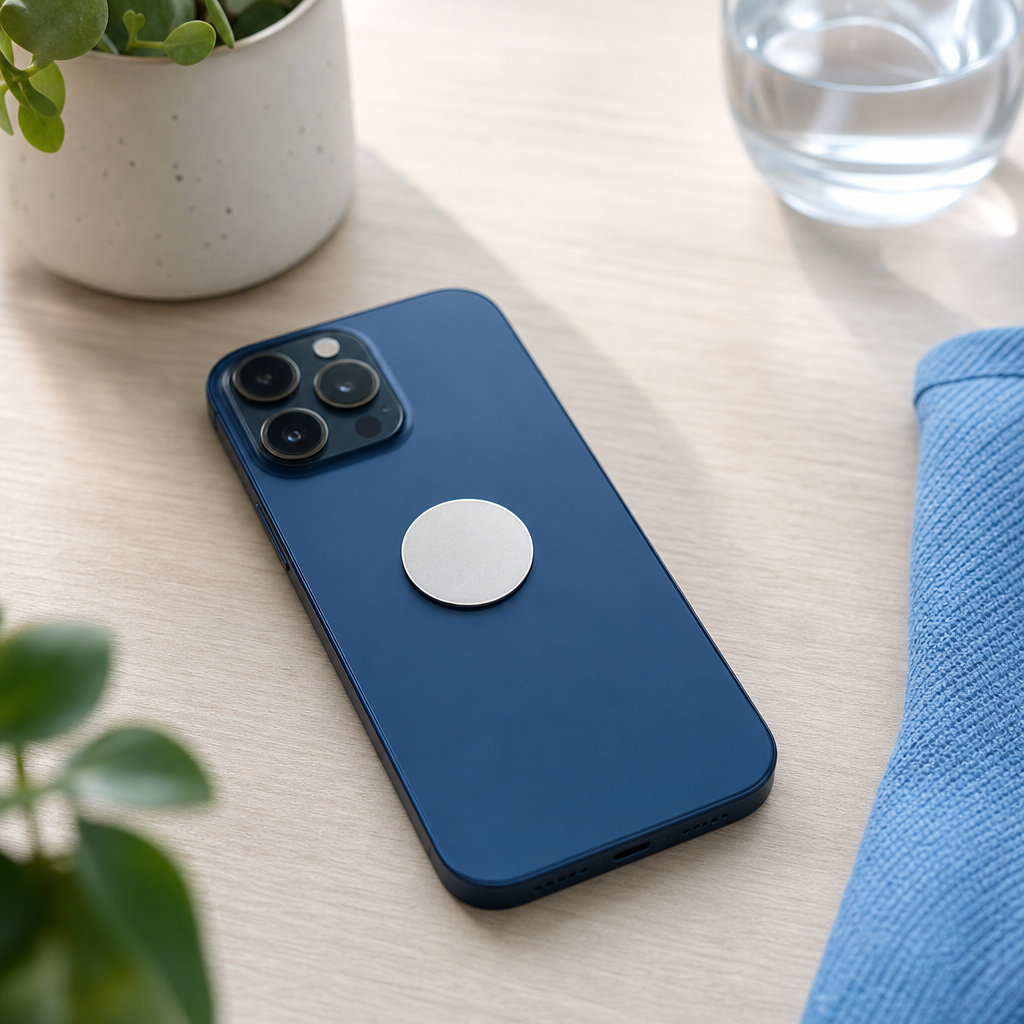
Discs for phones and dash devices. Discs stick onto the phone, tablet or dash-mounted device. Your phone is the device closest to you, and the one most likely to be in your hand, on the console or in your pocket.
Pendants and wristbands for the driver. A pendant or wristband travels with you, so coverage continues outside the car: the office, the supermarket, the flight home. Different formats suit different people, and we cover how to choose between them on the site.
Aulterra products are designed to harmonise the cabin environment while your devices keep working normally. They are a passive, install-and-leave layer for people who want that extra support on top of the habits above. We do not claim they lower measured field strength on a meter: a gauss meter should show the same readings before and after installation, and that is expected. What we share is what customers tell us about how they feel on the road and at home. For documented testing and peer-reviewed research on Aulterra neutralisation, see our science and evidence page and research archive. If you are new to the discs, our guide on how to apply an EMF neutraliser disc walks through placement step by step.
What Whole Car USB buyers describe
The following is customer feedback on the Aulterra Whole Car USB, quoted with permission. Individual results vary. See more customer stories on our testimonials page.
Y M Dorfman wrote:
I wanted to give you feedback on the car USB I bought. Thank G-d I see a very noticeable difference with it. I would usually become exhausted every time driving my car and need the bathroom frequently. Now I can drive an hour and a half without stopping for the restroom even ONCE! I'm also much more calm when driving. So Thank you, Thank you, and one more time THANK YOU!
Barb Barry wrote:
I noticed the difference right away. Will never go without one ever again.
Those accounts match what we often hear from drivers who spend real time in the cabin: less drained on arrival, and a calmer feel behind the wheel.
What does a long commute feel like with layered protection?
The most useful measure for a driver is not the reading on any one component. It is how many hours you spend inside the stack, and whether you have taken control of your immediate environment. Customers describe feeling less drained after long drives.
The car is the one environment where you cannot simply walk away. At home you can move rooms. At a desk you can stand up. In a car doing a 90-minute commute, you are in the stack until you arrive. That is why we think the car deserves its own thinking, not just a footnote to the home.
Our customer-reported estimates
We want to be transparent about our own numbers. These estimated ranges summarise what customers tell us in their own words:
- An estimated 60–85% improvement in perceived EMF-related fatigue, based on qualitative outcome descriptions from residential use cases. Individual results vary.
- An estimated 70–90% reduction in headache frequency reported by users in high-device environments, based on qualitative outcome descriptions from home office and workplace use cases. Individual results vary.
The figures come mainly from home and office feedback rather than a dedicated in-car survey. We publish them because drivers often ask how others describe their experience, and because they reflect the patterns we hear consistently from customers who use layered Aulterra protection.
One customer's account
One customer I have worked with has had severe allergies her whole life, and she reports that they are made worse around phones and laptops. She started with a disc on her phone, and later added an Aulterra Pillar Energy Pendant. She told me she now drives through the city and feels fine, something she could not do before. She even managed an international flight to visit family, with the pendant on. Her story shows why portable coverage matters once you step out of the car — and why we pay close attention to what customers describe in real life.
Where we agree and disagree with the mainstream
We agree with ARPANSA and ICNIRP on the measurements. EVs are generally within the reference levels. We disagree that this closes the question for everyone. A framework built around single sources and acute effects does not tell you what layered, chronic exposure means in real-world use. Until that is studied properly, we think the sensible approach is practical and proportionate: free habits first, then layered protection for those who want it. Your home and your car should work with you, not against you.
References
These references establish regulatory context. They do not endorse EMF Neutralizer products.
- Bundesamt für Strahlenschutz (BfS), press release on magnetic fields in motor vehicles, 2025.
- International Commission on Non-Ionizing Radiation Protection, Guidelines for limiting exposure to time-varying electric and magnetic fields (1 Hz to 100 kHz), 2010.
- International Commission on Non-Ionizing Radiation Protection, Guidelines for limiting exposure to electromagnetic fields (100 kHz to 300 GHz), 2020.
- Australian Radiation Protection and Nuclear Safety Agency, Radiation Protection Standard for Limiting Exposure to Radiofrequency Fields (RPS S-1), 2021.
- Australian Radiation Protection and Nuclear Safety Agency, Extremely low frequency electric and magnetic fields.
- World Health Organization, Radiation: Electromagnetic fields.
- International Agency for Research on Cancer, Monograph Volume 80: Static and Extremely Low-Frequency (ELF) Electric and Magnetic Fields (2002); Monograph Volume 102, Part 2: Radiofrequency Electromagnetic Fields (2013) (Group 2B classifications cited above).
- Electric Vehicle Council Australia, State of Electric Vehicles reports.
Stay informed on EMF wellness
Get practical tips and product updates in your inbox.
Frequently asked questions
Is electric vehicle EMF exposure Australia within ARPANSA limits?
Yes. Published in-cabin measurements generally sit within ARPANSA and ICNIRP reference levels for individual sources. Readings vary by model and are usually higher near the floor and front footwell. Those limits were not designed for many overlapping sources hour after hour. Our view is that cumulative daily exposure in a stacked cabin may still be worth taking seriously for anyone who drives or rides often. That is a belief, not a proven health effect.
Do electric cars emit more EMF than petrol cars?
Not as a simple rule. EVs add high-current battery cabling, an inverter and a motor. Petrol cars still have alternators, wiring and fans, so cabins are not field-free. Wireless devices are the same in any car. BfS reports that motor power is not an indicator of magnetic field strength and that layout matters. Measure your own car if you want real data.
Where is the EMF highest in an electric vehicle?
Readings tend to be higher near the floor and the front footwell, where the battery, cabling, inverter and motor are located, and lower toward the roof and rear seats. The pattern varies by manufacturer and by how the vehicle is driven, so cabin readings are not uniform.
Does the Aulterra car neutralizer reduce EMF readings?
No. We do not claim that Aulterra products lower measured field strength, and a meter should show the same readings with or without them. What we report is customer experience: people describe feeling less drained, and our percentage figures are estimates from qualitative descriptions, not clinical data. We make no medical claims.
Should I avoid fast charging with people in the car?
There is no Australian guideline telling you to stay out of the car during fast charging. We suggest limiting time inside as a precaution, since the car is stationary and a high-current system is running nearby. Stepping out to stretch is easy and costs nothing.
How do I use the Aulterra whole-car USB neutralizer?
Plug the Aulterra Whole Car USB into a USB socket in your car and leave it there. Add Neutralizer Discs to your phone and dash devices, and consider a pendant or wristband for the driver so coverage continues outside the car. It harmonises the cabin environment; it does not block signals or lower meter readings.

Richard Kent
Science-backed EMF wellness education from the EMF Neutralizer team.
Related articles
EMF Levels Inside Cars Australia: What Drivers Need to Know
EMF levels in cars come from several sources at once: low-frequency magnetic fields from wiring, motors and batteries in every vehicle type, plus radiofrequency…

How to Apply EMF Neutraliser Disc: A Step-by-Step Guide for Phones and Home Devices
To apply an Aulterra EMF neutraliser disc, clean and dry the back of your phone, peel the disc, and press it on firmly, clear of camera lenses and ports, then f…
Does Phone EMF Protection Actually Work? An Evidence-Based Look for Australians
Phone EMF protection products such as the Aulterra neutraliser disc do not block or reduce mobile radiation, and they are not designed to. Genuine harmonising d…