EMF Protection FAQs Australia: Your Most Common Questions Answered (2026)

If you have landed here with a browser tab full of half-answered questions about EMF protection, you are not alone. Every week, Australians search for clear, honest answers about whether electromagnetic fields are genuinely something to pay attention to, or whether the whole conversation is overblown. The honest answer is: it depends entirely on how you frame the question.
The mainstream line is that everyday consumer devices produce non-ionising EMF at levels well below regulated safety thresholds, so there is nothing to worry about. I do not fully accept that framing, and I will explain precisely why throughout this guide. The issue is not whether your phone or router exceeds a single-device safety limit. The issue is what happens when you are surrounded by a router, a smart meter, a laptop, a phone, a television, and a microwave simultaneously, for sixteen hours a day, every day. That is the reality of modern Australian life, and our regulatory frameworks were not designed with that cumulative picture in mind.
This page answers the most common EMF protection questions in one place. If you are new and want a map of our full guide library and product range first, start with our EMF protection guide hub or which Aulterra product to start with on our buyer's guide. I will walk you through what EMFs actually are, where they come from in a typical Australian home, what the body may register under sustained exposure, and how neutralisation products work and which one suits your situation. I will be direct about what the evidence supports and where the picture is still emerging. You deserve accuracy, not anxiety.
Key Takeaways
- Modern Australian homes and offices expose occupants to multiple simultaneous EMF sources around the clock, creating a cumulative daily exposure that goes well beyond what single-device safety standards were designed to assess.
- Symptoms commonly associated with sustained EMF exposure include fatigue, disrupted sleep, headaches, and difficulty concentrating. These are often dismissed or attributed to other causes.
- Regulatory thresholds in Australia, set by ARPANSA, address acute, single-device exposure scenarios, not the aggregate environmental load most people actually live with.
- EMF neutralisation products work through a different mechanism than shielding. They do not block fields. They retune the incoherent component of those fields so they interact differently with biological tissue, and customer-reported outcomes often describe meaningful improvements in sleep, energy, and headache frequency.
- Product selection should match your primary exposure source: phone, home, car, or body.
- The goal is not to eliminate every field from your environment. It is to neutralise your environment systematically, starting with your highest-exposure points.
Protect your family from EMF exposure
Browse our science-backed neutralizer products.
Shop EMF ProtectionSummary Table
- Common Concern
- Fatigue, headaches from extended use
- Recommended Product Type
- EMF Neutralizer Discs
- Coverage
- Single device
- Common Concern
- Headaches, poor concentration
- Recommended Product Type
- EMF Neutralizer Discs on each device
- Coverage
- Device-by-device
- Common Concern
- Poor sleep, fatigue
- Recommended Product Type
- Whole House USB
- Coverage
- Whole dwelling
- Common Concern
- In-car exposure, fatigue on long drives
- Recommended Product Type
- Whole Car USB
- Coverage
- Vehicle cabin
- Common Concern
- General wellbeing, energy, resilience
- Recommended Product Type
- Pillar EMF Energy Pendant / Vitality Wristband
- Coverage
- Personal, portable
- Common Concern
- Combined household EMF load
- Recommended Product Type
- Whole House USB + EMF Neutralizer Discs
- Coverage
- Layered approach
What Are EMFs and Where Do They Come From in a Modern Australian Home?
Electromagnetic fields are areas of energy produced whenever electricity flows or wireless signals are transmitted. They exist on a spectrum, from extremely low frequency fields produced by power lines and household wiring, through radiofrequency fields generated by Wi-Fi routers, mobile phones, and Bluetooth devices, to higher-frequency microwave radiation used in some cooking and communications applications.
In a practical sense, every electrical device in your home contributes to your ambient EMF environment. The sources that matter most in terms of proximity and duration are:
Smart meters. By 2026, smart meter rollout across Australian states is well advanced. Victoria completed its mandatory rollout years ago, and other states have followed. These devices transmit usage data wirelessly at regular intervals throughout the day. Because they are typically mounted on the exterior wall of the home, they sit within one to three metres of living areas and bedrooms in many Australian homes and apartments.
Wi-Fi routers. The average Australian household now runs multiple devices on Wi-Fi simultaneously. The router itself typically operates at 2.4 GHz and 5 GHz, broadcasting continuously. Most routers are left on around the clock. If yours sits in a living room or hallway close to a bedroom wall, it is contributing to your sleeping environment even when you are not actively using it.
Mobile phones. Australians average well over four hours of active screen time per day on mobile devices, and many people sleep with their phone on or beside the bed. The phone is the single highest-proximity EMF source for most people because it is held directly against the body or kept within centimetres of the face during calls.
Laptops and desktop computers. A laptop placed on a desk in front of you for eight hours generates both extremely low frequency fields from its power supply and radiofrequency fields from its Wi-Fi and Bluetooth radios. When combined with an external monitor, a wireless keyboard and mouse, and a phone sitting nearby, a standard home office setup involves five to seven simultaneous EMF sources within arm's reach.
Household appliances. Microwave ovens, induction cooktops, electric blankets, and even LED lighting with switch-mode power supplies all contribute to the household EMF picture. Electric blankets in particular are worth noting because they are used in direct physical contact with the body for extended periods during sleep.
Neighbours and shared building infrastructure. In apartments and terraced homes, which is the reality for a significant share of the Australian population, you are also exposed to the wireless infrastructure of neighbouring dwellings. You cannot control or see those sources, which makes the aggregate load genuinely unpredictable from outside your own flat.
The point of cataloguing all of this is not to create alarm. It is to establish a factual baseline: a modern Australian living in a city or suburb is immersed in an electromagnetic environment that did not exist twenty years ago, and that environment is denser than any individual device's safety rating would suggest.
Are Everyday EMF Levels Actually a Problem? The Cumulative Exposure Argument
This is the question that generates the most debate, and I want to address it directly rather than hedge.
ARPANSA, the Australian Radiation Protection and Nuclear Safety Agency, sets the standard referenced guidelines for EMF exposure in Australia. Those guidelines are informed by the International Commission on Non-Ionizing Radiation Protection and are designed to prevent established acute biological effects from high-intensity exposure. They are not designed to assess the long-term, low-level, multi-source exposure scenario that most Australians now live with. Our WHO and ARPANSA guidelines explainer breaks down what those standards measure and what they leave out.
The gap between those two scenarios is the crux of the issue.
Consider the logic this way. A single car on an empty highway produces exhaust well below any harmful threshold. Put ten thousand cars on the same stretch of road and the air quality picture changes entirely, even though each individual vehicle is still within its own emission standard. Regulatory frameworks designed to assess individual vehicles do not automatically tell you whether the aggregate environment is healthy to breathe in.
The same reasoning applies to EMF. When you are simultaneously exposed to a smart meter through the bedroom wall, a router broadcasting from the hallway, a phone on the bedside table, and an electric blanket in contact with your body, the body is not experiencing each of those fields in isolation. It is processing all of them at once, continuously, throughout your sleep cycle.
The scientific picture on chronic, low-level, multi-source exposure is genuinely unresolved. There are studies suggesting biological effects at levels below regulated thresholds, and there are studies showing no effect. The honest position is to acknowledge that uncertainty, not to dismiss it. What I observe consistently across customer experiences is that people who make deliberate changes to their immediate EMF environment, particularly in their bedroom and at their primary workstation, describe meaningful improvements in how they feel. That pattern is too consistent to ignore.
I am not making clinical claims here. What I am saying is that the invisible electromagnetic burden most Australians carry is real, it is cumulative, and the decision to address it proactively is a reasonable one regardless of where the peer-reviewed literature eventually settles.
What Symptoms Do People Associate With EMF Exposure?
The cluster of symptoms most commonly reported by people who believe their daily EMF environment is affecting them includes:
- Persistent fatigue that is disproportionate to sleep quantity
- Difficulty falling asleep or staying asleep, particularly if a router or smart meter is nearby
- Morning headaches or headaches that build throughout the workday
- Difficulty concentrating or a sense of cognitive fog by mid-afternoon
- Low-grade irritability or a feeling of being mentally scattered
- Ringing in the ears (tinnitus) or a sense of pressure in the head
- Skin sensitivity or prickling sensations when near active devices
None of these symptoms are unique to EMF exposure, which is precisely why they go undiagnosed and unaddressed for years in many people. A person experiencing morning headaches and afternoon fatigue is far more likely to be told to drink more water or improve their sleep hygiene than to have the question of their EMF environment raised at all.
One customer I worked with described moving into a new apartment and within days experiencing a combination of headaches, vertigo, fatigue, depression, ringing ears, and a frustrating inability to concentrate. She described it as feeling like the energy was being zapped out of her whenever she was home. She noted a transformer box directly outside her bedroom window and a strange electrical hum in the shared wall. After fitting a Whole House USB and wearing a pendant, she reported waking refreshed for the first time in weeks after a single night of use (though individual results vary). Her words: "I was starting to question my sanity, so this is a really big deal for me."
The pattern of relocation followed by rapid symptom onset is one of the clearest indicators that EMF environment, rather than lifestyle, is the variable at play. When nothing about your habits has changed but your physical location has, and your symptoms change correspondingly, the environment is the logical place to look.
There is also the experience of someone I know who has lived with a condition her entire life where her severe allergies are triggered and worsened by EMF exposure. Her reaction to mould is particularly acute when she uses a phone or laptop. Her condition is legally recognised as a disability, and the burden of it had led her to physically distance herself from built-up areas to find relief. After applying an EMF Neutralizer Disc to her phone, the improvement in her symptoms was significant enough that when the disc once fell off without her immediately noticing, she became ill very quickly. The correlation was unmistakable. She later began wearing the Pillar EMF Energy Pendant and describes it as a life-changing experience. She can now drive through the city without distress, and was able to take an international flight to visit family, something that would previously have been beyond consideration.
These outcomes do not sit neatly within a randomised controlled trial framework. But they are reported consistently, they follow a logical causal pattern, and they point toward a genuine interaction between EMF environment and biological response that deserves to be taken seriously.
Do EMF Neutralisers Actually Work? Evidence, Mechanisms, and Customer Outcomes
This is the question most newcomers to this space ask first, and it deserves a direct answer.
EMF neutralisers do not work by blocking or shielding electromagnetic fields. This is an important distinction. Shielding involves physically interrupting the transmission of a field using conductive materials. That approach has genuine applications in industrial settings but is largely impractical for everyday consumer use, and it does not retune the incoherent component of the field or change how that energy interacts with biological tissue.
Neutralisation works differently. The products in the EMF Neutralizer range are built on Aulterra technology, which uses a paramagnetic mineral compound to interact with the incoherent electromagnetic energy produced by devices. The proposed mechanism is that the compound retunes or neutralises the incoherent component of the field so that it no longer registers as a stressor to biological tissue. The field is not eliminated. The nature of how it interacts with the body is changed.
The science underpinning Aulterra's approach is detailed in the What Is Aulterra science article, which I recommend reading if you want to go deeper on the mechanism. For this guide, the relevant question is: does it produce observable outcomes?
Based on reported customer experiences across residential use cases, users describe an estimated 60–85% improvement in perceived EMF-related fatigue following product application. In home office and workplace settings, users in high-device environments report an estimated 70–90% reduction in headache frequency over a four-week period. These figures come from qualitative, customer-reported outcome descriptions, not clinical trials, and I present them as such. But the consistency of the pattern across a wide and varied user base is meaningful.
Peter Mitchell, a Principal Physiotherapist and practice owner on the Gold Coast, put devices on all his laptops, phones, his children's devices, and installed both a home and office house protector. He assessed the products using applied kinesiology, a recognised holistic health testing method used widely in complementary and integrative practice to evaluate how the body responds to environmental stressors. He describes finding the products effective in reducing the stress response triggered by device radiation and now supplies EMF Neutralizers to some of his clients. That is the kind of outcome that carries weight: a trained health professional using an established assessment approach and choosing to make the products available to clients who want them.
For those who approach this space with scepticism, that is a fair starting position. What I ask is that you weigh the cumulative customer experience pattern against the alternative: doing nothing while the invisible electromagnetic burden of modern life continues to accumulate.
Which EMF Neutraliser Product Suits Which Situation?
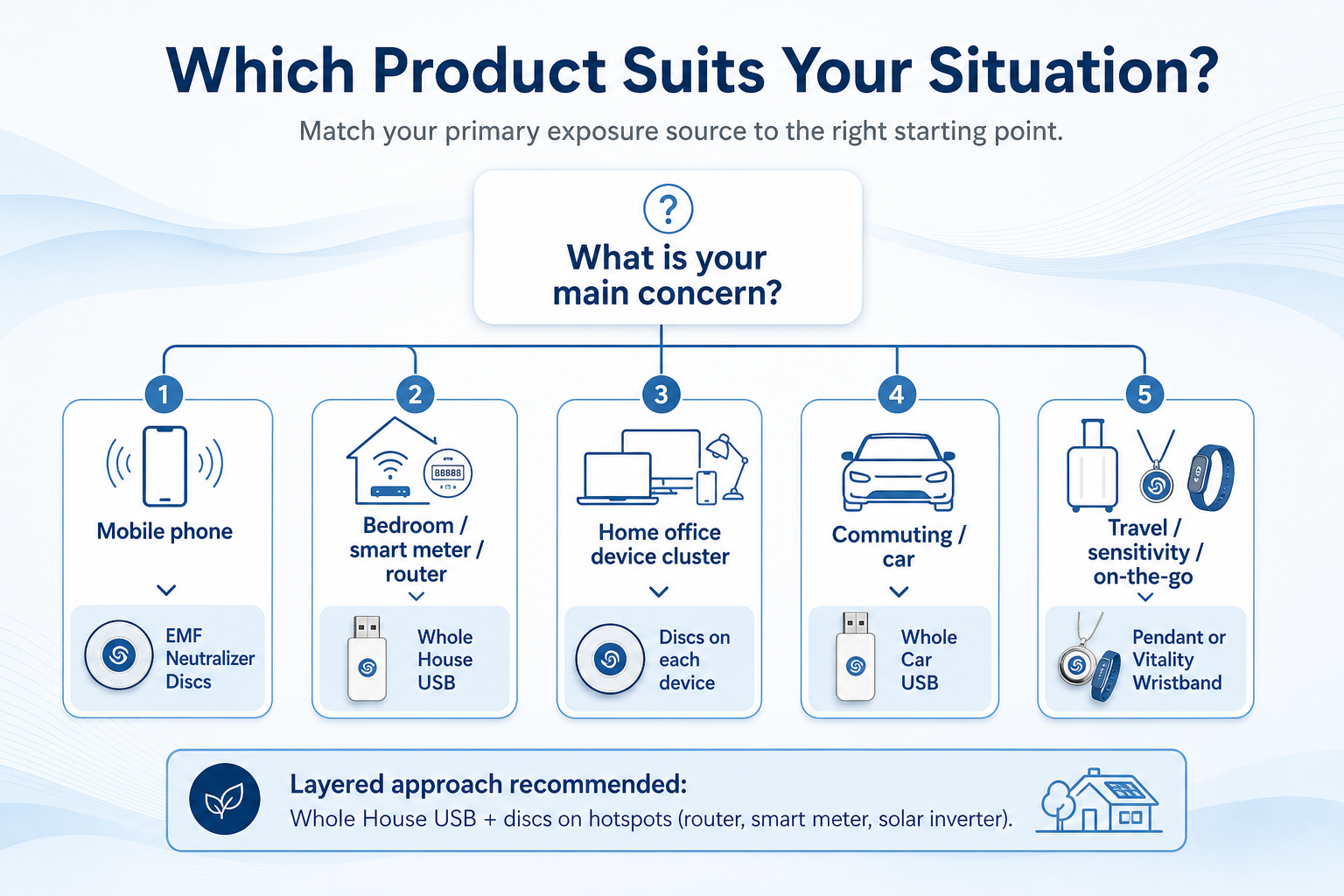
One of the most common questions I receive is: "Where do I start?" The answer depends entirely on your primary exposure source and living situation. Compare stick-on and plug-in options on our EMF protection devices collection, then use the breakdown below.
EMF Neutralizer Disc for Phones and Devices
The EMF Neutralizer Discs are the entry point for most people because the mobile phone is the highest-proximity EMF source in the average Australian's day. It is held against the ear, carried in a pocket against the body, and placed on the bedside table during sleep. A disc applied directly to the phone addresses the most concentrated personal exposure point. The same discs can be applied to tablets, laptops, desktop computers, microwave ovens, Wi-Fi routers, and any other individual device in your environment.
For the home office worker with a cluster of devices, applying discs to each piece of equipment is the most targeted approach, addressing each source individually. See the EMF Protection for Phone page for full guidance on phone-specific application.
Whole House USB
The plug-in Whole House USB is designed to extend coverage across an entire dwelling. It is the product I recommend when the primary concern is a bedroom environment affected by a smart meter, a router in an adjacent room, or building wiring that cannot be individually addressed. For people in apartments, where the external EMF environment includes neighbouring units and building infrastructure, the whole house unit provides a broader baseline of coverage — pair it with stick-on sources from our home EMF protection collection where needed.
For a large or irregular floor plan, as one customer noted after fitting her whole house unit, the single plug-in addresses the general environment but strategic placement of additional discs on specific hotspots (router, smart meter, solar inverter) completes the picture. This is the layered EMF protection approach, and it is how I recommend building out a comprehensive home strategy.
EMF Protection Pendants and Wristbands
Wearable products serve a different function from device-based or home-based solutions. They travel with you, which means they extend your protection into environments you cannot control: offices, public transport, shopping centres, airports, and other people's homes.
The Pillar EMF Energy Pendant is the product I recommend for anyone with significant sensitivity, a demanding travel schedule, or a work environment where they have limited ability to modify the physical infrastructure. The pendant works continuously as a personal field, providing consistent support for your biology regardless of where you are.
For those who prefer a wristband format, the Aulterra Vitality Wristband offers equivalent portable coverage; the choice is largely about personal preference and lifestyle. See the EMF protection jewellery guide for a full format comparison, or the EMF protection pendants and necklaces guide for pendants specifically.
Whole Car USB
The car is an often-overlooked EMF environment. Modern vehicles are dense with electronics: engine management systems, Bluetooth, GPS, in-built entertainment systems, and in electric and hybrid vehicles, significant battery and power management fields. If you spend meaningful time commuting, the Whole Car USB addresses this concentrated exposure period.
Building a Layered Strategy
For most Australians, the most effective approach is layered: a whole house unit for baseline home coverage, discs on the highest-use personal devices (phone first, then laptop and router), a pendant or wristband for personal coverage outside the home, and a car unit for regular commuters. This layered EMF protection approach does not require purchasing everything at once. Start with your most significant exposure source, observe the outcome, and expand from there.
How Do I Get Started and Choose Well?
Choosing the right starting point comes down to an honest audit of your own situation. I suggest walking through these questions:
Where do you spend most of your time? If it is a home office with multiple devices, start with discs on each piece of equipment. If it is primarily at home in a bedroom affected by a smart meter or router, start with a whole house unit. If you are frequently mobile, start with a pendant.
What symptom is most affecting your quality of life? Poor sleep is the most common presenting concern for people in bedroom environments with nearby smart meters or routers. Headaches and concentration difficulties are the most common concerns for desk-based workers. Energy depletion is the most common concern for those with high sensitivity or those spending long periods in high-density environments.
What is your floor plan and housing type? A single Whole House USB covers most Australian apartments, townhouses, and standard family homes. For a large, multi-storey house — or a home with separate living areas on another electrical circuit — a second unit is the practical next step. Regardless of size, I always recommend a layered approach: one Whole House USB for baseline coverage, plus Neutralizer Discs on high-output hotspots such as the router, smart meter, and solar inverter. That combination matters most in townhouses and dense urban blocks, where neighbours' wireless infrastructure adds exposure you cannot control from your side of the wall.
Are you starting from a place of scepticism? That is entirely reasonable. I recommend starting with a single phone disc, which is the lowest-cost entry point and the product with the most direct, observable daily interaction. Apply it, note your experience over two to four weeks, and let the outcome inform your next step.
What to Look for in an EMF Protection Brand
The EMF protection market in Australia includes products of wildly varying quality and credibility. Here is what distinguishes a trustworthy brand from one selling anxiety without substance:
- Transparent disclosure of the technology and mechanism behind the product
- Independent testing or research backing the product's claimed action
- Consistent, verifiable customer outcome reports, not just marketing testimonials
- Clearly communicated limitations: honest brands do not promise complete elimination of all EMF or make absolute health cure claims
- Accessible, responsive support for customer questions
The How to Vet an EMF Protection Brand article applies these criteria systematically and is worth reviewing before any purchase.
A Note on Realistic Expectations
EMF neutralisation is not a silver bullet and I will not pretend otherwise. If you have significant health concerns, your starting point should always include a conversation with a qualified health professional. What neutralisation products do is address a specific variable in your environment: the cumulative daily exposure to incoherent electromagnetic fields. When that variable is contributing to your symptoms, addressing it can produce meaningful, observable improvements. When other variables are the primary driver, the improvement will be more modest.
What I consistently observe is that people who approach neutralisation as one part of a broader approach to supporting their biology, alongside good sleep habits, regular movement, and a diet that supports nervous system function, get the best outcomes. Your home should work with you, not against you, and removing an unnecessary environmental stressor is a reasonable step toward that goal.
The invitation here is straightforward: explore the EMF Neutralizer range, identify the product that matches your most significant exposure source, and start there. The bedroom and the phone are the two most common starting points for good reason. Most people notice something within the first two weeks.
References
-
ARPANSA (Australian Radiation Protection and Nuclear Safety Agency), Electromagnetic Energy Overview. The official Australian government source for EMF safety guidelines and the framework by which consumer device emissions are assessed in Australia. Sets out the regulatory basis for current exposure standards.
-
International Commission on Non-Ionizing Radiation Protection (ICNIRP), Guidelines for Limiting Exposure to Electromagnetic Fields. The international standard that informs ARPANSA guidelines. Sets out the biological basis for current acute-exposure thresholds and the scope conditions under which those thresholds were derived.
-
Bioelectromagnetics Society, Peer-reviewed research journal covering biological and physical interactions between electromagnetic fields and living systems. Primary academic source for the ongoing scientific debate around non-ionising EMF effects at low levels.
-
Aulterra International, Published research and independent testing documentation for paramagnetic mineral compound EMF neutralisation technology. Basis for the mechanism of action underlying EMF Neutralizer product range. Referenced in the What Is Aulterra article on this site.
-
ABS (Australian Bureau of Statistics), Household Use of Information Technology, Australia. Provides data on Australian household device ownership, internet access, and technology usage patterns relevant to estimating aggregate EMF exposure across typical dwellings.
-
The BioInitiative Working Group, BioInitiative Report: A Rationale for Biologically-based Public Exposure Standards for Electromagnetic Fields. Independent review of over 2,000 peer-reviewed studies examining biological effects of non-ionising radiation, presenting the case for precautionary standards below current regulatory thresholds.
Stay informed on EMF wellness
Get practical tips and product updates in your inbox.
Frequently asked questions
What does our "emf protection faqs australia" article explain about EMF and why Australians should care?
This article explains that an electromagnetic field is a physical field produced by electrically charged objects — and why sustained, multi-source exposure is the practical concern for Australians today. In practical terms, every electrical device in your home, from your router to your smart meter to your phone, generates an EMF. Australians should care because modern homes and workplaces now involve sustained, simultaneous exposure to multiple EMF sources at levels and durations that simply did not exist a generation ago. The question is not whether individual devices exceed regulated thresholds. It is whether the cumulative daily load is having a biological effect over time.
Are Australian EMF safety standards adequate?
Australian safety guidelines, set by ARPANSA and informed by the International Commission on Non-Ionizing Radiation Protection, are designed to prevent acute biological effects from high-intensity, single-device exposure. They are not designed to assess long-term, low-level, multi-source exposure. A person surrounded by a router, smart meter, laptop, phone, and television simultaneously for sixteen hours a day is not a scenario those standards were built for. That gap in the regulatory framework is precisely why taking independent, precautionary action is reasonable.
What symptoms might suggest my EMF environment is affecting me?
The most commonly reported symptoms include persistent fatigue despite adequate sleep, morning or workday headaches, difficulty concentrating, low-grade cognitive fog, poor sleep quality, ringing in the ears, and a general sense of feeling drained at home or at a specific workstation. These symptoms are non-specific and can have many causes, but when they correlate with time spent in particular environments or with increased device use, the EMF environment is worth addressing.
Do EMF neutralisers block electromagnetic fields?
No. EMF neutralisers do not block or shield electromagnetic fields. They work through a different mechanism: the paramagnetic mineral compounds in Aulterra-based products interact with the incoherent component of the electromagnetic energy produced by devices, changing how that energy interacts with biological tissue. The field is still present but its effect on the body is altered. This is a fundamentally different approach from Faraday cage-style shielding, which is why neutralisers can be compact, non-intrusive, and applied directly to devices.
How long does it take to notice a difference after using EMF Neutralizer products?
Many users report noticing changes within the first one to four nights when addressing a bedroom environment, particularly improvements in sleep quality and morning energy. For headache and concentration improvements in a work environment, the pattern across reported customer experiences suggests the most marked changes emerge over a two-to-four-week period. Individual responses vary. Those with higher sensitivity tend to notice changes more quickly.
Which product should I buy first if I am new to EMF protection?
Start with the product that addresses your highest-proximity, highest-duration exposure source. For most Australians, that is the mobile phone. A phone disc is the lowest-cost entry point and addresses the device you are most likely holding against your body for hours every day. If your primary concern is a bedroom environment affected by a smart meter or router, the Whole House USB is the more appropriate starting point. If you need portable protection for work or travel, a pendant is the right choice.
Are EMF protection products safe to use?
Yes. EMF Neutralizer products do not emit radiation, do not interfere with device functionality, and do not require any change to how you use your devices. They are passive products that work through the physical properties of the compounds they contain. Individual responses vary, as with any wellbeing product.
Can I use multiple products together for greater coverage?
Absolutely, and this is the recommended approach for people with significant concerns or complex living environments. Combining a whole house unit with discs on individual high-use devices and a personal pendant covers your home environment, your specific device cluster, and your personal field when you are outside the home. This layered approach is the most comprehensive strategy and the one most likely to produce consistent, noticeable outcomes across all the environments you move through during the day.

Richard Kent
Science-backed EMF wellness education from the EMF Neutralizer team.
Related articles
EMF Levels Inside Cars Australia: What Drivers Need to Know
EMF levels in cars come from several sources at once: low-frequency magnetic fields from wiring, motors and batteries in every vehicle type, plus radiofrequency…

Electric Vehicle EMF Exposure Australia: What EV Drivers Should Know About In-Car Fields
Published measurements generally place electric vehicle magnetic fields within ICNIRP and ARPANSA reference levels, so there is no regulatory basis for alarm. F…
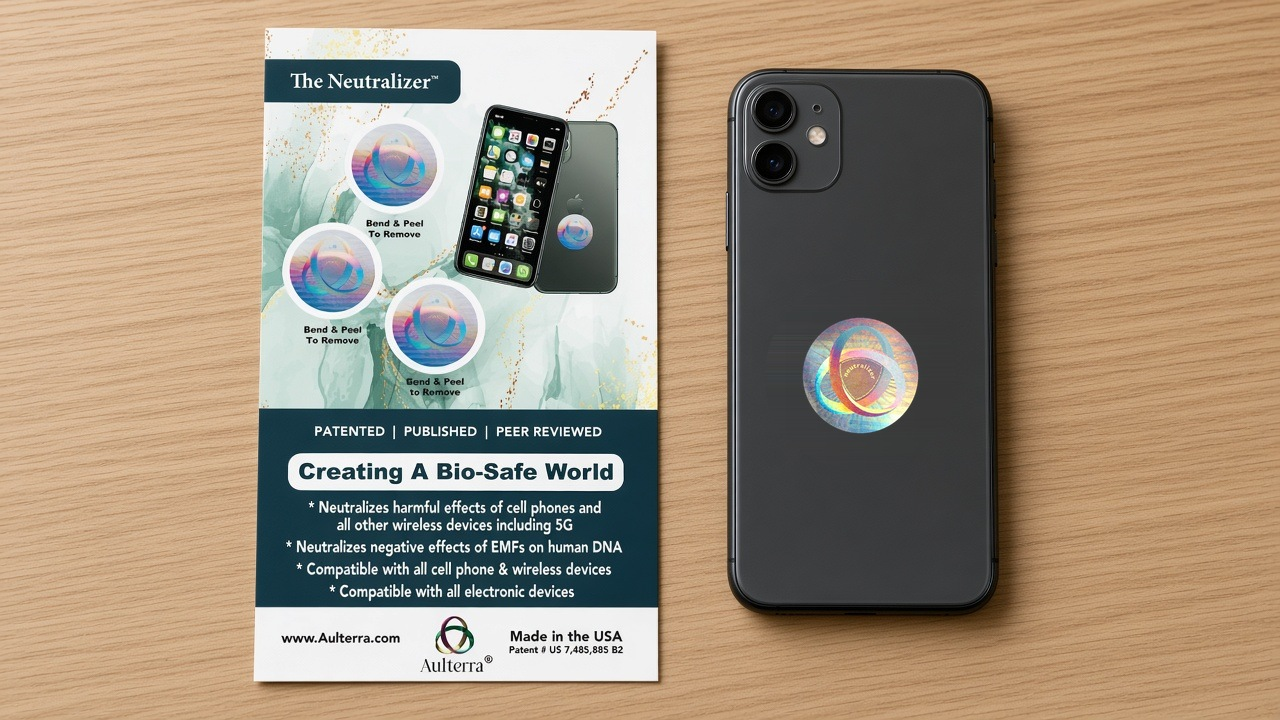
How to Apply EMF Neutraliser Disc: A Step-by-Step Guide for Phones and Home Devices
To apply an Aulterra EMF neutraliser disc, clean and dry the back of your phone, peel the disc, and press it on firmly, clear of camera lenses and ports, then f…